
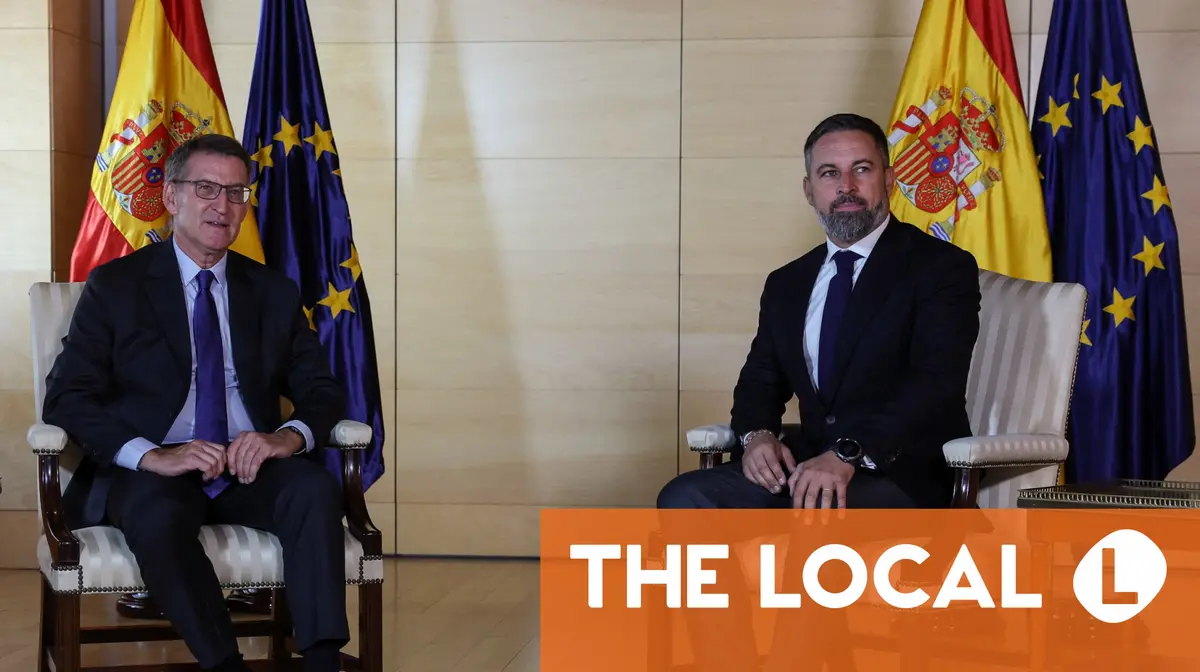
Spain’s main opposition conservative party united with the far right to have its leader re-elected in the region of Aragón on Wednesday, their latest alliance before next year’s general election.
Regions wield significant powers in key areas such as health, education and housing in Spain’s decentralised political system, making the deal a potential bellwether for the national vote.
Jorge Azcón of the Popular Party (PP) was re-elected for another term as the northeastern region’s leader thanks to the support of the far-right group Vox.
A beaming Azcón shook hands with Vox’s representative in Aragón, Alejandro Nolasco, following a debate and vote in the regional parliament.
READ ALSO: What Aragón’s regional election results mean for Spain
The PP had won February’s regional elections, defeating a former minister and spokeswoman of Socialist Prime Minister Pedro Sánchez’s government, Pilar Alegría, but fell short of a majority.
That obliged them to negotiate with Vox before successfully forming a new government in Aragón, a scenario that also played out in the western region of Extremadura last week.
In 2024, Vox withdrew from five regional governments where it had been in coalition with the PP, citing a dispute over the distribution of unaccompanied migrant minors.
But the parties have patched up disagreements at the regional level and continue to negotiate following elections in the northwestern region of Castilla y León, where the PP needs Vox to reach a majority.
Sánchez told parliament in Madrid on Wednesday that a PP-Vox agreement on “national priority” in its regional governments “is nothing but xenophobia, racism, segregation and confrontation”.
The outcome of this renewed attempt at governing together will likely be closely watched by voters ahead of the next national election, which Sanchez must call by mid-2027.
Most polls suggest the PP would win but would need Vox’s support to form a governing majority in Spain’s increasingly fragmented parliament.
