
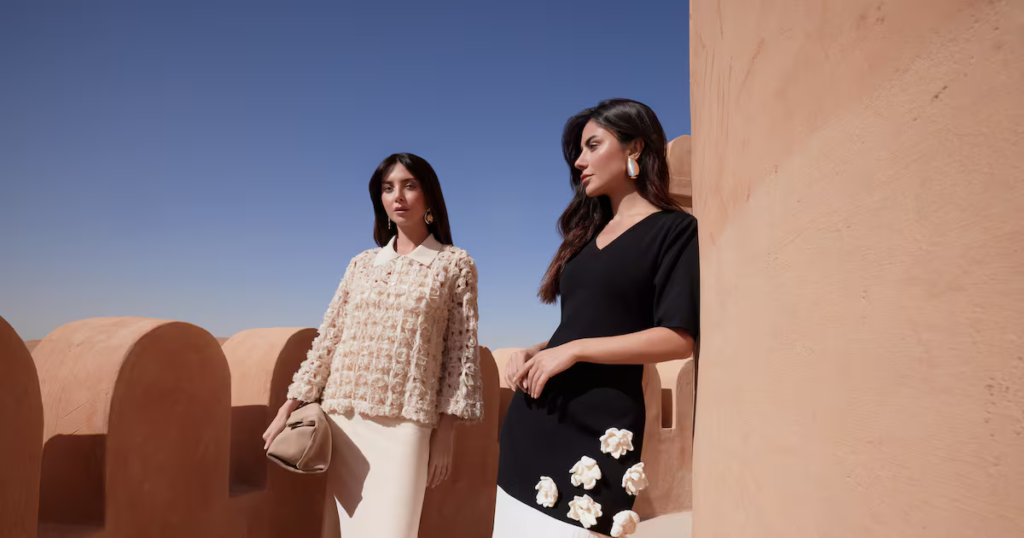
For years, Ramadan in fashion meant little more than a capsule collection or a decorative storefront. Then came a surge of interest after the pandemic as global brands rushed to capitalise on this valuable commercial window, launching events and activations across Gulf countries like Bahrain, Kuwait, Oman, Qatar, Saudi Arabia and the United Arab Emirates.
“What started five or ten years ago at a small scale is now something every major maison participates in,” said Stanislas Brunais, marketing director at Middle East luxury e-tailer Ounass, which carries products from Alaïa to Zegna.
But even as brands rolled out activations in a more localised manner in the years that followed, the growing recognition of the Muslim holy month as a key retail opportunity created new challenges. One issue was that marketing strategies became increasingly formulaic.
“Consumers are fatigued by repetition. You can’t play the same record every Ramadan,” said Fahed Ghanim, chief executive of the fashion retail division at Majid Al Futtaim Lifestyle, a Dubai-based conglomerate with a portfolio of 29 shopping malls across the Middle East and North Africa region, including the Mall of the Emirates, the Mall of Oman and the Mall of Egypt.
An oversaturation of events now overwhelms clients during Ramadan, weakening the very connections brands are trying to build.
Make it More Meaningful
The exclusive capsule collections that became signals of authenticity and commitment remain a key entry point for fashion brands engaging with Ramadan. However, brands now need to evolve their approach, suggests Nathalie Mroue, co-founder of Middle East-focused brand consultancy and communications group Maison Pyramide.
While the “capsule collections, modest silhouettes and edited special colourways for products” of the early years were “new and productive at the time,” they are now seen by many consumers as table-stakes strategies, she says.
The key is to extend the Ramadan opportunity beyond the collections that have become a mainstay, from this year’s offerings by luxury players Gucci, Bottega Veneta and Loro Piana to fast-fashion giants Zara, H&M and Mango.
Similarly, activations built around iftar and suhoor — the fast-breaking meal during sunset and the meal before sunrise — allow brands to signal respect for Ramadan while creating social buzz around their special collections. But as more players entered the market, the sheer volume of events began to dilute their impact.
In cities like Dubai and Riyadh, VIP clients can receive multiple invitations per evening, leaving many events feeling interchangeable. “Last year, we were executing at least two Ramadan events per week across Saudi Arabia, Kuwait and the UAE. By the end of the month, the oversaturation and exhaustion were obvious,” recalls Mroue, whose clients include Harrods, Majid Al Futtaim, LVMH brands and regional labels.
Getting Ramadan right is particularly important in the Gulf region. According to Bain & Company, the Gulf Cooperation Council region is a key growth driver for the global luxury industry, with GCC sales on track to reach $15 billion by 2027, growing at a rate of 4 to 6 percent, compared to a generally flat or contracting markets in traditional hubs including China, Europe and the US.
“Collections designed for the region are now succeeding globally [but] Ramadan is not [just] a GCC occasion,” Ghanim said. “Muslims in London, India, the US and beyond celebrate it.”
Brands often treat the GCC as a strategic testing ground, refining campaigns that later serve as operational and creative blueprints for Southeast Asia, Africa and other regions. Yet experts say the industry still underestimates the diversity of consumer behaviour among Muslim communities across the globe, and the distinct traditions they follow, which demand locally tailored approaches to Ramadan.
Syncing with the Customer’s Rhythm
Retailers are beginning to rethink how they engage with clients during the season. Instead of large-scale spectacles, some are shifting toward smaller, more targeted activations or operational improvements that better match how customers live during Ramadan.

At Ounass, for example, insight into consumer behaviour has led to practical changes. The Al Tayer-owned retailer extended overnight delivery windows to match the late-night shopping patterns common between iftar and suhoor. “People are browsing at midnight and buying at 2 or 3 am,” said Ounass marketing director Stanislas Brunais. “If you want to serve them properly, you have to meet them in their rhythm.”
This recalibration reflects a broader shift in how brands think about engagement. The relevance of events must now be justified; they are no longer the default solution. “The shift isn’t about spending less,” said Brunais. “It’s about activating with more intention.”
Executives at Chalhoub Group, a Dubai-based conglomerate representing luxury brands from Dior to Tiffany & Co., note that brands are investing earlier in Ramadan planning, developing capsules and storytelling months in advance and grounding decisions in consumer insight rather than symbolic efforts at the last minute.
“Our approach is not to react to a compressed calendar, but to plan with foresight,” said Grace Khoury, senior vice president of fashion at Chalhoub, noting that some brands represented by the group have been planning for Ramadan since last June. This allowed teams “to work strategically, thoughtfully, and with ease.”
At Landmark Group, one of the region’s largest retailers operating multiple mid-tier fashion brands under its Centrepoint umbrella including Splash and Max, Ramadan unfolds in phases reflecting shifts in consumer behaviour. Early demand focuses on preparation, with home and wardrobe purchases leading the cycle, while the final weeks see a surge in gifting and celebratory dressing.
“Our storytelling is anchored in how families actually live,” said Landmark board member Nisha Jagtiani, noting that roughly 70 percent of the retailer’s top customers nearly double their shopping frequency during the month. “Customers don’t just want products; they want to feel understood.”
As Jagtiani sees it, Ramadan is not a single campaign moment but a multi-phase season that evolves week by week. “Shopping begins well before the month starts, turns inward during Ramadan itself, and becomes celebratory again approaching Eid,” she said, referring to Eid al-Fitr, the holiday that marks the end of the Muslim holy month.

For brands seeking credibility during Ramadan, success depends on understanding how customers’ daily rhythms shift from reflective periods to more social ones. Consumption patterns mirror that cadence, moving from introspection to festivity.
That behaviour challenges the traditional fashion calendar, which tends to focus on product drops rather than cultural cycles.
Landmark, however, found a way to make its brand Max more accessible, bundling coordinated sets, layering options and complementary footwear and accessories. The approach proved effective as consumers sought pieces that could move fluidly between work, family gatherings and social occasions during the month.
A highly localised Ramadan strategy is increasingly important for Landmark. Jagtiani said Max launched 21 additional exclusive kaftan styles in Saudi Arabia, where the garment is a stronger sales driver than in the UAE.
There are also important nuances within individual markets. While Arab nationals remain central to markets like the UAE, expatriate communities from South Asia, Europe and beyond also shape consumption patterns and engage with Ramadan traditions.
The brands best positioned to capture spend are often those that embed cultural insight not only into their products but also into the narratives that surround them.
Nike’s recent regional “Style By” campaign, which launched in early February ahead of Ramadan, resonated because it aligned with lived cultural experiences rather than surface aesthetics or spectacle. Shot in Old Dubai, it centred on everyday modest dressing as a personal choice and form of empowerment, highlighting local creatives and artisans.
Abercrombie & Fitch, Levi’s, Charles & Keith and Lululemon also experimented with culturally specific designs, regional collaborations and narrative-driven campaigns that emphasise inclusion rather than exclusivity. This year, Abercrombie launched its first garments using a logo in Arabic.
These adaptations reflect a broader industry recalibration. The question is no longer how loudly brands can show up during Ramadan, but how meaningfully.

Mastering Cultural Connections
Ramadan is defined by prayer, spiritual reflection and generosity, alongside family gatherings and communal rituals that shape daily life. Brands that treat it purely as a commercial opportunity risk coming across as tone-deaf.
“Consumers can immediately tell which brands genuinely understand the month and which ones are decorating around it,” Mroue said.
Some brands lean heavily on superficial symbolism — lanterns, crescent moons and ornate décor — without fully engaging with the values or deeper meaning behind Ramadan.
Beyond imagery, campaign copy must also feel genuine. “Translation alone isn’t enough,” said Arabic cultural intelligence adviser Taqua Malik. “The language must feel warm, connected to the heart of the audience. Otherwise, it feels like an add-on.”
Another criticism is that some campaigns feel isolated from the brand’s broader activity, prompting industry leaders to urge brands to treat Ramadan as a strategic anchor rather than a one-off event.
“Today, Ramadan is no longer a symbolic nod. It’s something that needs to be institutionalised into regional planning — a touchpoint for the rest of the year,” said Mroue. “And I would say mid-tier and premium high-street, as well as regional brands are leading the way in that regard, willing to experiment more and connect well with the local market.”
Mroue and others point to accessible regional brands like Lime from Saudi Arabia and Ipekyol from Turkey and Lebanese jeweller L’Atelier Nawbar, which have used local content creators and personalities in campaigns that resonate with regional audiences.
“Local and accessible brands tend to build deeper day-to-day relationships with consumers,” said Ghanim, noting that “cultural relevance comes from consistency, not just visibility.”
Middle East retailers agree that Ramadan should not be approached as a seasonal spike but as a cornerstone event. In a region with a diverse calendar shaped by other opportunities — national days, shopping festivals, tourism seasons and religious holidays — global brands risk under-investing throughout the rest of the year.
“Ramadan, while still the single most important moment in the retail calendar, is the beginning of the conversation,” Jagtiani said. “Not the end.”
Malik put it another way, suggesting that brands need to realise that “this isn’t about showing up once a year. It’s about belonging.”
