
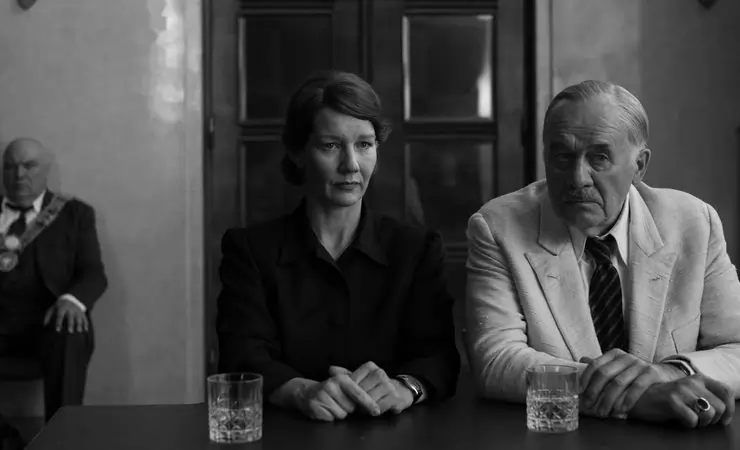
Paweł Pawlikowski’s Fatherland is undoubtedly one of the most highly anticipated films in competition at this year’s Cannes Film Festival, and it is easy to see why. The Polish director remains one of the most respected filmmakers working today, with his last feature, Cold War, earning him the Best Director prize at the 71st Cannes Film Festival.
As his first feature since then, anticipation surrounding Fatherland has understandably been immense. Towards the end of the film, Sandra Hüller’s Erika asks her father to return to Cannes, a moment that felt especially poignant while watching the film at the festival itself.
The film recreates the real-life visit exiled German Nobel Prize-winning writer Thomas Mann made to his divided homeland in 1949 after nearly a decade away. Played by Hans Zischler, Mann attends ceremonies in both capitalist West Germany and Soviet-controlled East Germany. Calm and measured throughout, he refuses to align himself with either side, remarking that he is being forced to choose between “Stalin and Mickey Mouse”. Accompanying him on the journey is his daughter Erika, played with remarkable poise by Hüller.
While the plot itself may appear deceptively simple, a lingering sense of absence hangs over Fatherland through Erika’s brother Klaus, an outcast and drug addict who was also invited on the trip but never arrives. His absence quietly shapes the emotional weight of the story.
As expected from Pawlikowski, the cinematography is extraordinary. Long-time collaborator Łukasz Żal crafts a series of elegant black-and-white images that completely immerse the audience in post-war Germany. From smoke-filled bars to cramped hotel rooms and long road journeys across the country, every frame feels meticulously composed and visually stunning. Yet beneath the beauty, the monochrome photography also casts a quiet shadow over the film’s grief and emotional restraint, reflecting both fractured family relationships and the wider impact of the Cold War.
The performances are unquestionably the film’s greatest strength. Hüller is exceptional, effortlessly moving between German, French and English while conveying deep wells of love, frustration and sorrow beneath Erika’s composed exterior. She delivers the role with extraordinary precision and subtlety, further proving herself to be one of the most versatile actors working today.
Zischler is equally compelling. He balances the warmth of a father with an emotional distance and intellectual rigidity that make Mann both fascinating and difficult to fully understand. His chemistry with Hüller is magnetic, grounding the film emotionally even during its quieter moments. Although the film explores a wide range of emotions across its concise 82-minute runtime, it can occasionally feel difficult to fully connect with the characters because of how emotionally restrained they remain.
However, as the film progresses, small cracks begin to appear, gradually revealing a more vulnerable side to both Erika and her father. The screenplay by Pawlikowski and Henk Handloegten is beautifully written: sharp, understated and deeply human. The dialogue feels natural and lived-in, elevated further by the strength of the performances. Unsurprisingly for a film centred around a literary figure, many of its lines linger long after the credits roll.
Overall, Fatherland is a visually stunning and emotionally layered drama, elevated by remarkable performances and masterful craftsmanship throughout. It marks another impressive achievement from one of contemporary cinema’s most celebrated directors.
★★★★★
In cinemas soon / Sandra Hüller, Hanns Zischler, August Diehl, Devid Striesow, Anna Madeley / Dir: Pawel Pawlikowski / MUBI / Cert: TBC
Discover more from
Subscribe to get the latest posts sent to your email.
