
VALLETTA: The Malta Film Commission released earlier this year a new study titled The Impact of the Film Industry in Malta: 8 Years of Growth, which contains some very impressive statistics: “Taken together since the launch of the cash rebate scheme, the industry has generated over 1.5 billion EUR in gross value added. Of this total contribution, 356m EUR was created prior to 2018, and more than 1.2 billion EUR in subsequent years, with the annual contribution in the post-2018 period being six times as much pronounced than in the preceding period.”
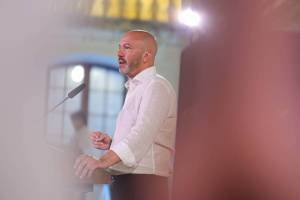
Johann Grech was appointed head of the Malta Film Commission in 2018. Under his leadership over the past eight years the film industry in Malta has undergone a huge transformation.
FNE spoke to Commissioner Grech about the achievements of the past eight years and his vision for the future.
FNE: You have said that Malta is a small country that has dared to think big? What does that mean for the film industry and what has been the contribution of the incoming film production to the Maltese economy?
JOHANN GRECH: “If you look at my track record of the last nine years, you can see that we transformed the industry completely from a seasonal one to an industry that now works every day for a lot of people.
We have dreams, we have goals, and we created a roadmap. And we changed things. We increased rebates, we started investing more in crews, we launched a master plan.
So, all these elements in our roadmap led us to big results. Our report released this year highlights the eight years of growth, 2018 to 2025. In 2023, we accounted for one-sixth of the economic growth of the Maltese economy.
That year was the year Gladiator II shot here, we want to attract more big franchise films. Because the ripple effect of a big movie is huge on our economy. Every sector wins. Today, we are also looking at attracting more films with medium budgets of say four to twenty million.
Under my administration, the industry generated over 1.2 billion EUR into our economy. Malta launched the rebate in 2005. So if you look at the period 2005 until 2025, the industry generated over 1.5 billion EUR. But between 2018 and 2025, in my eight years heading the commission, 1.2 billion EUR, of the total 1.5 billion EUR was generated under my administration.
FNE: And as you have frequently mentioned, one of the biggest accomplishments is creating full time sustainable jobs for Maltese crews working in the film industry.
JOHANN GRECH: Today, we have over 1,000 people working in film as we speak. These are full time sustainable jobs.
A priority for me is upskilling our crews. We have launched a 2m EUR fund for scholarships for upskilling of our professionals. I don’t know if there is any commission in Europe that offers an upskilling programme for its crews. There are other commissions that jointly with other institutions organize such programmes, but I think we are the leaders in the market. The 2m EUR scholarship fund is a scholarship for crews to upgrade their skills.
We have also launched a framework for standardization of our skill base. In fact, we are working with Film London on seven programmes already, including camera and lighting, production, hair and makeup, and others.
FNE: Film New York board member and head of the European Producers Club, my colleague Dariusz Jablonski, is here at the Mediterrane Film Festival to talk about coproduction. How do you think a small country like Malta can participate in international co-productions?
JOHANN GRECH: I believe in the art of the possibility, and we want to be players, real players, on the global stage. Coproductions are about not just funding, but also about relationships and about collaboration between different countries, new countries. We follow the EU convention on coproduction, obviously, we need to invest more, and we want everybody to invest more, including the private sector.
The platform of the Mediterranae Film Festival is a platform where we debate and network with people, so we are making sure that there is more collaboration between producers coming from different countries.
We created this platform to enhance our networking. It is about culture, but it is also about business.
Not just to attract films to Malta, but also to play our part on the global stage. That’s part of our global vision. We want to be part of the global discussion.
If we have goals and vision, we can make things happen from the top, we always move in that direction. It’s a small country, but we’re ambitious. And we can lead and we can play a real part on the world stage.
