
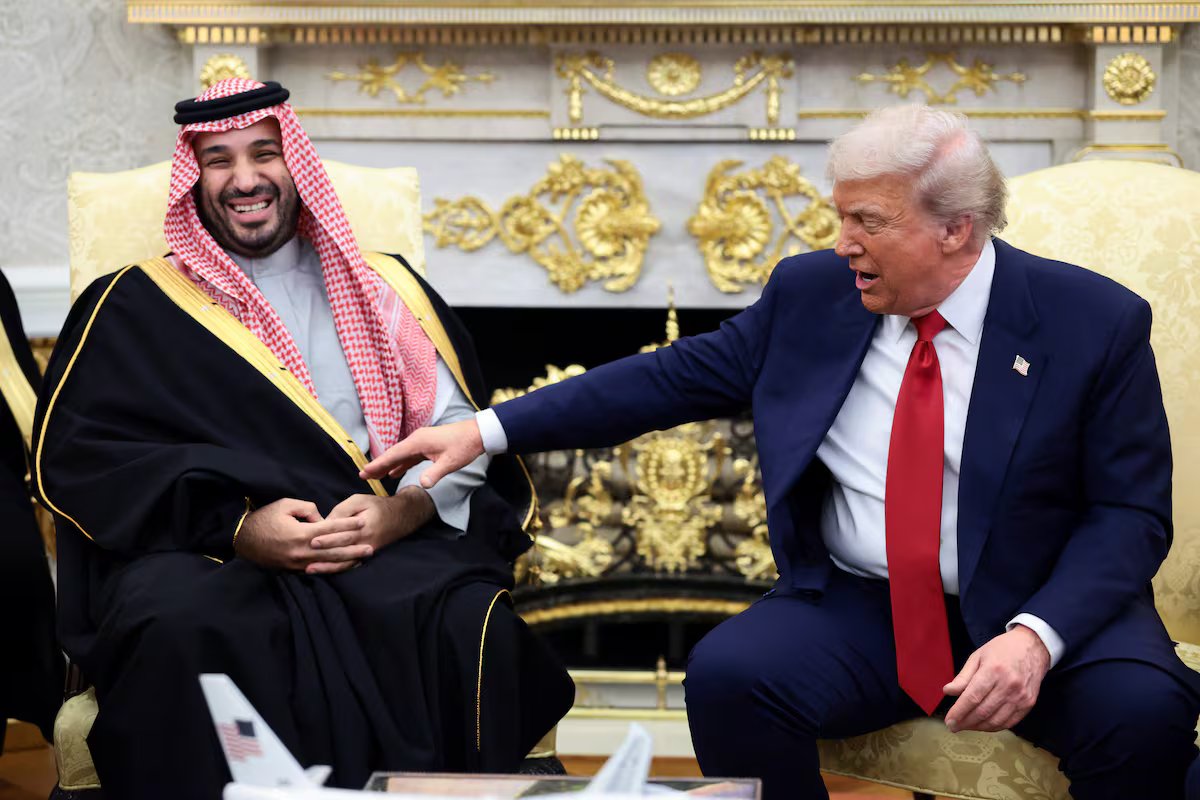
U.S. President Donald Trump maintains that the goal of the war against Iran is to curb Iran’s uranium enrichment program and prevent the country from developing a nuclear weapon. However, on July 22, he signed a nuclear deal with Tehran’s rival, Saudi Arabia, that will allow Riyadh to enrich uranium. Although the pact limits the use of the material to atomic energy for civilian use, critics warn that it lacks sufficient guarantees to prevent the Saudi kingdom from using that capability for military purposes and developing a nuclear bomb.
“The United States has quietly abandoned one of the central rules of the nuclear age,” writes Robert Pape, an international security expert and professor at the University of Chicago, in an analysis on Substack. Pape criticizes the fact that Washington has approved a 30-year civil nuclear deal that allows Saudi Arabia to produce enriched uranium without requiring either the ‘Gold Standard’ prohibition on domestic enrichment and reprocessing or the IAEA [International Atomic Energy Agency] Additional Protocol allowing for more intrusive inspections. Washington has accepted for Riyadh what it has spent two decades trying to deny Tehran, Pape pointed out.
In a Truth Social post on July 23, Trump said the agreement with Saudi Arabia would be conditional on the country joining the Abraham Accords which provide for the normalization of relations with Israel — potentially upending the deal. The absence of tougher non-proliferation rules, however, persists.
The ‘gold standard’ of non-proliferation
Many countries can develop atomic programs exclusively for civilian purposes. The World Nuclear Association believes that the demand for nuclear energy will continue to grow and that this technology will be essential for countries to achieve their long-term energy goals. In fact, 31 countries currently have nuclear reactors generating electricity, according to IAEA data. Others, such as Turkey, Egypt and Bangladesh, have reactors under construction.
The international community established a safeguarding system to prevent civilian nuclear programs from being used for military purposes. The IAEA conducts regular inspections of nuclear facilities to verify that materials that can undergo nuclear fission are not used for the manufacture of atomic weapons. Most commercial reactors use uranium enriched to between 3% and 5%. For a nuclear weapon, a country would start diverting uranium to facilities designed to enrich it to 90%.
Moreover, when the U.S. signed a nuclear pact with the United Arab Emirates in 2009, what is called the ‘gold standard’ was established. The agreement stated that Abu Dhabi was renouncing two fundamental stages of the nuclear energy production cycle which provide the technical capability needed to make an atomic weapon: namely, uranium enrichment, carried out using large centrifuges, and the reprocessing of spent nuclear fuel, from which material suitable for nuclear weapons can also be extracted.
In short, the Emirates can produce nuclear energy, but it acquires the already enriched uranium from international suppliers, without the necessary technology to enrich it on its own. It also does not reprocess used nuclear fuel, since the country does not have a plant for reprocessing.
The country has nuclear reactors for electricity production. These do not, in themselves, have the potential to produce an atomic bomb: “While nuclear power reactors themselves are not a proliferation concern, enrichment and reprocessing technologies are open to use for other purposes, and have been the cause of proliferation through illicit or unsafeguarded use.” the World Nuclear Association explains on its website.
Some countries have mastered all stages of production and possess the technology to develop an atomic weapon yet still choose not to do so. Japan, for example, has mastered all stages of the nuclear fuel cycle, from uranium enrichment to power generation in reactors and reprocessing of spent fuel. But it has chosen not to cross the threshold into the development of nuclear weapons.
Other countries, such as India in 1974 and later Pakistan, did decide to take this step. Currently, the Stockholm International Peace Research Institute (SIPRI) considers nine countries to possess nuclear weapons: the U.S., Russia, France, the U.K., China, India, Pakistan, Israel, and North Korea.
According to Pape, nuclear proliferation does not occur in isolation. Uranium enrichment is not a weapon in itself, he argues, but it is the most important first step in developing one. The second step is the political decision. Once enrichment technology is mastered, he argues, “the distinction between a civilian and military program increasingly depends on political decisions rather than technical capability.”
The political decision is often determined by circumstances. An ally can become an enemy and what was agreed upon can change.
Saudi Crown Prince Mohammed Bin Salman has publicly stated that Saudi Arabia would seek to develop nuclear weapons if Iran were to obtain them. That is how proliferation works, Pape argues. The Soviet Union followed the example of the United States. “The United Kingdom and France followed the Soviet Union’s path to nuclear capability, mirroring prior escalations. China developed nuclear capabilities in response to the United States, India subsequently responded to China, and Pakistan reacted directly to India. Israel’s program shifted Arab security calculations, prompting Iran’s acceleration in response to the U.S. and Israel, which now drives Saudi Arabia’s counter-steps,” Pape writes.
Now Trump’s nuclear deal with Saudi Arabia could simply serve to dial up internal pressure within Iran, prompting it to finally cross the threshold that allows it to develop a nuclear weapon. It could also open a window for other countries with sufficient technology to follow suit because the rules of the game have changed: competition prevails over non-proliferation.
Sign up for our weekly newsletter to get more English-language news coverage from EL PAÍS USA Edition
