
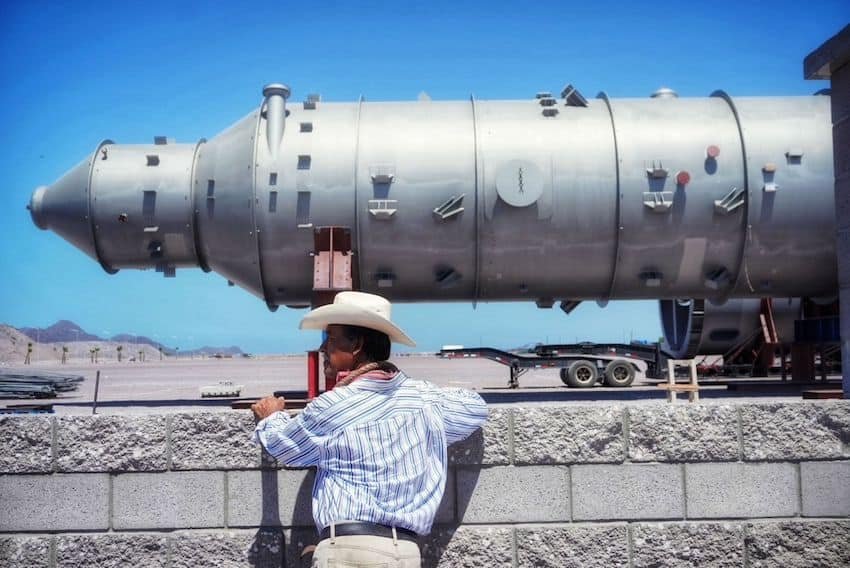
In response to long-standing protests against the construction and operation of an ammonia plant along the Sinaloa coast, the Environment Ministry (Semarnat) has announced that it will maintain permanent surveillance over the construction and future operation of the factory.
Construction — which is 80% complete — will continue.
‘We will defend this territory with our lives’: Activists blockade Topolobampo ammonia plant
Protesters oppose the construction and operation of the plant along Ohuira Bay in Topolobampo, arguing that the project is unviable for social, environmental and economic reasons.
The Save Ohuira Bay organization claims that the ammonia plant will destroy the fragile balance of the ecosystem with chemical pollution and destructive dredging.
Semarnat officials say authorization was granted by the federal government according to standards meant to prevent, mitigate and address any possible environmental impact.
Ohuira Bay is a Ramsar site (a wetland of international importance designated under the intergovernmental environmental treaty known as the Ramsar Convention) which is vital to thousands of migratory birds, dolphins, whales and local fisheries.
Critics accuse the government of illegally confiscating 200 hectares of land by fraudulently registering private property as federal land and cutting down mangroves. They also allege that the Indigenous Yoreme peoples that have lived in the region for thousands of years were not properly consulted.
As a result of the often passionate protests, Semarnat this week said it will establish clear control, supervision and restoration measures that ensure that the project’s development adheres to the strictest environmental criteria established in the law.
Gas y Petroquímica de Occidente (GPO) — the company that has been building the plant since 2014 — is required to monitor and prevent wastewater discharges, and control emissions into the atmosphere. It will also take action to protect and restore the mangrove, while also implementing conservation programs for flora and fauna in Ohuira Bay.
The plant is projected to produce 2,200 tonnes of ammonia a day as well as 6,000 tonnes of methanol per day. It will also store 75,000 tonnes of ammonia and features a floating unit that would liquefy 15,000 tonnes of fracking gas, carried by Texan pipelines across a coastal lagoon.
GPO acknowledges that it will suck up 2,000 cubic meters of seawater per hour and return it hot to the bay, such that it will increase the temperature by 3°. Save Ohuira Bay says such action will devastate marine life when combined with the increase in salinity from the plant’s brine discharges.
Researchers at the Sinaloa campus of the National Polytechnic Institute estimate that the plant will cause the destruction of 60% of shrimp production in the bay, more than 500 tonnes annually.
With reports from La Jornada, Milenio and El Sol de Mazatlán
