
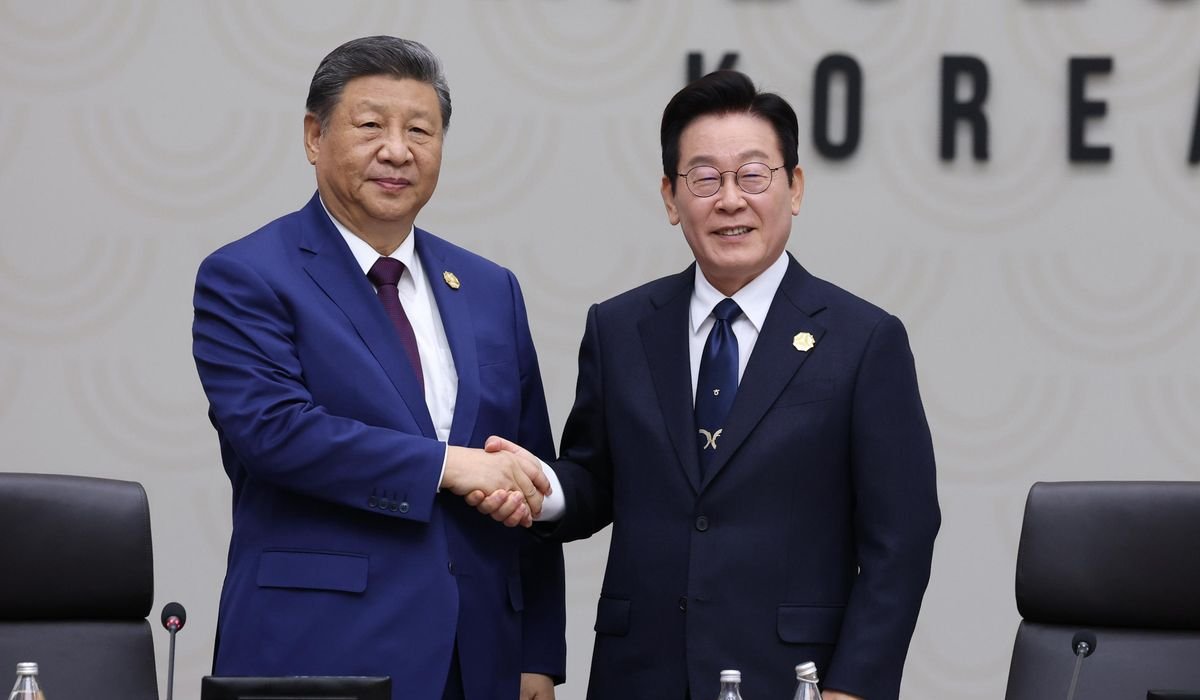
The House version of the fiscal 2027 defense authorization bill calls on Defense Secretary Pete Hegseth to report on the Chinese Communist Party’s influence in South Korea.
The provision would require the Pentagon chief to conduct an assessment of the CCP’s “malign influence” in South Korea and the risks posed to U.S. defense interests.
According to the $1.15 trillion bill approved on Wednesday, the report must be completed by the end of November and must include an assessment of how China’s influence poses human intelligence and defense risks to American military forces based in South Korea.
Other provisions will explore the growth of Chinese technology firms in South Korea and whether they represent defense risks.
Last, the report must examine whether steps can be taken by the South Korean government to assist the growth of U.S. technology firms and “to address any defense threats identified by the Department of Defense from the [People’s Republic of China] that impact the information security of the United States Armed Forces based in the Republic of Korea.”
A committee spokeswoman said the provision was added during markup of the bill last month and was sponsored by Rep. Ronny Jackson, Texas Republican.
The measure, which must be reconciled with a Senate version of the defense bill, reflects Republican concerns that the government of liberal South Korean President Lee Jae-myung is moving South Korea closer to its communist Chinese neighbor.
Mr. Lee took office in June 2025 and promised to pursue pragmatic diplomacy with China, a shift from ousted former President Yoon Suk Yeol, who favored more anti-communist and pro-U.S. policies.
The current South Korean leader prioritized closer ties to China early in his administration and traveled to Beijing in January, declaring this year to be the first year of a “full-scale restoration of Korea-China relations.”
Chinese President Xi Jinping, during the January meeting, noted China and South Korea’s shared experience in World War II opposing “Japanese militarism” — a recurring Chinese propaganda theme.
Mr. Lee has a history of taking openly pro-China positions, telling a campaign rally that South Korea should say “xiexie” — thank you — to China and that what happens in the Taiwan Strait is not a concern.
Critics of Mr. Lee have charged China with meddling in South Korean elections, though the claims remain unsubstantiated.
South Korea is a key U.S. military ally, with an estimated 30,000 U.S. troops stationed on the Korean Peninsula.
The South Korean government began waiving visa requirements for Chinese visitors in September, a move critics saw as opening the door to increased Chinese espionage.
China has been caught running several espionage operations in South Korea, including the case of a South Korean soldier raised in China who was arrested in April 2025 and charged with suspicion of leaking secrets of joint U.S.-Korea military exercises to Chinese intelligence.
Two Chinese teenagers were arrested in March 2025 for photographing military aircraft near Suwon Air Base, and a South Korean military intelligence official was arrested in July 2024 on suspicion of leaking classified information that identified overseas agents, reportedly to a Chinese person of Korean descent.
China also operates Confucius Institutes in South Korea that are viewed by U.S. officials as key elements of CCP influence operations that promote Beijing’s ideology.
One pro-China member of the Lee administration is National Intelligence Service Director Lee Jong-seok, a longtime “pro-autonomy” political figure who in 2021 called South Korea and China’s relationship a “geographical destiny that cannot be in conflict.”
China expert Gordon Chang said the problem for the U.S. is a South Korean government that is “run by those who hate America.”
“Yes, the Chinese are taking over the South, but they could not do that unless Lee Jae-myung let them in. Fortunately, most South Koreans support us,” Mr. Chang said.
Supporters of Mr. Lee have said the president is a centrist who has adopted a pragmatic policy that seeks mutually stable ties with China, the U.S. and Japan.
Mr. Hegseth has praised the Lee administration for increasing its defense spending.
U.S. and South Korean military leaders met last fall and issued a statement suggesting U.S. military forces in South Korea could take part in out of area operations, such as a defense of Taiwan against Chinese aggression.
The main focus of the troops, however, remains on threats posed by North Korea.
Army Gen. Xavier Brunson, commander of U.S. Force Korea, said during a podcast in May that U.S. military power on the peninsula is a “dagger” in the heart of Asia pointed at China.
The comments drew condemnation from China’s government as “hostile and aggressive.”
The South Korean Embassy in Washington did not immediately respond to a request for comment on the legislation.
China also has been linked to disinformation operations in South Korea.
In September 2023, Seoul’s Korea Communications Commission said foreign agents used virtual private networks to pose as Korean residents who flooded a major portal with pro-China comments.
Mr. Hegseth told The Washington Times in November that the U.S. must defend persecuted Christians around the world, including in South Korea.
“President Trump has made clear that the United States will always defend the right of Christians to freely worship here at home and around the world,” Mr. Hegseth said. “As a Christian, this is also very important to me and my family.”
The secretary responded to questions posed about a growing global crackdown on Christians, who are facing persecution in Nigeria, China, South Korea and elsewhere.
In South Korea, conservative Christians also are facing persecution, and several faith leaders have been forced into severe pretrial detention.
They include Hak Ja Han Moon, the 82-year-old co-founder and spiritual head of the Family Federation for World Peace and Unification, who is in failing health and is being held on what appear to be politically motivated financial charges.
The federation, formerly known as the Unification Church, owns multiple businesses, including The Washington Times.
Another conservative religious leader, the Rev. Son Hyun-bo, 62, the founder and head pastor of South Korea’s Segeroh Presbyterian Church, faced similar harsh detention for five months before being released in January.
Mr. Son, a former South Korean special forces commando, met with activist youth leader Charlie Kirk days before Kirk’s assassination in September in Utah.
