
They call themselves the “Angels of the Night.” On paper, they present themselves as a grassroots neighborhood group alarmed by rising crime in Valencia. Dressed in black T-shirts and caps bearing a silver logo of two children holding hands beneath angel wings, the self-styled vigilantes are preparing to patrol the streets. Their first target is La Malvarrosa, a seaside district of about 13,000 residents long stigmatized by its proximity to Las Casitas Rosas, an area known as a hub of drug trafficking that attracts a steady stream of users.
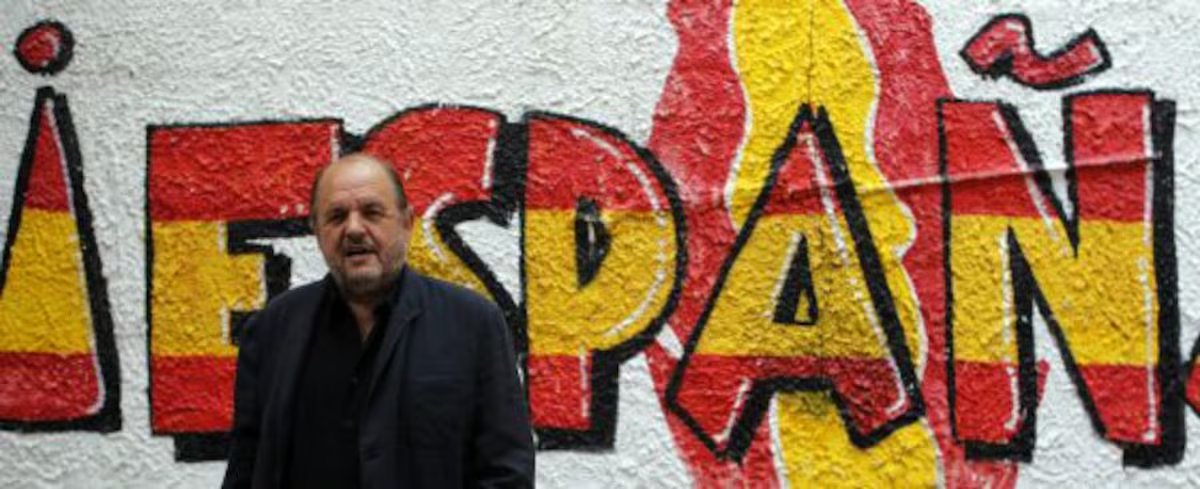
But this isn’t an organic citizens’ movement. Rather, it’s organized by the Valencian fascist party España 2000 (“Spain 2000”), which is led by José Luis Roberto Navarro, a 72-year-old lawyer and private security businessman. The group has concealed its role through the NGO Hogar Social Patriota María Luisa Navarro, named after Roberto’s mother and registered with the Valencian regional government as a social welfare organization in 2010.
Roberto acknowledges to EL PAÍS that he is the driving force behind the project. He insists that the patrols, made up of six-person teams trained in martial arts and composed largely of hardline anti-immigration activists, operate within the law. For that reason, he says, their movements will be reported to the authorities.
“The aim is to collaborate with the police in hotspots [for crime],” he says from a sparse office in central Valencia that serves as headquarters for his private security empire. A bust of Spanish dictator Francisco Franco, a framed photograph of Enrique Rodríguez Galindo, the former Civil Guard general convicted for his role in the death squads formed to combat Basque separatism, and a charcoal portrait of fascist ideologue Ramiro Ledesma Ramos overlook the room.
For Roberto, logistics are essential. Although he initially considered equipping patrol members with pepper spray, the idea was quickly abandoned. When they begin patrolling in the coming weeks, volunteers will carry whistles and will be required to follow a code of conduct designed to prevent abuses and excesses.
Most of the volunteers, the extremist confesses, are members of España 2000 — a small organization consisting of 2,500 members that lacks any real representation in local or federal government. Back in 2015 — before the rise of the far-right party Vox, which currently holds about a tenth of the seats in Spain’s Congress — España 2000 managed to win six council seats across four municipalities in Corredor del Henares, near Madrid. Its political calling card: an uncompromising anti-immigration message.
The militia’s mission will focus on detaining perpetrators until the police arrive. The members will also distribute leaflets about public safety to tourists. “We’re going to do this in the areas with the most immigrants. Moroccans and Algerians cause problems. The second phase will take place in the center of Valencia,” the lawyer explains. He’s known as “El Cojo” (“The guy with a limp”) because he uses a prosthetic right leg as a result of thalidomide, the drug that caused birth defects in thousands of children born in the 1950s and 1960s.
Roberto is a follower of José Antonio Primo de Rivera (1903-1936), the founder of the Spanish fascist party Falange. And he’s not acting alone: Roberto, who used to be the secretary general of the Spanish Brothel Owners’ Association (ANELA), has recruited Ricardo Ferris, a lawyer and criminologist, for his street operation. Up until 2022, Ferris was chief inspector of the National Police’s central station in Valencia. Ferris was dismissed by Spain’s Interior Ministry after he linked immigration and crime at a conference organized by Vox.
Ferris is a partner in a Dominican Republic-based subsidiary of Roberto’s security company. He will closely supervise the initiative in Valencia. “We will be the eyes and ears of the police,” the former inspector explains. Following his dismissal, he took a desk job. He’s now retired from the National Police.
After an hour-long conversation with EL PAÍS, the leader acknowledges that the NGO, the España 2000 political party, as well as the civic association La Resistencia are all part of the same operation, sharing a common purpose. Everything is coordinated from a headquarters near La Malvarrosa, the neighborhood where patrols will soon be deployed.
The headquarters of this self-proclaimed fascist movement organizes afternoon gatherings. For instance, there’s a lecture by the man who used to be Rudolf Hess’s nurse (Hess was Adolf Hitler’s deputy), as well as talks given by far-right figures in Spain, such as the neo-Nazi bookseller Pedro Varela. These are among the offerings of this group, which is embroiled in numerous controversies and lawsuits for hate crimes.
A longstanding fixture of Valencia’s far-right circles, the NGO Hogar Social Patriota María Luisa Navarro first gained national notoriety 14 years ago for distributing food exclusively to Spaniards. The initiative mirrored the tactics of Greece’s neo-Nazi Golden Dawn movement. After EL PAÍS revealed the practice, Valencia’s Food Bank, which supplied the organization with food financed through an agricultural assistance program run by Spain’s Agriculture Ministry, cut off its support. Roberto’s organization was then forced to collect donations directly outside supermarkets.
The far-right activist also organizes self-defense workshops aimed at preparing participants to confront what he calls the “enemies of Spain.” Active-duty members of Spain’s security forces and military have attended these sessions. Chokehold techniques are included in the training program.
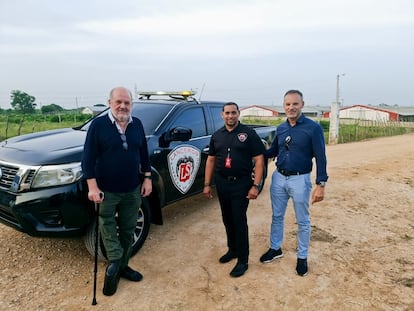
Roberto’s overriding concern is ensuring that the full extent of his business network remains hidden. It is his best-kept secret. Official company records link the far-right leader to just two firms. The most important is a private security company founded in 1979 that reported profits of €8.4 million ($9.8 million) in 2024 and employs 194 people. Over the past nine years, the company has secured around €900,000 (nearly $1.1 million) in public contracts.
Three institutions have awarded Roberto his most lucrative contracts: the Geological and Mining Institute of Spain ($642,000, when converted from euros); the Ramón Pignatelli Student Residence and Study Center, run by the Zaragoza Provincial Council ($187,000); and the Tarragona Provincial Council’s Department of Economy and Finance ($146,000). This is according to Spain’s Public Procurement Platform. “Most of my security companies in Spain and abroad aren’t registered under my name,” Roberto admits.
The strategy undertaken by this lawyer and former professor, who, back in 2003, was the target of a letter bomb sent by anarchists (it ended up injuring two postal workers in Valencia), is based on preventing left-wing administrations from blacklisting his business conglomerate.
Since media storms and lucrative deals don’t always go hand in hand, this extremist carefully calculates the impact of his words. In 2021, Roberto helped organize a neo-Nazi march alongside Alberto Ayala de Cantalicio, who once led the banned Ultra Sur fascist football hooligan group. Participants chanted “faggots, get out of our neighborhoods” as they marched through Madrid’s Chueca neighborhood, the heart of Spain’s LGBTQ+ community.
“I’m always on the edge of what’s acceptable,” Roberto confesses, his gaze fixed on the charcoal portrait of Ramiro Ledesma Ramos, one of the men responsible for introducing fascism to Spain.
Translated by Avik Jain Chatlani
Sign up for our weekly newsletter to get more English-language news coverage from EL PAÍS USA Edition
