

What percentage of Mexicans are internet users?
How do internet connectivity rates differ across Mexico?
How many Mexican homes have computers?
Find out the answers to those questions in this week’s “Mexico in Numbers” article, which primarily focuses on internet use in Mexico.
* All of the data in this article comes from the results report of the latest National Survey on the Availability and Use of Information Technology in Homes (ENDUTIH). The survey was conducted by the national statistics agency INEGI in more than 65,000 homes between Aug. 25 and Oct. 17, 2025. INEGI published the results report in June 2026.
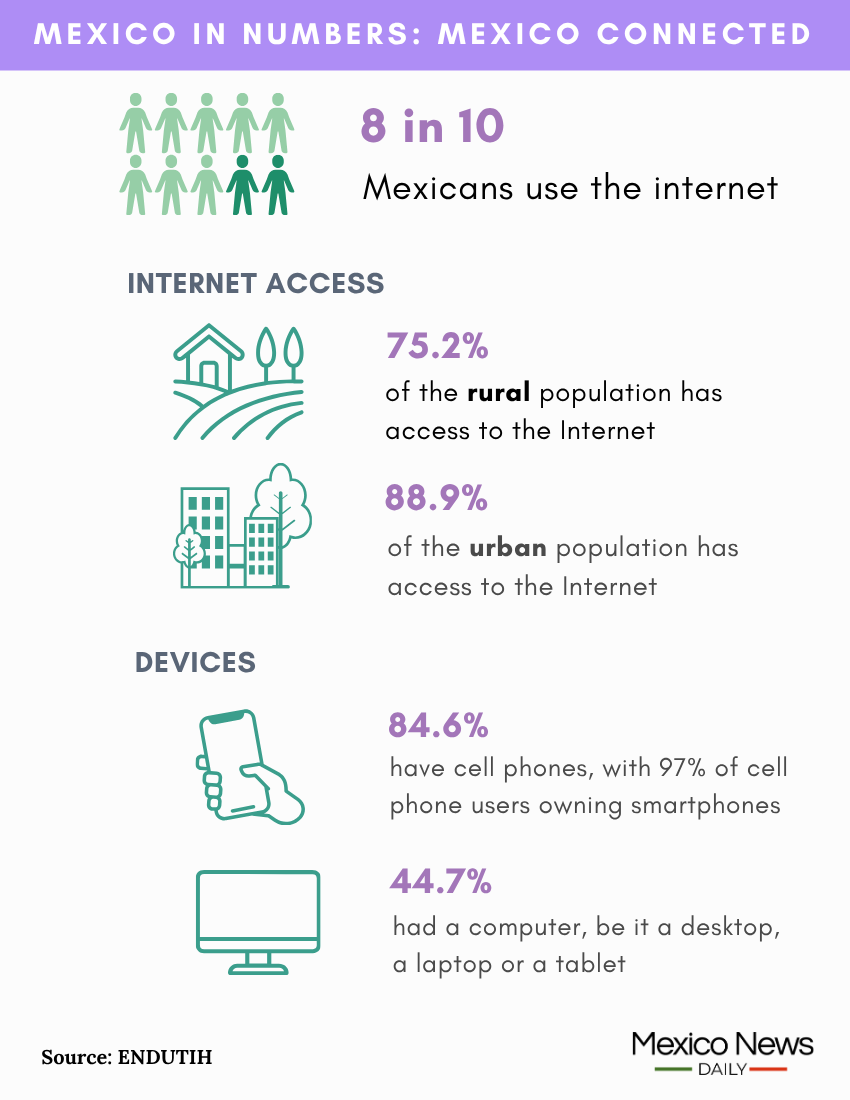
More than 8 in 10 Mexicans use the internet
Some 104.9 million people in Mexico were internet users in 2025, a figure equivalent to 86.1% of the population aged six and above.
The percentage of the population that uses the internet has gradually increased over the past decade. In 2022, the figure was 78.6% while in 2023 it was 81.2%.
In 2024, 83.1% of Mexicans aged 6 and older were internet users, a figure three percentage points below the most recent number.
Compared to 2015, the percentage of the Mexican population that were internet users in 2025 was 28.7 points higher.
The percentage of males aged six and older who use the internet was 86.6% last year, exactly one point higher than the figure for females (85.6%).
The urban/rural divide
INEGI reported that 88.9% of people who live in urban areas of Mexico were internet users in 2025. The figure for people who live in rural areas of the country was 75.2%.
Thus, the urban/rural internet use gap was 13.7 points in 2025, down from 27 points five years earlier.
Between 2020 and 2025, the percentage of urban internet users increased 10.7 points from 78.2% in the former year to 88.9% in the latter.
In the same period, the percentage of rural internet users increased 24 points, rising from 51.2% in 2020 to 75.2% last year.
The previous federal government launched a “Social Coverage Program” to increase internet coverage in rural parts of Mexico.
Nuevo León has the highest percentage of internet users
In 2025, 93.9% of residents of the northern state of Nuevo León were internet users, the highest rate among Mexico’s 32 federal entities.
Baja California ranked second (93.2%), followed by Quintana Roo (92.1%).
More than 90% of the populations of four other entities were internet users in 2025: Baja California Sur, Nayarit, Aguascalientes and Mexico City.
The southern state of Chiapas had the lowest percentage of internet users in 2025. Just 71.2% of Chiapanecos were internet users last year. The only other state with a rate lower than 80% was Oaxaca (78.6%).
Teens and young adults are the most connected cohort
In 2025, the percentage of internet users in eight different age cohorts was as follows:
- 6-14: 85.4%
- 15-24: 97.6%
- 25-34: 96.5%
- 35-44: 94.3%
- 45-54: 88.9%
- 55-64: 78.8%
- 65-74: 57.8%
- 75+: 30.3%
While the percentage of internet users aged 75 and over was low, it was much higher in 2025 than in 2015, when just 3% of that age cohort went online.
More than 8 in 10 Mexicans have cell phones
In 2025, there were 103.2 million cell phone users in Mexico, representing 84.6% of the population aged six and over. That percentage increased 13.2 points from 71.4% in 2015.
The vast majority of cell phone users in Mexico — 97% — use smartphones.
Among those people, 90.6% use instant messaging apps such as WhatsApp on their phones, while 80.4% access social media.
Almost eight in 10 (77.8%) smartphone users access audio and video content on their devices, while 52% make use of navigation apps such as Google Maps and Waze.
The percentage of Mexican homes with computers has declined over the past decade

In 2025, some 17.7 million Mexican homes — 44.7% of all homes in the country — had a computer, be it a desktop, a laptop or a tablet.
The percentage rose 0.8 points compared to 2024, but declined 0.2 points compared to 2015, when 44.9% of Mexican homes had a computer. The decline over the past decade is indicative of the rise of the smartphone, which in many ways is a small computer.
Mexico News Daily
