
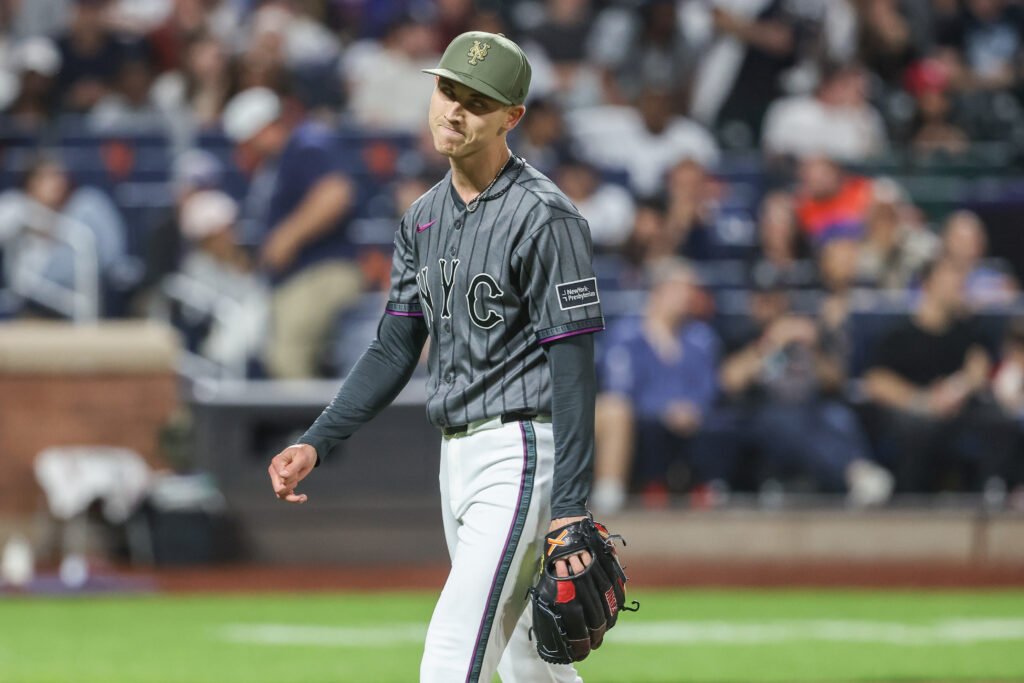
The Mets, in the midst of perhaps the most disappointing season of any club in baseball, head into the trade deadline as clear sellers. They’re not going to trade Juan Soto or promising young talents like Nolan McLean, Carson Benge, A.J. Ewing and Christian Scott. It’s unlikely that they’d be able to find a way around the sizable portion of Francisco Lindor‘s remaining guarantee and his full no-trade protection. Dealing Bo Bichette and his multiple opt-outs also seems far-fetched. Beyond that, most members of the Mets’ roster will see their names bandied about the rumor circuit for the next couple weeks.
One thing the Mets don’t plan to do this time around, reports Joel Sherman of the New York Post, is eat money in order to facilitate trades. The Mets kicked in nearly $36MM when trading Max Scherzer to the Rangers in 2023 and another $35MM deal in the trade that sent Justin Verlander back to Houston just a few days later. That type of expenditure apparently isn’t in the cards when it comes to their forthcoming deadline sell-off.
Paying down the remaining contracts on some of their more appealing trade chips could allow the Mets to secure greater prospect returns, but it’d mean continuing to pay not only that salary but also the sizable tax to which they’re subjected as a team in the top tier of luxury tax penalization. The Mets don’t have a particularly well-regarded farm system at this point — Baseball America ranked them 24th on their July update — but that’s in part due to players like Benge, Ewing and McLean all graduating from prospect status this season. Twenty-four-year-old lefty Zach Thornton is on his way to doing the same.
A Lindor trade already seemed unlikely, but if the Mets aren’t going to absorb any of the five years and $160MM that remains beyond the current season, it’s all but an impossibility (unless there’s a long-shot scenario that sees them take on another weighty contract in return — though even then they’d still need Lindor to sign off on such a move). Pricey veterans like Marcus Semien, Jorge Polanco, Sean Manaea and Luis Robert Jr. will be tough to deal without including cash. Closer Devin Williams has hit another rough patch. He still has a 3.16 ERA in 25 2/3 innings dating back to late April, but with $34MM owed in 2027-28 (albeit with $10MM deferred), he’d be a tough sell, too.
That doesn’t mean the Mets aren’t going to both trade veteran players, reduce their spending and add some minor league talent. Freddy Peralta ($8MM salary), Clay Holmes ($13MM salary, $12MM player option), A.J. Minter ($11MM salary), Brooks Raley ($4.75MM salary plus incentives) and Luke Weaver ($8MM in ’26, $11MM in ’27) are all signed to reasonable enough deals that contending clubs will want them even without any financial help to grease the wheels on a swap. As of this writing, that group is owed another $16.1MM in 2026 salary. The Mets owe an additional $18.79MM in luxury taxes on that sum. Dealing that quintet would trim about $35MM from the books.
There are other trade candidates to consider. Catchers Francisco Alvarez ($2.4MM salary, arb-eligible through 2029) and Luis Torrens ($2.275MM in ’26, $5.75MM per year in 2027-28) could both draw interest. Reliever Huascar Brazoban ($1.05MM in ’26, arb-eligible through 2029) might also draw some looks. Outfielder Tyrone Taylor ($3.8MM salary) isn’t hitting righties, but he’s roughed up lefties, runs well and can play all three outfield spots. He could be a bench piece on a contender.
As can be seen in MLBTR’s newly rolled-out Payroll Tracker — available to Trade Rumors Front Office subscribers — the Mets have the second-highest CBT/luxury tax payroll in the sport. Their $380,594,134 total trails only the Dodgers. There’s no hope of dipping under the tax threshold when they’re so far over the $244MM first-tier limit, but shedding those contracts could still trim a decent chunk off the 2026 books and — in the case of Weaver and Holmes — off the payroll in 2027 (when Frankie Montas‘ $17MM dead-money hit will also be off the books).
