
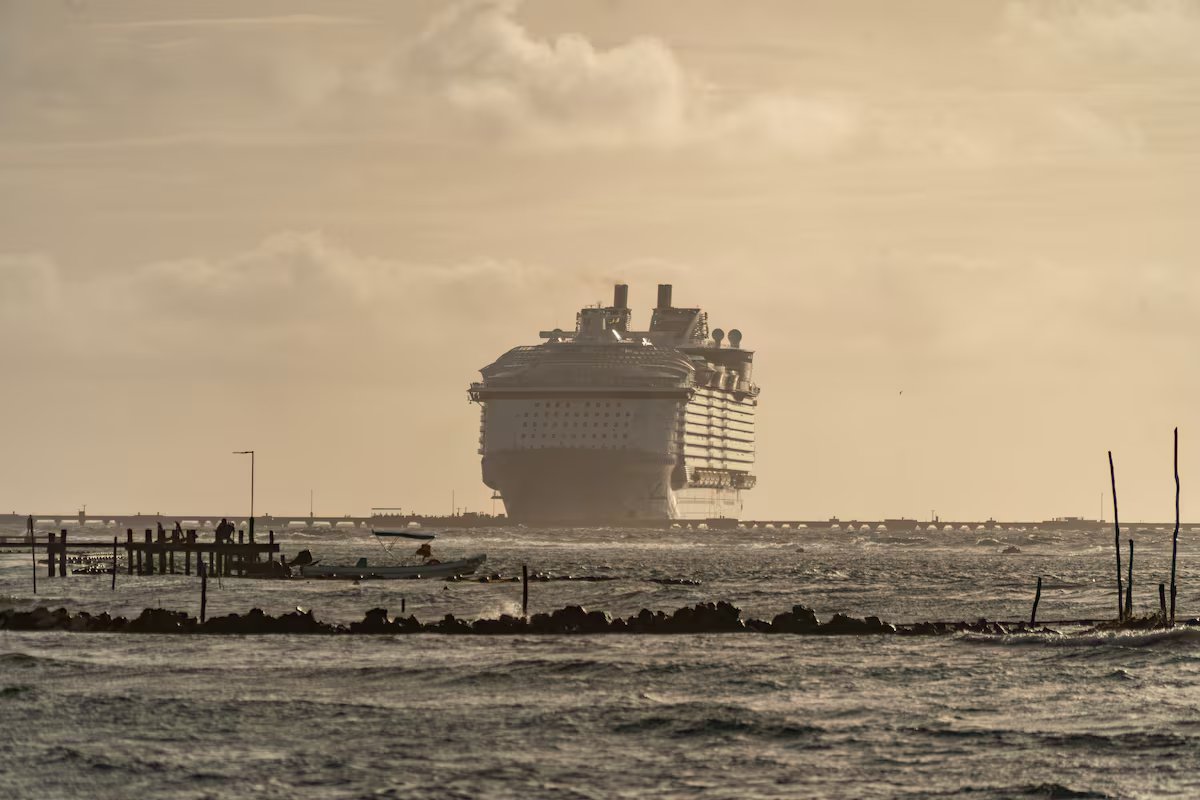
There are no Mexican cruise ships, yet they make up one of the fastest-growing tourism sectors in the country. Nor are many of their passengers Mexican, either: the typical tourist who buys tickets for such voyages is an adult from Western countries, Japan or China, between 45 and 70 years old. And despite promised nationwide windfalls, the reality is that the global cruise holding companies, which have designed the ships to be floating cities unto themselves, with all kinds of shows and services aboard, are few and wind up with the vast majority of the profits they produce. “After running statistical analysis, I realized something that has been documented for years: that cruise ships are an oligopoly,” says José Antonio Barragán Ojeda, professor at the National Autonomous University of Mexico (UNAM) in Mérida and author of several analyses of the cruise industry in Mexico.
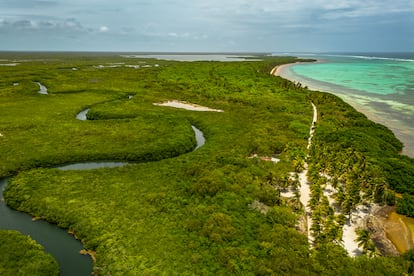
The town of Mahahual in Quintana Roo has become an example of the sector’s worst practices. Construction on an aquatic park in the Costa Maya port — where administrative control has been in the hands of Royal Caribbean since 2025 — unleashed a wave of backlash that, for the first time, reverberated throughout the country, extending thousands of miles from the Mexican Caribbean sea. Questions have been raised regarding the speed with which the corporation obtained permits to change zoning regulations in the municipality of Othón P. Blanco in Chetumal. There has also been debate over the environmental impact that construction of the complex will have on a landscape of coral reefs and mangrove swamps, which is home to over 300 species.
Despite the cancellation of that project, after discussion arrived as far as the National Palace, one thing became clear: in the more than two decades since Puerto Costa Maya set up shop in Mahahual (it was inaugurated in 2001 and managed until 2025 by the magnate Isaac Hamui Abadi and his family’s ITM business group), the ancient fishing village of some 2,600 inhabitants has fallen into complete abandon.
Unpaved and gravely deteriorated roads, daily electricity outages, a crisis over waste management, very little infrastructure — and all this prior to a 2026 in which, according to UNAM researchers, 40 million metric tons of sargassum biomass is expected to wash up from the Atlantic. Which is all to say, the promised investment in local communities in exchange for turning them into a port for cruise ships has been, so far, unfulfilled.
In an extensive analysis published in 2020 entitled Los cruceros en México. Un panorama general de una actividad con claroscuros [Cruise ships in Mexico. A general panorama of an activity with highs and lows], Professor Barragán Ojeda writes that cruise tourism is an activity capable of generating an important economic boon, “but at considerable environmental cost.” He also explains that the sector shows high rates of growth, with twofold increases in the rate of ship arrivals and numbers of passengers onboard.
In keeping with these findings, in May, the Mexican Secretariat of Tourism announced that in the first quarter of 2026, there were 3.6 million passengers arrivals, representing a 9.9% increase over the same period in 2025. It also noted the docking of 1,080 cruise ships, an increase of 4.8% compared to last year. “Cruise tourism is a powerful tool to drive development in certain areas, diversify tourist activity, and make sure that economic growth comes to those who make their living from tourism. When things go well for the tourism industry, things go well for communities,” stated the head of the department, Josefina Rodríguez Zamora.
But cases like that of Mahahual disprove that argument. And the visit from Secretary of the Environment Alicia Bárcena to the town following the cancellation of Royal Caribbean’s planned Perfect Day themed cruise stop in Mahahual demonstrates that direct dialogue with residents, oversight of business activities in the region, and the monitoring and protection of natural resources provide a roadmap for collective decisions on the future of investment in the area.
Barragán Ojeda began to research the cruise ship industry while analyzing the construction of the Maya Train during the administration of former president Andrés Manuel López Obrador. This was before the coronavirus pandemic, and he and his peers had began to research the phenomenon of touristification. Their analysis addressed cruise ships, because one of the justifications for Obrador’s emblematic train project was to connect several tourism sites on the Yucatán Peninsula, and there were questions as to the plan’s viability.
That was when Ojeda came to understand the cruise sector as an oligopoly, or an industry controlled by a small handful of firms. “There may be many brands, but they are grouped into very few holding companies: Royal Caribbean, Carnival, Norwegian. And they are responsible for 85% of the cruise ships. If we add Disney, that’s practically 100%. So as a group, as an oligopoly, they hold all the cards — because if they say no, block initiatives or sabotage a destination, as they have done in Australia and in Zihuatenejo when the latter began to charge them an environmental fee, when that happens it makes your local economy crash, because they are practically the only ones who offer the service,” he says.
Passengers with time and money
Plus, this kind of floating tourist attraction is only within reach for those who can afford not only the all-inclusive package on a multi-day, multi-port cruise and given that no cruise ships have their home port in Mexico, if a Mexican tourist wants to buy a ticket, they have to have a U.S. visa, pay for a flight to one of the port of embarkations like Florida or California, oftentimes pay for a night of lodging — in addition to all the extra fees on the ship that are actually not included in packages, like bottled water, onboard internet access and tips.
Then there’s the matter of time. The typical passengers on these trips at sea are retired adults who can commit to trips that last up to weeks.
Minimum windfall
In 2020, when the flow of arrivals to Mexico was around 10 million cruise passengers a year, Ojeda analyzed the data and asked whether the spending of those individuals was actually resulting in great benefits to local economies. “What does that number mean? Are those 10 million worth all that investment? Digging into official figures, it turned out that on average, a cruise passenger at the time spent $60. Nowadays, in the post-pandemic era, the average spending in 2025 was $85 per cruise passenger, while an international tourist spends $1,200. That’s a big difference,” he says.
A cruise’s dynamic is that of a long-term stay during which tourists have everything they might need. “Cruise ships are themselves not forms of transportation like an airplane or ferry, the cruise ship is actually a destination unto itself,” says Ojeda. The stops it makes along the way in ports like Cozumel, Mahahual and Santo Domingo are part of their itinerary and the ship’s own offerings.
“When a person gets their ticket, it includes everything: food, drinks, amenities, lodging, for at least seven days or more. That means that onboard a cruise ship coming from Miami, when it gets to Cozumel, there is perhaps little incentive to get off the boat. If they want a restaurant, they already have the food that’s included onboard. There’s a bar, water slides, water activities. So for those who get off at the different destinations of a cruise ship, spending is minimal; on crafts and souvenirs,” he says.
Another factor is how long a ship docks at a destination. This can run from six to eight hours, or an entire evening, which allows for tours of local spots and short trips. “The benefit in itself is minimal, because often what is offered is the same as what they already have on their boat. Particularly because the target audience is largely baby boomers, who are known for not spending a lot of money. If they already paid for something, they’re not going to pay for it twice,” he says.
Environmental impacts
In an analysis of the contamination produced by cruise ships, Víctor Saucedo Salazar, a member of the Salvemos Mahahual [Let’s Save Mahahual] collective, says that this kind of vessel does not only emit carbon dioxide, but also extremely high levels of sulfur and nitrogen oxides, due to their use of heavy fuel oil. “Cruise ships burn much dirtier fuel to keep their ‘floating cities’ operational, even when they are docked at the port,” he says.
Saucedo Salazar uses comparisons to put these effects into perspective. For example, a mid-sized cruise ship emits approximately the same amount of greenhouse gases as 12,000 automobiles. Also, due to maritime fuel having up to 500 times more sulfur than diesel, a single cruise ship emits as much sulfur in one day as more than a million cars. “A large-sized cruise ship emits particulate contaminants equal to having 34,400 trailers running simultaneously to fuel its hotel operations (lights, air conditioning, kitchens) while it is docked.”
A 2006 documentary entitled Trainwreck: Poop Cruise does a good job of illustrating what can happen if one or more problems on a vessel stop it from functioning correctly, and the waste ceases to be released in to the sea, instead accumulating until the ship’s systems collapse.
Saucedo Salazar continues, “A passenger on a seven-day cruise emits as much carbon dioxide as driving a midsize car for a year. The industry is under a little bit of pressure. Since 2025 and 2026, new regulations (like the European Union’s ETS system) require cruise liners to pay for their methane and nitrous oxide emissions, which are driving the use of liquid natural gas and shore power, for which they ‘plug in’ at ports and turn off their motors,” he says.
Add wastewater to the ships’ impacts — a single day on a cruise liner can generate close to 1,078,000 liters. “It’s like a caravan of 108 water tankers lined up at a port, ready to discharge waste into the sea when the ship sets sail at sunset,” says Saucedo Salazar.
Ojeda says that cruise companies are on an urgent search for new customers, which has led to projects like Perfect Day, and other themed trips that look to attract different kinds of clientele. Still, the expert says there are signs that within a decade, the industry will be on the decline due to generational change and international regulations.
But in a July 2025 interview, president of the Mexican Cruise Association Arturo Musi Ganem defended the industry after the Mexican government proposed a passenger tax on large cruise companies. He criticized legislators for going “against competitiveness”. “The cruise ships in our country have been increasing for 40 years and have demonstrated loyalty to this country and instead of rewarding them, they impose more taxes, fees, and don’t build more infrastructure for them. I’m of the school of thought that you have to cater to your best client,” he declared.
Sign up for our weekly newsletter to get more English-language news coverage from EL PAÍS USA Edition
