
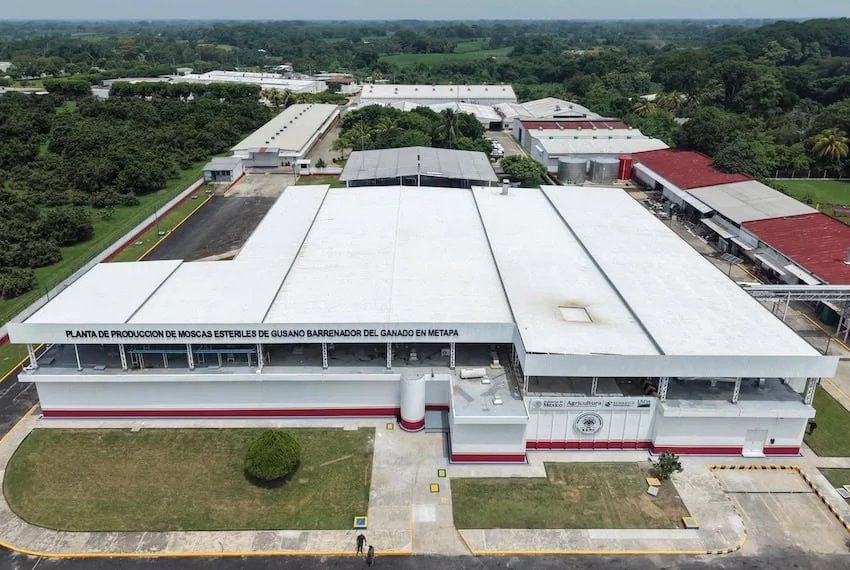
Officials from Mexico and the United States inaugurated a US $50 million sterile fly production plant on Saturday in Metapa de Domínguez, Chiapas, near the Guatemala border, aiming to contain the New World screwworm outbreak across Mexico and increasingly the U.S., which is disrupting cattle trade.
The joint development and financing of the plant marks “a major step in protecting the health of all warm-blooded animals,” said Mexico’s new Agriculture Minister Columba Jazmín López Gutiérrez.
En Metapa de Domínguez, Chiapas, con recursos del gobierno de Estados Unidos y México, construimos una Planta para producir moscas estériles que acaben con el Gusano Barrenador que tanto afecta al ganado. Esta es una muestra de trabajo conjunto, de cooperación para el desarrollo… pic.twitter.com/xJ3dcnUfeT
— Claudia Sheinbaum Pardo (@Claudiashein) June 28, 2026
The facility is expected to eventually produce up to 100 million sterile flies a week to suppress the screwworm, a parasite that burrows into the flesh of warm-blooded animals and can be fatal if untreated. However, concerns remain about whether it is possible to produce enough sterile flies to eradicate the screwworm.
Mexico confirmed its first screwworm case in November 2024, and the pest has since traveled northward through Mexico and into the U.S. The first animal case in the Mexican border state of Durango was confirmed in early June, with a total of 27 animal cases having since been confirmed in the United States.
Mexico launched cross-agency and industry efforts to contain the spread and impact of the pest in November 2024 and has since inspected over 5.3 million head of cattle. Still, the screwworm has infected over 30,000 animals in Mexico to date.
In addition to the Chiapas plant, the U.S. announced last year plans to develop its own sterile fly facility in Texas.
“Our countries have beaten this before, 40, 50 years ago; we will beat the New World screwworm again,” U.S. Secretary of Agriculture Brooke Rollins said during the opening ceremony of the Chiapas plant.
President Sheinbaum praised the new plant as an example of the benefits of Mexico-U.S. cooperation. “Animal diseases, pests and the challenges of food safety aren’t limited by borders,” she said. “In the face of those challenges, the best response is to team up, share our experiences and build solutions together.”
The U.S. has kept its border mostly closed to Mexican live cattle since May 2025, disrupting a trade that previously supplied more than 1 million animals to U.S. feedlots each year. Mexico is now forced to export meat rather than live cattle.
With reports from Reuters, AGDAILY and El Financiero
