
If you visit the high-elevation city of Zacatecas (3,175 meters), you might very well happen upon the huge aqueduct that is now part of a city park there. Made of pink canterra stone, it’s both elegant and impressive, making it hard to miss. But it is hardly unique. Zacatecas is just one of many locations in central Mexico that still have their aqueducts, built hundreds of years ago.
In Mexico, aqueducts were constructed for the same reason they were built in ancient Rome: to transport fresh, potable water over long distances to cities, agricultural areas, convents, haciendas and mining areas. The large number of aqueducts is due to geographical, historical and engineering factors that spanned both the pre-Hispanic and the colonial eras. Whether still in use today or simply historic landmarks, these architectural marvels are a common feature of the landscape in cities like Morelia, Querétaro, Oaxaca and Xalapa. Although most are now simply tourist attractions, a few historic ones are still in use today, serving local needs. Here are some of Mexico’s most notable:
The Chapultepec Aqueduct
Before the conquest, the Mexica built their first aqueduct in 1418 to supply water to the city of Tenochtitlán (now Mexico City), because the immediate surrounding water was brackish and polluted.
Using sophisticated hydraulic engineering, they built the aqueduct primarily from mud, wood and plant materials, bringing fresh water from the springs of what is now Chapultepec Park. At that time, Chapultepec was a lush, rural environment encircled by dense vegetation. Its water resources made it a sacred space. There were landscaped botanical gardens and recreational baths for the nobility.
A high-tech wonder, it included two parallel mortar-lined channels, allowing the Mexica to divert water to one channel while cleaning or repairing the other, ensuring a continuous supply of fresh water. A small section of it, about 22 stone arches, can still be found on Chapultepec Avenue near Metro Sevilla, along with the historical fountains in Chapultepec Park.
The Padre Tembleque Aqueduct
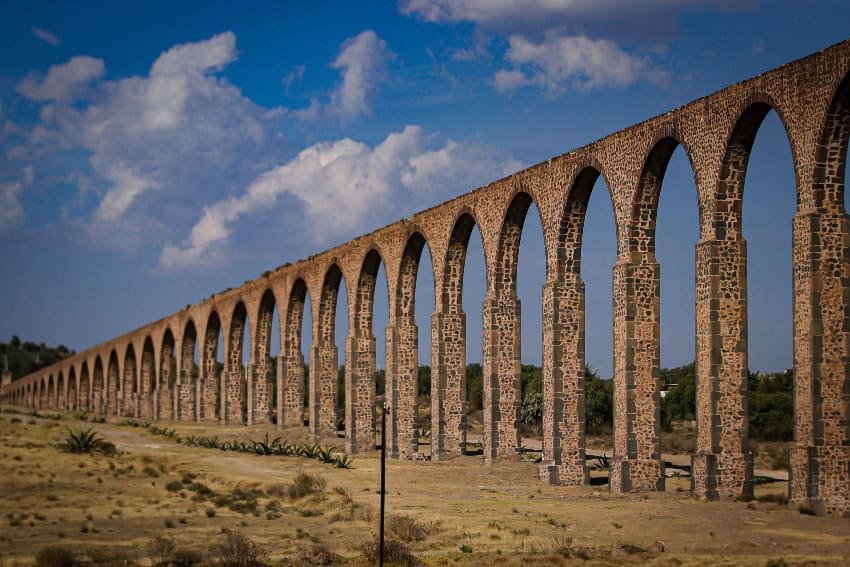
The six-kilometer stretch of the 16th-century Padre Tembleque Aqueduct, located between the Mexican states of Hidalgo and Mexico, remains partially active, transporting water for nonpotable uses such as irrigation and washing.
The structure is named for Fray Francisco of Tembleque, the 16th-century Spanish Franciscan friar who designed and built it. The 48-kilometer aqueduct was named a UNESCO World Heritage Site in 2015.

With its 67 arches, it was the highest single-level arcade ever built in an aqueduct. It is a unique marriage of European Renaissance hydraulic knowledge and Mesoamerican construction techniques, including the use of adobe. Unusually for its time, it was designed to bring water to Indigenous communities, rather than solely to Spanish cities, missions or businesses. It was so well designed that many of its original components, including canals and reservoirs, still exist.
The Querétaro Aqueduct
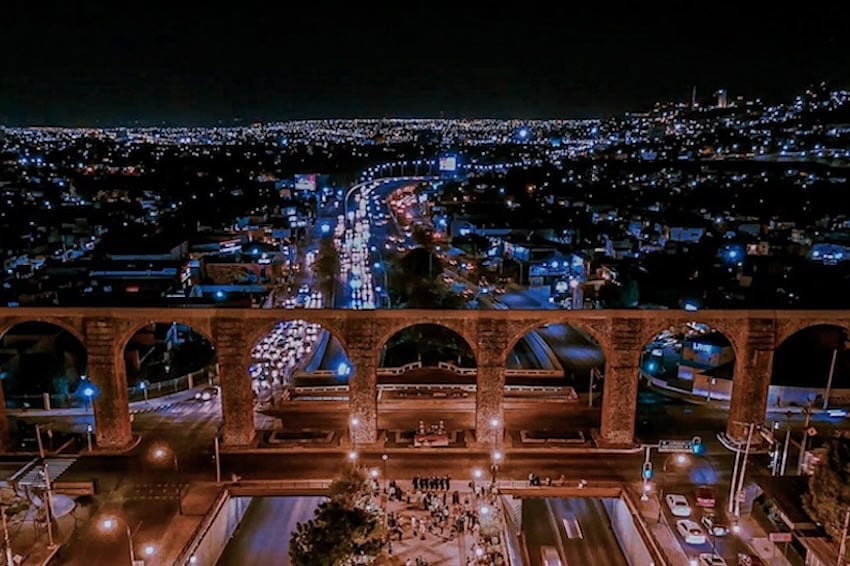
This 18th-century aqueduct in the city of Querétaro, built between 1726 and 1738, according to the National Institute of History and Anthropology, is one of the largest and most famous in the country. It also comes with a curious urban legend involving a tragic love story.
The Marquis Juan Antonio de Urrutia y Arana, a wealthy Spaniard, is said to have fallen in love with a Capuchin nun, Sister Marcela, who accompanied him from Mexico City to Querétaro to found a convent in the area. While she refused to speak to him directly, some versions of the legend say, the aqueduct was said to be his gift of a clean water supply for the new convent, an impressive marvel he built for his unrequited love.
Some versions of the legend say that Marcela also asked him to build what would be called the most beautiful house in Queretaro, La Casa de la Marquesa, (House of the Marchioness), for her aunt and guardian, Doña Josefa Paula Guerrero y Dávila. The building survives today as a hotel in Queretaro’s historic center.
With 74 arches, Queretaro’s aqueduct is a highly recognizable landmark in the city, with residents and roadway signs often referring to it simply as “Los Arcos.”
Aqueduct of Morelia
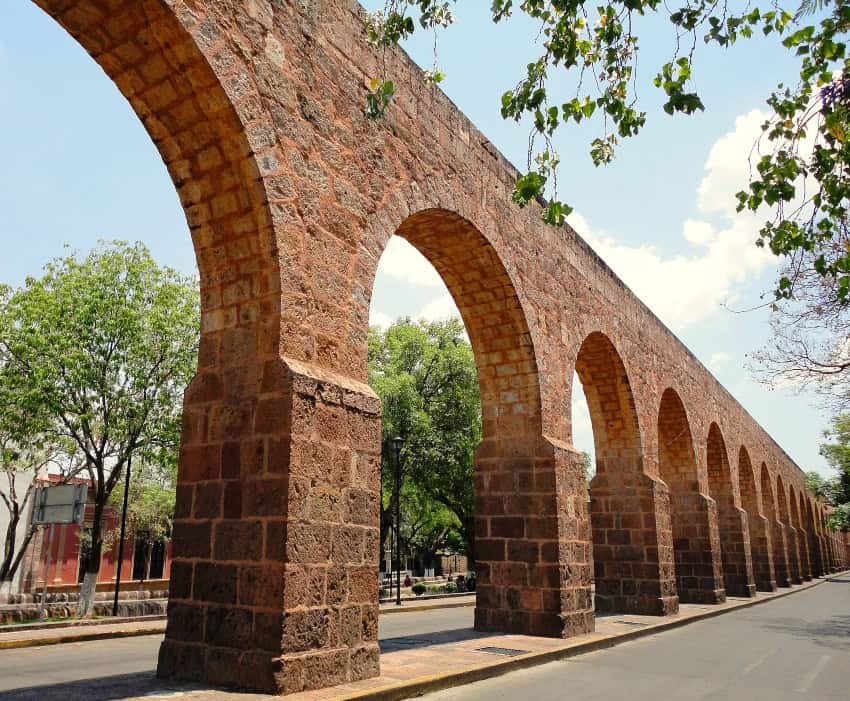
The Aqueduct of Morelia, built in the 1700s, is so iconic in Mexico that a 19th-century water distribution box (the Caja de Agua) from the structure is featured on the back of the Mexican 50-peso bill. While its pipe has existed since the city’s founding, in 1598, Morelia’s mayor, Tomás González de Figueroa, ordered the construction of a more resistant pipe made of lime, stone, earth, and sand, and then in 1705, Bishop Manuel Escalante appointed Antonio Altamirano as the builder of its iconic arches. It was reconstructed between 1785 and 1789 by Fray Antonio de San Miguel, the bishop of Michoacán, after it had collapsed during an earthquake.
The architectural marvel features 245 arches of pink cantera stone, extends nearly 1,880 meters, and rises to a height of up to 8 meters. While it no longer supplies Morelia (or anywhere) with water, in its heyday, it supplied water to 30 public fountains, including the famous Pila del Ángel and the Pila del Carmen.
The aqueduct’s useful life came to an end around the beginning of the 20th century, when the Porfirio Díaz administration modernized Morelia’s water distribution system with iron pipes. But this well-preserved landmark still attracts visitors at sunset, when the setting sun makes the pink cantera glow, creating a backdrop for a postcard-perfect photo.
The aqueduct at Hacienda de Pacho
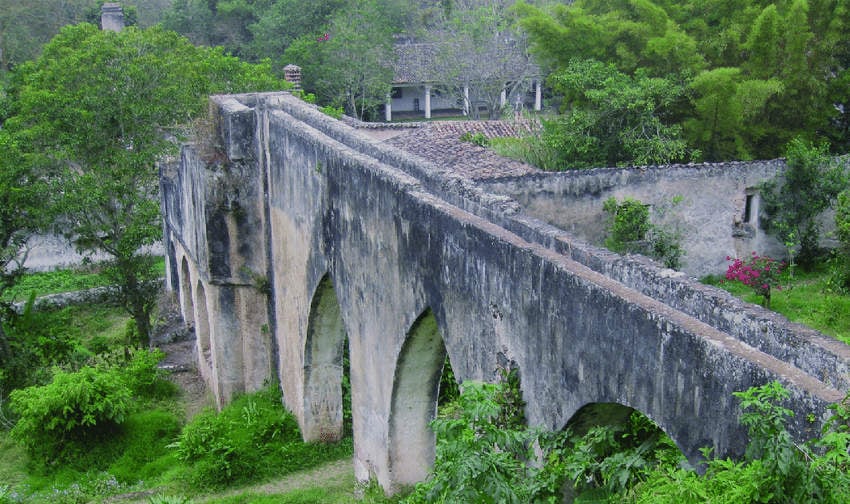
The 16th-century aqueduct at the Hacienda de Pacho, near Xalapa, is highly unusual because of its Gothic arches. Roman arches, which the Spanish introduced to Mexico, are semicircular, requiring thick walls for support, while Gothic arches are pointed, allowing for taller, lighter structures.
The aqueduct in Xalapa is the only one of its kind in Mexico, and suggests a direct transfer of construction styles from the Portuguese island of Madeira, the original home of the hacienda’s first owner.
Arcos del Sitio
The tallest aqueduct in Latin America, Arcos del Sitio is located about an hour north of Mexico City in Mexico state. At 1,400 feet long, this four-level, 200-foot-high structure has 43 levels of arches and spans a gorge. Nearby are picnicking and camping sites and, Mexico’s specialty, a zip line. But the coolest feature of this aqueduct is that you can actually walk across the top of it and see the canyon below.
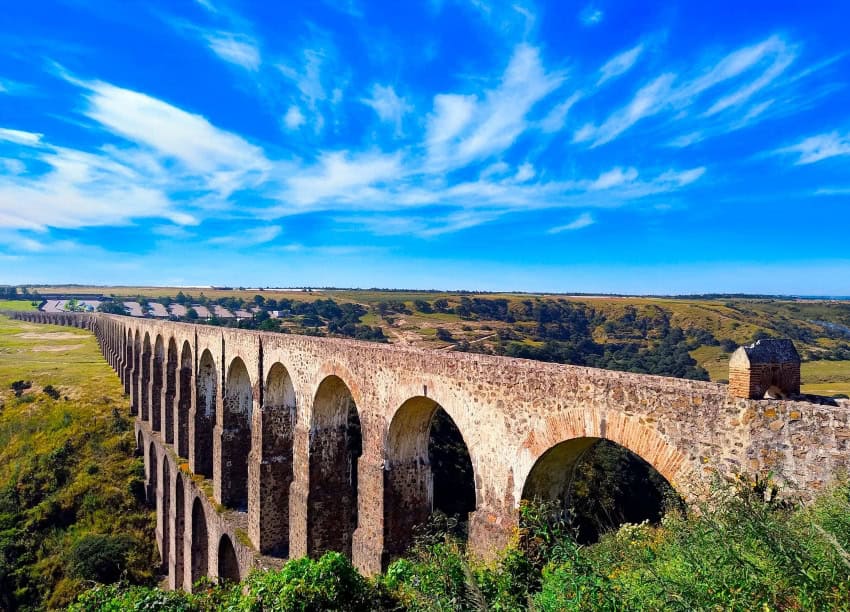
Dozens of aqueducts are dotted around central Mexico, which means when you’re traveling around, chances are good that you’ll find one not far away. These elegant waterworks — some still in use — are a testament to Mexico’s history of visionary engineers from long ago.
Louisa Rogers and her husband Barry Evans divide their lives between Guanajuato and Eureka, on California’s North Coast. Louisa writes articles and essays about expat life, Mexico, travel, physical and psychological health, retirement and spirituality. Her recent articles are available on her website, authory.com/LouisaRogers.
