
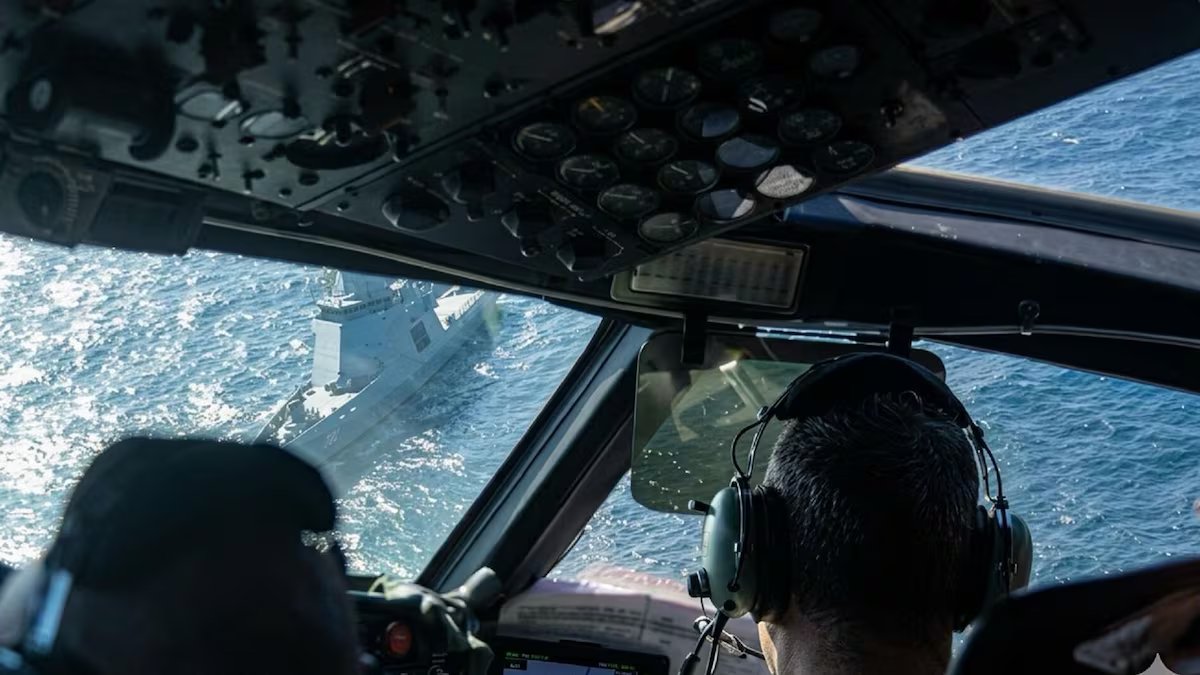
Javier Milei’s government announced Wednesday the signing of an agreement with the United States to strengthen “its surveillance and control capabilities in the South Atlantic,” according to an official statement. The deal runs for five years and means, on one hand, a U.S. contribution of technology to modernize the South American country’s naval equipment and, on the other, authorization for forces from U.S. Southern Command to take part in patrolling Argentina’s southern sea.
The U.S. embassy in Argentina had already previewed the matter, but the signing of the agreement was only confirmed on Wednesday by the Argentine Ministry of Defense. The letter of intent signed by officials from Southern Command and the Argentine navy will allow the country to “incorporate new operational capabilities, technology, and training for personnel,” as well as improve “the detection, monitoring, and surveillance capabilities of maritime spaces” and “the response to illicit activities and threats.”
What the official statement did not specify was the formal title the agreement will carry, a detail the U.S. embassy did disclose under the slogan Protecting Global Commons Program. That reference to treating Argentina’s maritime zone as a “commons” alarmed sectors opposed to Milei, who are critical of his unconditional geopolitical alignment with Donald Trump’s administration.
Cooperation between the two countries has already begun with the U.S. provision of “multispectral sensors, command-and-control systems, communications, and data-link equipment” for an Argentine navy B-200M Cormorant aircraft. It will continue with the supply of two Textron B-360 ER MPA aircraft, equipped to carry out surveillance tasks, detect vessels, and identify maritime traffic, among other functions. The Argentine navy will also receive “vertical takeoff drones suitable for operation from offshore patrol vessels” and a simulator for P-3C Orion aircraft.
The initiative is part of the U.S. Department of Defense’s Program 333, through which Washington seeks to deepen its military ties with allied countries. In that sense, the U.S. embassy in Argentina emphasized that the letter of intent inaugurates a “strategic five-year alliance to defend the global commons and strengthen regional security.” Milei’s government, by contrast, stressed another perspective on the agreement: “We will defend our maritime sovereignty with greater presence, technology, and our own capabilities to protect Argentina’s strategic interests.”
Most of the criticism of the accord came from Peronism. “The Argentine sea is not a global commons. It is an area where Argentina has the obligation to exercise its own jurisdiction and to safeguard its resources,” said Carlos Bianco, Buenos Aires province’s minister of government and right-hand man to Governor Axel Kicillof, one of the figures aiming to run against Milei in the 2027 presidential election. “Instead of offering our South Atlantic as an area for training and naval mapping to other powers, the national government must carry out its sovereign functions there,” Bianco added.
The Kirchnerist group La Cámpora also rejected the “global commons” label. “It belongs to Argentines and is strategic for national development. Argentina’s maritime zone is one of the most productive and diverse in the world,” it said in a statement, accusing Milei of “giving away strategic information about the South Atlantic.”
Since taking office at the Casa Rosada in December 2023, the far-right Milei has ended Argentina’s traditional global commitment to multipolarity and subordinated the country’s foreign policy to his relationship with Trump. That stance has already produced numerous actions, from backing the U.S. and Israel in the war with Iran to authorizing U.S. military exercises inside the country and the president’s visit last month to the nuclear-powered aircraft carrier USS Nimitz when the ship was off the Argentine coast.
Sign up for our weekly newsletter to get more English-language news coverage from EL PAÍS USA Edition
