
– The leading TV market focused on Central and Eastern Europe has hosted its largest edition to date, bringing together industry experts to discuss the future of content and distribution
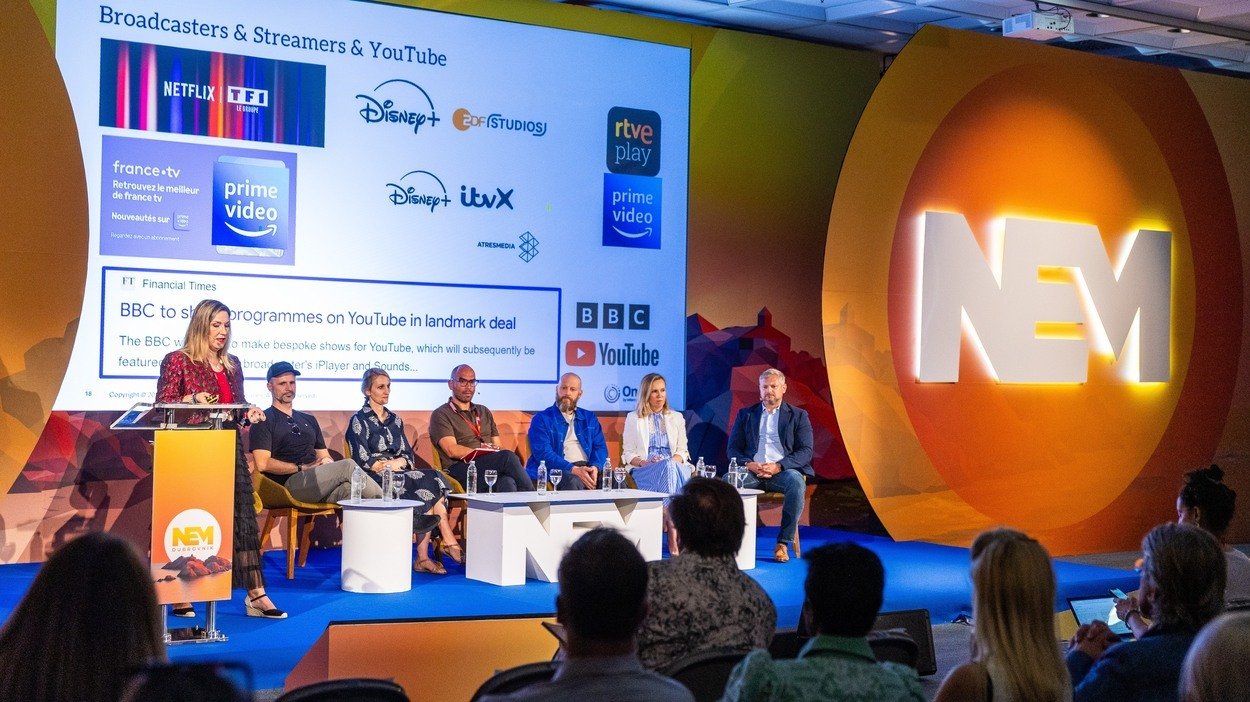
A moment during one of the panels
NEM Dubrovnik 2026, held at the Hotel Dubrovnik Palace from 9-12 June, celebrated its biggest edition yet, reaffirming its position as the leading television industry gathering in Central and Eastern Europe. Bringing together broadcasters, streaming platforms, distributors, telecom operators, producers and technology companies from across Europe and beyond, the event explored the key forces reshaping the media business, from consolidation and content investment to artificial intelligence (AI) and changing distribution models.
The event opened with the presentation “Three Media Trends”, powered by the European Audiovisual Observatory, which examined the growing number of partnerships between broadcasters and global streaming platforms, investment patterns in European content and the accelerating pace of industry consolidation. Participants highlighted collaborations between major international players and public broadcasters as evidence of a changing audiovisual ecosystem increasingly driven by strategic alliances.
The panel “What Makes a Long-term Buyer-seller Relationship Work?”, sponsored by Globo, brought together executives from CME, Croatian Radiotelevision (HRT), Globo, FTV Prima and Cyfrowy Polsat. The discussion emphasised trust, transparency and flexibility as essential elements underpinning sustainable business relationships. CME’s chief content officer, Igor Draguzet, noted how digital rights have become a fundamental component of content deals, rather than a premium add-on, reflecting broader changes in content acquisition strategies.
Leadership and decision making were central themes on the second day. The panel “The Leader’s Decision Making: Intuition vs Strategy” explored how executives balance data-driven insights with experience and instinct in an increasingly complex market environment. The discussion featured representatives from Armoza Formats, RTV Slovenia, CANAL+, SkyShowtime, Banijay Entertainment and The Walt Disney Company.
A keynote conversation with CME CEO Sam Barnett focused on the enduring strength of local content. Barnett argued that local storytelling remains the most effective way for regional broadcasters to compete against global streaming giants, emphasising the value of culturally specific stories and trusted local news operations. His remarks echoed a recurring theme throughout the market: that regional identity remains one of the industry’s most valuable assets.
The challenges and specificities of operating in Central and Eastern Europe were explored during the session “Why CEE Operators’ Decisions Work Differently”. Speakers highlighted the region’s unique market dynamics, audience behaviours and investment priorities, arguing that CEE cannot be understood solely through comparisons with larger Western European markets.
Consolidation emerged as one of the dominant topics of the event. The panel “What Mega Mergers Mean for the Future of Media”, moderated by Omdia‘s Maria Rua Aguete, examined how large-scale mergers are reshaping competition, content strategies and market structures worldwide. Participants discussed the opportunities created by greater scale alongside the challenges of integration and maintaining investment in local content. Several speakers stressed that regional players must continue to prioritise distinctive local programming in order to remain competitive.
AI was another major focus. The panel “From Search to Suggestion: How AI is Redefining Content Discovery”, sponsored by Wiztivi, explored how AI-powered recommendation systems are evolving towards more contextual and predictive forms of audience engagement. Industry experts discussed the growing role of personalised content discovery and the opportunities that AI creates for improving viewer experiences in increasingly crowded content environments.
The influence of digital platforms was examined in the session “YouTube as a Distribution Opportunity”. Speakers analysed the platform’s emergence as a significant content distribution channel, particularly among younger audiences, and discussed how broadcasters and distributors can integrate YouTube into broader content strategies.
Among the more forward-looking discussions was “Micro-drama in CEE: Safe Bet or Risky Business?”, sponsored by Prva TV, which explored the rapid growth of short-form scripted content. Panellists debated whether the micro-drama phenomenon, already established in parts of Asia, could successfully translate to Central and Eastern European markets.
The event also addressed some of the industry’s most pressing challenges. “Stopping Digital Piracy: What Actually Works?” gathered legal, telecommunications and industry experts to discuss enforcement mechanisms, industry cooperation and strategies for protecting audiovisual content. Meanwhile, “The Trend You Think Is Overhyped”, sponsored by Backscreen, encouraged participants to critically reassess some of the industry’s most widely discussed developments, including AI, FAST channels and streaming.
Keynote sessions with Fremantle CEO Jens Richter and Antenna Group CEO Henning Tewes provided broader perspectives on the industry’s transformation. Richter reflected on Fremantle’s evolution from a company primarily associated with entertainment formats into a diversified global content producer spanning drama, factual programming and feature films. Meanwhile, Tewes focused on the importance of creating emotional connections with audiences, arguing that successful entertainment companies must balance local relevance with regional scale.
NEM Dubrovnik 2026 underscored the growing importance of collaboration, local storytelling and technological innovation in a television industry navigating consolidation, evolving audience habits and the increasing influence of AI. Over four days, the event demonstrated that while distribution models and technologies continue to change, compelling content and strong partnerships remain at the centre of the business.
