
All stories in El Jalapeño are satire and not real news. Check out the original article here.
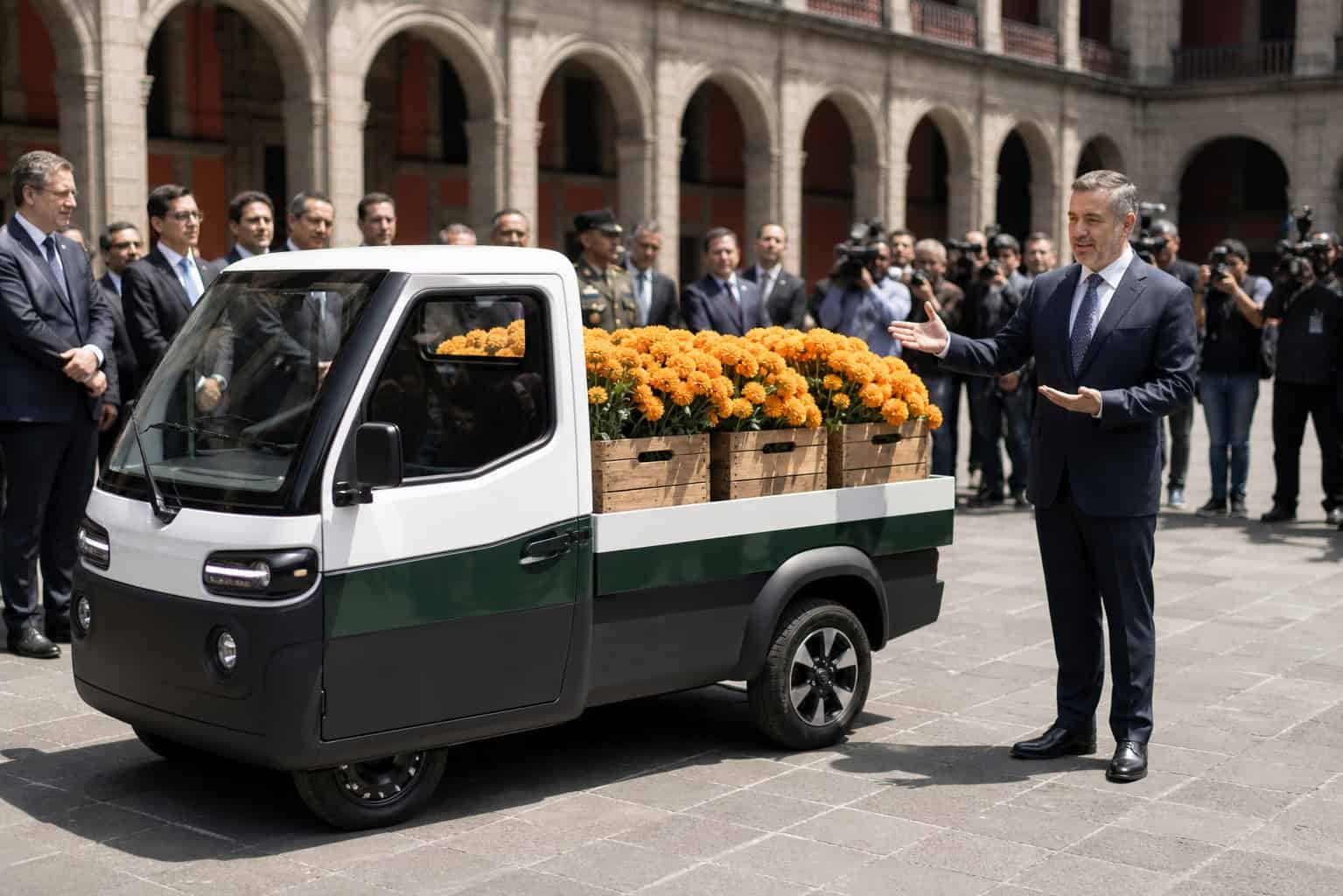
MEXICO CITY — In a landmark moment for national industrial policy, the federal government officially unveiled the prototype for the Olinia Carga, a Mexican-designed electric vehicle (EV) specifically engineered to move three extremely small items across distances best measured in paces.
The vehicle, which was presented in the courtyard of the National Palace, represents the next evolutionary leap in the administration’s “mini-electromobility” initiative. Designed with total pragmatic clarity, the low-cost pickup aims to revolutionize the micro-logistics sector by transporting light burdens that would otherwise require two moderately assertive people or a very sturdy wheelbarrow.
“To design this vehicle, we looked directly at how cargo is actually moved in our towns,” said project director Roberto Capuano, gesturing toward a bed meticulously arranged with three wooden crates of marigolds. “What we saw was a market crying out for something that sits precisely between a heavy-duty motorcycle and walking briskly while holding a box.”
According to official technical specifications, the Olinia Carga features a maximum range of 120 kilometers and can carry up to 650 kilograms, provided the weight is distributed with mathematical perfection and the wind is blowing from behind. A key selling point is the “low trunk” — an empty cavern under the bed made possible by the absence of a traditional engine — which officials noted is ideal for storing folding tables, two spare umbrellas, or a single, carefully folded tarp.
Project engineers confirmed that while the vehicle is capable of reaching a top speed appropriate for a residential alleyway, its primary design achievement is its ability to sit idling outside a neighborhood tiendita without consuming a single drop of gasoline.
“In Mexico, we are proving that we can engineer solutions tailored directly to our exact, hyper-local needs,” Capuano added, noting that a public tender will soon be opened to find strategic manufacturing partners willing to build a vehicle whose primary market advantage is that it fits in spaces where real trucks are strictly forbidden. “We are not just building an electric car; we are building an electric car that can comfortably navigate a Wednesday tianguis without disturbing the fruit stalls.”

The Olinia Carga is expected to go on sale in late 2027 for approximately 150,000 pesos, at which point government officials remain confident it will completely dominate the highly competitive niche of delivering fresh cheese across single city blocks.
Check out our Jalapeño archive here.
Got an idea for a Jalapeño article? Email us with your suggestions!
