
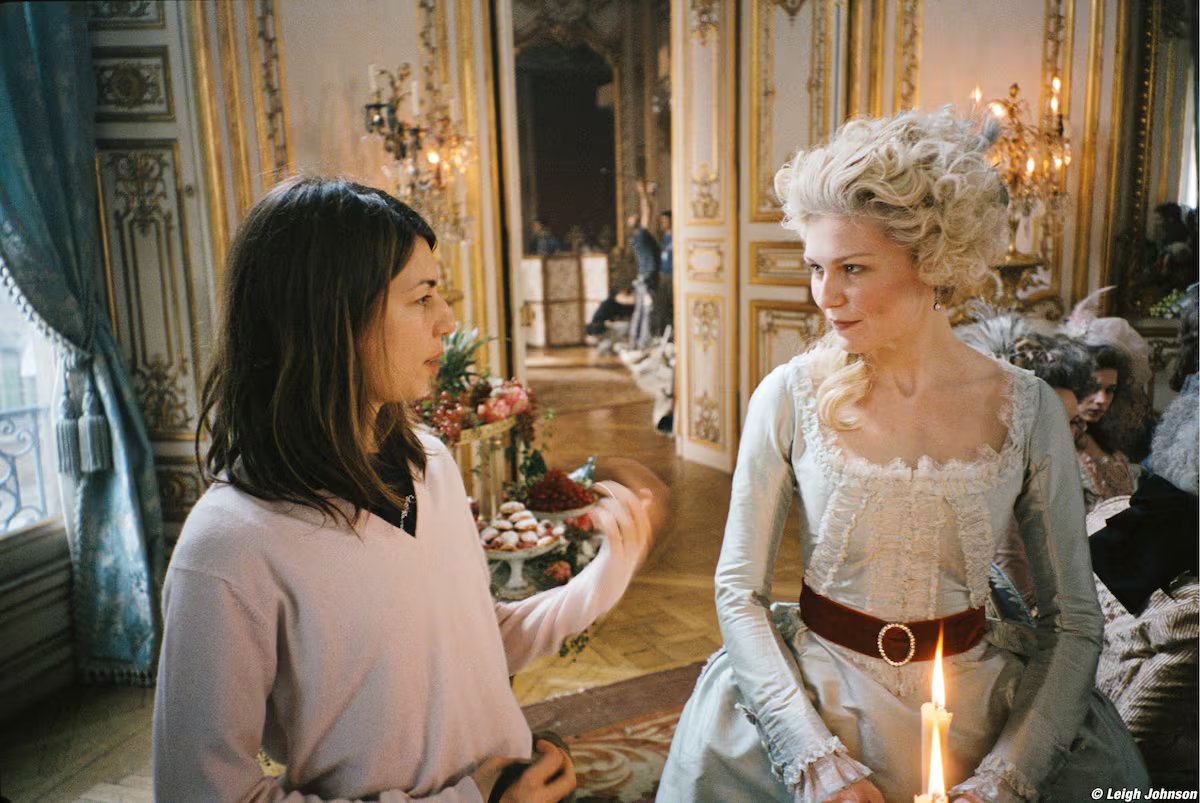
Since finding out that I’d be writing this article, every time I mentioned that 20 years have passed since the premiere of Marie Antoinette, people’s reaction has been the same. “It can’t have been that long ago,” they say, their faces full of terror and shock, whether they saw the film in theaters or are among those who have discovered it much after the fact via Tumblr, Pinterest or TikTok.
Generally speaking, there is something odd about the way we perceive the passage of time in the 21st century. In speaking of film, there are certain movies that seem to age rapidly. And then there are those that stay trapped in a kind of permanent present. Sofia Coppola’s Marie Antoinette clearly belongs in the latter category.
Today, its visual imagination still seems absolutely contemporary, as does its use of music, its mix of pop culture and historical drama, and the manner in which it films femininity. Even its view of fame and public exposure fits better in the era of Instagram and TikTok than in the years in which Facebook was just beginning to expand past U.S. university students.
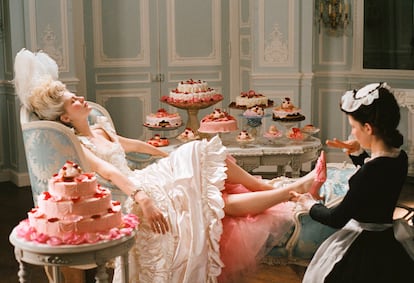
Some shots from Marie Antoinette seem to have been designed to circulate on social media. The pastel macaroons, the shoes (designed by Manolo Blahnik) arranged as objects of desire, the interminable parties, songs by The Strokes playing in Versailles and that famous Converse sneaker, hidden among period heels. It all transmits a visionary modernity, as if the New York director had understood before anyone else where visual culture would be moving in the following decades.
But in 2006, some of the film’s critics interpreted this prescience as defect. The movie was booed (if also applauded) at the Cannes Film Festival, and an abundant number of journalists described it as “superficial, capricious and frivolous.”
Twenty years later, perception of it is nearly the opposite. It’s becoming increasingly evident that Coppola was not trivializing the story of Marie Antoinette, but rather, utilizing the 18th century to speak of something profoundly contemporary: femininity rendered spectacle and the feeling of being trapped inside an identity designed by others.
Cannes didn’t understand Sofia Coppola
In retrospect, many of the negative reviews directed at the film in 2006 seem to speak less of the movie and more of the rarity of its female director approaching capital-H History through an openly feminine lens.
What some reviewers did not understand was that Coppola never wanted to create an academic reconstruction of the 18th century. She was inspired by the biography of Antonia Fraser, Marie Antoinette: The Last Queen of France to make a film that was much more subjective, an emotional portrait of a teenager (who in real life, was married at just 14 years of age) and forced to become an icon before she truly knew herself.
The movie begins with the member of royalty, played by a magnificent Kirsten Dunst, leaving the Austrian court to marry the heir to the French throne, the future Louis XVI, who is played by Jason Schwartzman. It finishes with the outbreak of the French Revolution a few years before she met her end at its guillotine.
But despite this political background, the focus of the film lay elsewhere, in the personal experience of a girl destined to be queen, forever being watched by a court that controls everything from her clothes to the person that dresses her in the morning.
The director herself explained in a press statement, according to IndieWire, that she wanted to avoid “a dry, historical period movie with the distant cold tableau of shots […] I wanted this film to let the audience feel what it might be like to be in Versailles during that time and to really get lost in that world.”
And so, Coppola turned Versailles into a space that functioned as the psychological extension of her protagonist. The pastels, the shoes, the parties and the infinite layers of silk, in addition to creating eye candy for the viewer, represented the bars of a carefully decorated prison. Seen today, Marie Antoinette appears to be a film that is about fame, disguised as a period drama.
History’s first influencer?
The princess, and later queen, was the prisoner of pre-established public rituals. Her every move was observed, commented on and reinterpreted by the members of her court. Her marriage was a political spectacle, as well as an item of celebrity gossip. Her image constantly circulated, deformed by rumor and caricature. In one of the movie’s most memorable scenes, young Marie Antoinette is not even allowed to dress herself, as palace etiquette ordains that the simple act be converted into a humiliating public ceremony.
Today, it’s hard not to connect all this with the logic of social media and its influencers, and the obligation to turn private life into content. A permanent aesthetic pressure, the feeling of being trapped within an idealized version of oneself… Coppola shot it all, two decades before platforms like Instagram and TikTok would amplify the mechanism on a global scale.
That’s why the film’s anachronisms work so well. They’re ways of emotionally connecting that 18th century adolescent to the young people of the aughts. Its Versailles resembles more closely a high school, a pool party or a Tumblr feed (the site wouldn’t launch until the following year) than a history lesson.
The birth of coquette-core
A large part of the aesthetic that now dominates certain corners of the internet owes much to Marie Antoinette. Its obsession with pastel tones, macaroons, corsets, pearls, lacing — but also, its contrast between visual sweetness and emotional sadness, form part of so-called “coquette core,” one of the dominating visual trends on TikTok and Pinterest in recent years. The film established the rules of this language, years before there was a name to describe it.
Seen in 2026, the way in which Coppola utilized this aesthetic, with masterful assistance from costume designer Milena Canonero, who won an Oscar for her work on the film, is a perfect way to portray the protagonist’s feeling of emptiness. The more exuberant her life in Versailles, full of sweets and champagne, heels, dresses and jewelry, the more bored Marie Antoinette seems to become.
It is due to this kind of detail that the film has aged so much better than many of its contemporaries. Coppola understood, or at least intuited, how the future visual culture would be hybrid, self-referential and deeply suggestive. By not hiding its pop culture references, she made her film something much more unique.
The revenge of the female gaze
But perhaps Marie Antoinette’s biggest contribution has to do with its point of view. Two decades years after its premiere, it is becoming more evident that its dresses, its pastels, and its parties are part of a much more complex reflection on female representation.
Professor Todd Kennedy, an expert in film theory and gender studies from the University of Nichols, writes in an article entitled Off with Hollywood’s Head: Sofia Coppola as Feminine Auteur that the director’s greatest achievement has been her reformulation of the traditional cinematographic gaze.
According to the essay, which was published by the magazine Film Criticism, the director developed an aesthetic in dialogue with the classic gaze theory, which at the same time, inverts many of the tropes inherited from the male auteurs of the 1960s and ‘70s, including the tradition represented by her own father, Francis Ford Coppola.
In the case of Marie Antoinette, this inversion is particularly radical. The film forces the spectator to identify with the observed person, rather than those who observe her. The protagonist is the object of constant surveillance. She is symbolically undressed from the beginning of the film, when she must leave Austria and let go of her previous identity before entering France.
Coppola does not convert this exposure to erotic spectacle nor aspirational fantasy, according to Kennedy. She films it through a lens of vulnerability. Dunst plays the queen as someone trapped between the desire to enjoy herself and the impossibility of truly belonging anywhere.
Kennedy also pinpoints an important difference from Coppola’s prior films. In The Virgin Suicides (1999) and Lost in Translation (2003) there are still masculine figures that act as intermediaries for the viewer. Not so in Marie Antoinette. Here, that filter disappears and the public is left before a feminine experience shown in a direct, emotionally exposed manner.
Part of the initial rejection of the film, perhaps, has to do with this. In 2006, critics were much better prepared to see Marie Antoinette from the outside, rather than put themselves in her shoes (a metaphor never put to better use).
With time, Coppola’s risky bet has wound up becoming one of the reasons why the film continues to look so very modern. Subsequent films like Pablo Larraín’s Spencer (2021) and Coppola’s own Priscilla (2023) have inherited its same sensibility: women trapped inside public images that prove too large to comfortably inhabit.
It is difficult to imagine a more symbolic image of this cultural transformation than the fact that in September, the Palace of Versailles will inaugurate a large commemorative exhibition dedicated to the film. What for years was treated as a minor experiment has wound up becoming a museum piece.
Perhaps, this is because Marie Antoinette was a movie ahead of its time. In 2006, there was still no clear language with which to speak of aesthetic prisons, feminine representation or public construction of identity. Nor was there a visual culture dominated by hyper-aestheticized images of apparently perfect lives. Today, we live completely within that ecosystem.
Sign up for our weekly newsletter to get more English-language news coverage from EL PAÍS USA Edition
