
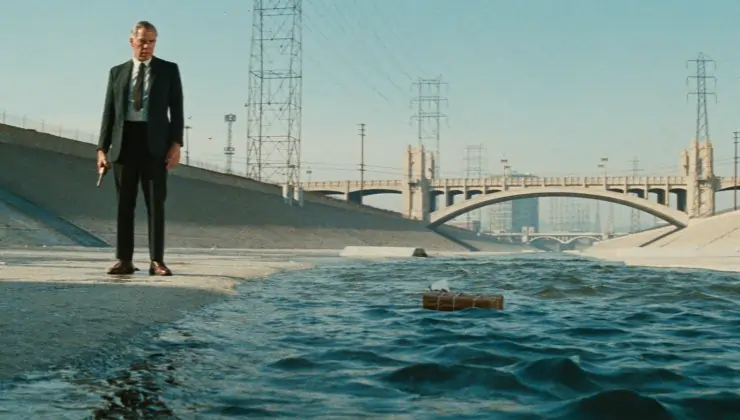
There’s never been another movie icon like Lee Marvin. He’s tougher than McQueen, more sadistic than Eastwood, and more charismatic than Bronson. Critic Howard Hampton once compared him with other stoic screen icons, arguing that where you can see them play at being cool, Marvin embodies “an icy intractability all the more persuasive for the shards of pain and doubt and exhaustion you glimpsed around his razor sharp edges.” Unlike the other action stars, there was always an intelligence to Marvin’s performances that either softened the brutality of his characters or made them even more malicious. No film captured that quality better than Point Blank, still one of the most influential, existential and effortlessly stylish crime films ever made.
Based on The Hunter by Donald E Westlake, and directed by John Boorman in his Hollywood debut, the film stars Marvin as Walker, a criminal betrayed during a heist on Alcatraz by his partner Reese (John Vernon) and his wife Lynne (Sharon Acker), and left for dead. Sometime later, Walker re-emerges and begins methodically working his way through “The Organisation”, the syndicate Reese now works for, demanding the $93,000 owed to him. He’s not even seeking revenge, necessarily, just his money.
This distinction matters. Despite its reputation as the definitive revenge thriller, Walker barely seems interested in vengeance itself. Again and again, he deadpans: “I want my money.” It becomes a mantra, and eventually a joke. When Organisation boss Brewster (Carroll O’Connor) finally confronts him, genuinely baffled that so much bloodshed has ensued over a relatively meagre amount, Walker’s almost sheepish response – “I really want my money” – elicits one of the few genuine laughs of the film.
Marvin’s performance is extraordinary precisely because of how little he appears to do. Walker moves through the film like an avenging spectre: cold, clinical and almost inhuman in his focus. He says very little, reacting to betrayals and violence with little more than a cold stare, yet Marvin never lets him become dull or one-note, finding dynamic, interesting angles to play each scene. For instance, in his big confrontation with Lynne, he simply cut his lines, leaving Acker a rambling, guilt-ridden monologue. It becomes a confession, with Walker sitting next to his ex-wife, apparently unmoved – his impassive exterior belying something deeply wounded lurking beneath the surface.
The supporting cast is excellent across the board. Vernon makes Reese an oily and hissable villain, while Angie Dickinson brings a combination of toughness, cynicism and vulnerability to Chris, Walker’s sister-in-law and reluctant ally. The scene where she really lays into Marvin, with Dickinson slapping, punching and clawing at the unflinching Walker, is one of the most emotionally exhausting sequences in the film, with both actors looking genuinely drained by the end.
The various members of The Organisation are also vividly characterised; a series of slimy men in tailored suits who each bring something distinct to their characters. Michael Strong is wonderfully weaselly as the oily car salesman Stegman, Lloyd Bochner is a nice contrast as the self-assured Carter, and Carroll O Connor offers moments of levity as the cheerfully mercurial Brewster. Keenan Wynn is especially unnerving as Yost, Walker’s enigmatic guide through the criminal underworld. acting as either a kind of guardian angel or a Mephistophelean figure. He gives an uncharacteristically subdued performance, playing the character with such eerie restraint that he almost feels supernatural.
And perhaps he is. There’s a compelling argument that Walker actually dies from his gunshot wound in the opening sequence, and the rest of the film unfolds in his dying moments, like a noir version of An Occurrence at Owl Creek Bridge. It’s a convincing theory, and one that is surprisingly difficult to dismiss. Walker has an unerring talent for apparating out of nowhere wherever he is needed, and he never directly kills anyone. He might be responsible for their fates, but he never pulls the trigger himself. Dickinson’s bitter line “You died at Alcatraz, alright”, is delivered as a dig at his unfeeling nature, but hangs over the entire film like a challenge to the audience.
Released in 1967, Point Blank arrives at the transition point between classic film noir and the emerging existentialism of New Hollywood cinema, and the tension between those styles gives the film its unique identity. The smart suits, brutalist architecture and hard-boiled dialogue all feel like they belong to an older era, but the filmmaking itself feels startlingly modern.
Boorman mimics the style of European filmmakers like Alain Resnais and Jean Pierre Melville and applies this to an American noir setting, and the result feels entirely of its own. Shot by Philip Lathrop, every frame looks meticulously composed, with Marvin often partially obscured or dwarfed by looming foreground objects, turning the urban landscape into its own kind of abstract prison. This 4K UHD restoration from Criterion, approved by Boorman himself, preserves the grain and texture of the original, really emphasising the colours that Boorman brought to the film, subtly progressing from a muted, almost monochrome palette to the vivid, warm colours that characterise the second half of the film.
Henry Berman’s elliptical, non-linear editing is possibly even more important in giving the film its unique sense of identity. Flashbacks bleed into the present without warning, giving the audience an almost intuitive insight into Walker’s thinking. The love scene between him and Chris is maybe the most cinematic since Don’t Look Now, in the way Boorman puts us squarely in Walker’s mindset without a word of dialogue. The sound design is also impeccable, especially in the sequence where the intense soundscape of Walker’s shoes determinedly pounding the floor echoes over shots of Lynne going about her day, before he finally bursts into her apartment. The non-linear, experimental sound design features overlapping dialogue, repeated sound cues and fractured audio transitions that bleed into the present-day narrative; all of which contribute to the disorienting, experimental feel of the film.
It’s impossible to overstate Point Blank’s influence on modern cinema. You can see its DNA in the work of directors as varied as Jean Luc Godard, Christopher Nolan, Michael Mann and Edgar Wright. Few films have ever looked this cool while also being so strange and disorienting. Nearly six decades later, the filmmaking still feels iconic and aggressively stylish. An existential, almost nihilistic, hard-boiled thriller that has never been bettered.
Special Features
As far as the extras go, many of these are replicated from the previous Blu-ray release of the film from the Premium Collection. These include an interview with Boorman conducted by Geoff Dyer, a short documentary on Alcatraz, and the standout feature, a commentary with John Boorman and Steven Soderbergh, originally recorded in 2001. The enthusiasm Soderbergh brings to the conversation is really infectious, even as he openly admits to stealing liberally from the film for his own The Limey.
The new features include an interview with Mark Harris, a program on the brutalist architecture of the film with historian Alison Martino, and a retrospective on the film and LA crime cinema from director Jim Jarmusch.
★★★★★
Out now on 4K UHD / Lee Marvin, Angie Dickinson, John Vernon, Carroll O Connor, Keenan Wynn / Dir: John Boorman / The Criterion Collection / 18
Discover more from
Subscribe to get the latest posts sent to your email.
