
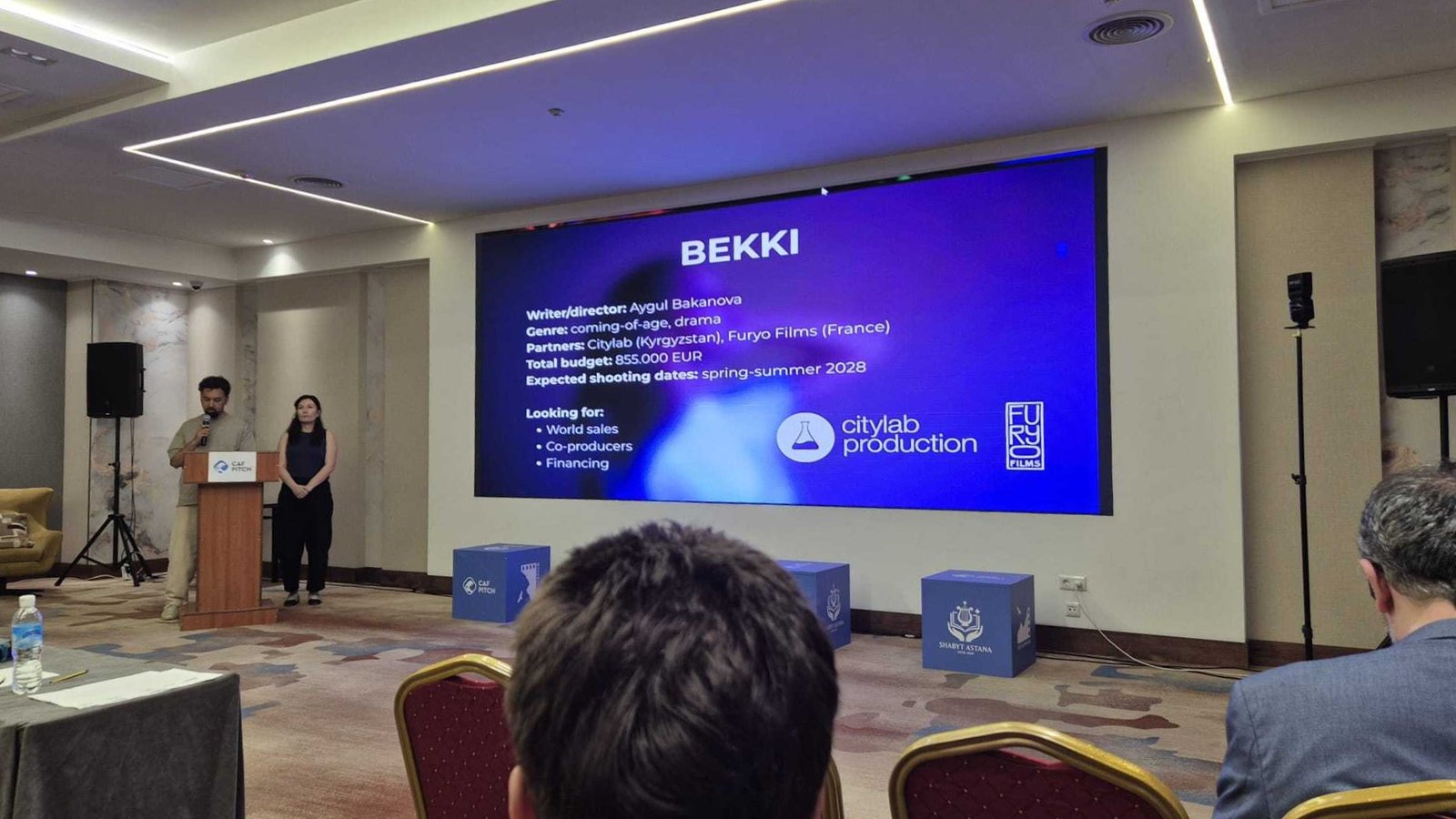
– We take a closer look at five of the ten projects taking part in this year’s CAF Pitch, an emerging pitching platform for Central Asian voices hosted by the Bishkek International Film Festival
Chingiz Narynov (left) and Aygul Bakanova during the pitch for Bekki
One of the key industry initiatives at the fourth Bishkek International Film Festival (BIFF), running in the Kyrgyz capital from 7-12 June (see the interview with festival director Argen Adil Uulu), is the CAF Pitch. For the 2026 edition, the sidebar picked ten Central Asian projects in development, with a focus on identifying new talents and supporting young directors working on debut features. Festival representatives, independent producers and distributors were invited to assess the pitches. Official partners included the Red Sea Film Fund and Kazakhstan’s Shabyt Astana Public Foundation, providing cash awards of 500,000 KGS (approximately €5,000), 400,000 KGS (€4,000) and 175,000 KGS (€1,750), respectively. The pitching sessions, held on 10 June, were moderated by CAF Pitch coordinator Erke Dzhumakmatova. Below, we take a closer look at five of the presented projects:
Izat – Ilimbek Maksatbekov (Kyrgyzstan)
Sixteen-year-old Izat tries to make money over the summer by selling women’s underwear, an unlikely business that soon draws him into a knot of desire, shame and social pressure. Things appear to be going well until he gets one of his married customers pregnant and finds himself entangled with the wrong business partners. Self-taught documentarian Ilimbek Maksatbekov ventures into fiction and describes his film as a coming-of-age drama exploring adolescence, family shame, local taboos and self-assertion, rooted in his own background: “Growing up, my parents sold women’s underwear at the market to support the family.” The protagonist’s name, meaning honour, dignity and esteem, reflects a teenager trying to prove his manhood in a conservative society where intimacy remains difficult to discuss. Produced by Amina Satarova, the project is currently in development, with the team working on the full draft of the script and seeking script-development labs, local funding, festivals and international co-producers.
Bekki – Aygul Bakanova (Kyrgyzstan/France)
Penned and helmed by Aygul Bakanova, and produced by Chingiz Narynov, Bekki is a coming-of-age drama centred on an 18-year-old Bishkek street dancer whose mother and older sister both choose to leave, forcing her to decide whether to escape, too, or to stay and define herself through movement. Co-produced by Citylab Production (Kyrgyzstan) and Furyo Films (France), the project is in active development, has a total budget of €855,000 and is eyeing a spring-summer 2028 shoot, while seeking co-producers, financing and world sales. Bakanova roots the story in a generation of Kyrgyz children raised by their grandparents or siblings while their migrant parents remained mere voices on phones and screens. Bekki is not presented as a victim, but as “happy, free and alive”, immersed in rave parties, dance battles and late nights. The director says, “Dance becomes her language. Dance becomes her form of rebellion,” as the film contrasts Bishkek’s neon-drenched nightlife with modest, run-down domestic interiors.
Taste of Shawarma after Tipsy Night – Amir Amenov (Kazakhstan)
Directed by Amir Amenov (who is now finalising his debut feature, titled Warm Night, Cold Beer) and produced by Zarina Kissikova, Taste of Shawarma after Tipsy Night follows Sancho, a provincial young man who arrives in Almaty and tries to adapt to city life and win over the woman of his dreams, only to literally lose his language, taste and colour. Amenov describes the project as “a tragic comedy, a satire about class, identity and the need to be loved, but most of all, it’s about pretending.” Set among cheap bars, long walks, late-night conversations and shifting social masks, the film explores a city where, in the director’s words, “bourgeois people pretend to be intellectuals, working-class people pretend to be revolutionary, and artists pretend to understand art”. Moving between realism and light surrealism, the film uses food as a key metaphor, contrasting artificial haute cuisine with the taste of shawarma at 4 am: “Something honest, something so simple and true.”
Work and Travel – Dana Alimjanova (Kazakhstan)
Produced by Aruzhan Dossymkozha, Work and Travel follows a Kazakh exchange student struggling to remain abroad in order to support her mother back home, only to become involved with a scammer offering a sham marriage for citizenship. The idea was partly inspired by the producer’s own experience of being offered such an arrangement on two occasions. Alimjanova frames the coming-of-age drama as “a film about female sacrifice”, adding that this burden is “passed from one generation to another”. The protagonist mirrors her mother, who once had to give up her own dreams to raise children and take care of her husbands, suggesting a cycle of self-denial shaped by social expectations. Visually, the team plans to contrast a crowded, noisy foreign metropolis, captured through handheld camerawork and tight frames, with the open spaces of a Kazakh village, shot more slowly and in wider images. The project is in early development, and is seeking labs and co-production partners, with over half of the film expected to shoot abroad.
Crutches for My Father – Madi Balzhanov (Kazakhstan)
Produced by Laura Sabanbayeva, Crutches for My Father is a magical-realist feature following 25-year-old Marat, who is sent to bring crutches to his father in hospital – a man he has not spoken to in years, and whose alcoholism and violence remain stored in his body as living memory. When Marat arrives, the bed is empty: his father has discharged himself and headed towards a dacha sold long ago, a place now existing only in childhood memory. Balzhanov describes the movie as deeply personal and “dedicated to my 70-year-old father”, adding: “When he is near me, my body tightens, and I cannot speak, but I can speak to you now.” The journey turns trauma into physical experience, as summer suddenly becomes winter and Marat loses the use of his legs. Planned for a 2027 shoot, the project has a budget of $416,240 (approximately €360,300), and is seeking Asian and European co-producers, gap financing and regional funds.
