
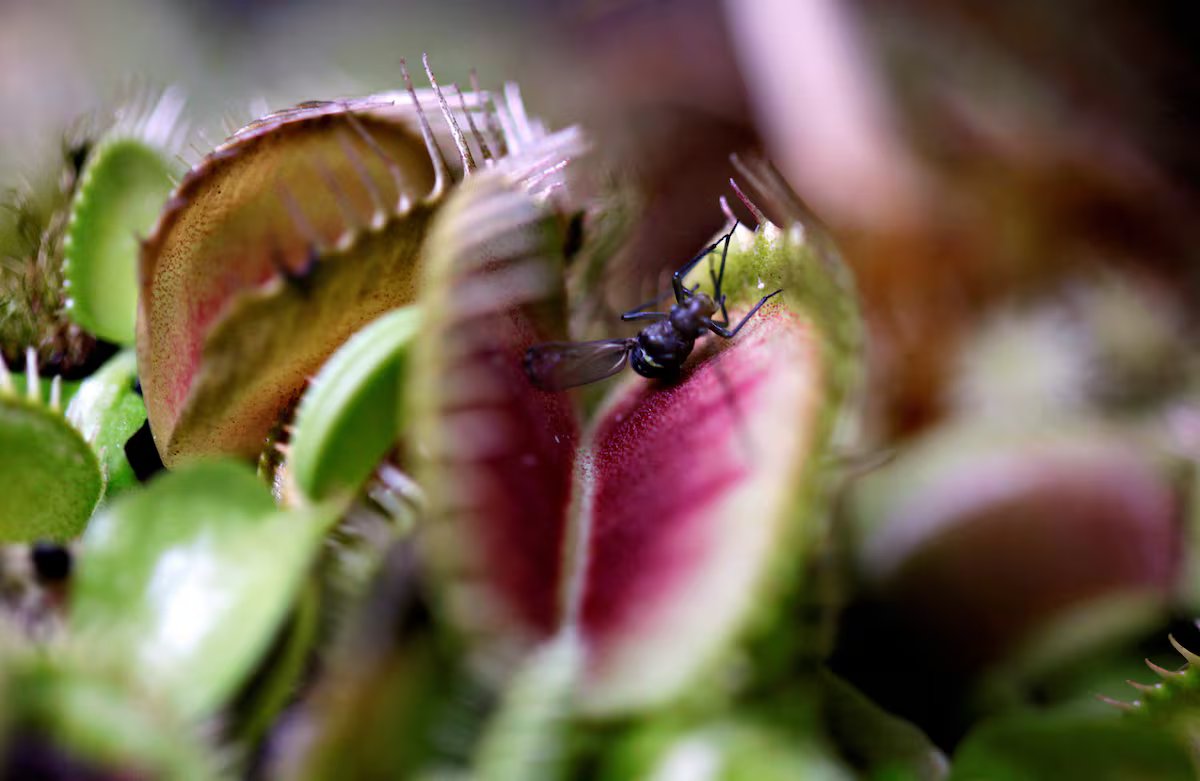
When Charles Darwin first saw a Venus flytrap, he was fascinated. The British naturalist was a pioneer in the scientific study of the carnivorous plant, perhaps the most famous one in the world. Seeing it move so quickly made it seem like an animal. The researcher even thought that there must be some plant equivalent to muscles and nerves. More than a century later, the Venus flytrap continues to challenge scientists’ ideas about plant movement. Now, a team of physicists and biologists have show that the secret to its snapping jaws lies in its capability of modifying the mechanical properties of its cellular walls almost instantaneously, a change that sets off the closure of the leaf around its prey.
In just a few seconds, the cellular walls of a specific layer of the leaf soften and release stored elastic energy. The result is a fatal trap for small and medium-sized insects, which are imprisoned in tenths of a second.
The study’s authors break with previous dominant theory about the plant’s moves. It was once believed that when an insect grazed the sensorial hairs of the Venus flytrap (Dionaea muscipula) two times, an electrical signal from calcium ions traveled along the leaf and triggered its rapid movement, with the trap’s two lobes snapped shut around the prey. This hypothesis posited that the closure was made possible by a rapid movement of the water between the cells — a sort of hydraulic mechanism comparable to that of a pressure-driven machine.
Physicist Yoël Forterre, one of the authors of the study published on Thursday in Science, says there were doubts as to the logic of this theory. He explains that the water can be quickly displaced within a cell, because it only needs to cross the membrane. Still, when it has to travel long distances between cells and tissue, the process becomes much slower. “When you want to move water a long distance from one cell to the other through tissue, that’s far,” says the researcher, who has been studying the plant for more than two decades.
Forterre acknowledges he was not the first to suspect the dogma. There have been previous studies, like one published in 1989 by German researchers Hodick and Sievers, that pointed in this direction and inspired their most recent investigation. “There are many plant movements that utilize the transportation of water, and I think that it was this analogy that primarily led to the thinking that the Venus flytrap functioned like that,” he says.
The discovery
Researchers analyzed the plant’s movement from several angles. First, they studied the macroscopic dynamic of its closure by monitoring it three-dimensionally. To do so, they used a stereoscopic setup, a technique used to simulate the perception of depth in 3D. The authors found that the plant’s internal motor was active for approximately three to four seconds, slower than the final snap that can be observed.
The next question was whether water transportation could be the driving force behind this movement. To investigate, they measured how long it takes for water to move through the trap’s cells. According to the results, passing through the entire tissue would take between 30 and 150 seconds — far too long to account for a movement that takes place in just a few seconds. Furthermore, if water were responsible, delays would be observed in different areas of the leaf as the liquid moved. However, such delays never appeared.
“Discovering that the cell wall can adjust its mechanical properties on such a short timescale is, to my knowledge, truly novel,” says Forterre. According to the physicist, “to date, this is the fastest mechanical change found in plants with cell walls.”
Jacques Dumais, a biologist who specializes in biomechanical plants and did not participate in the study, thinks it supplies the most solid evidence to date on the mechanism behind the flytrap’s closure and connects it for the first time to a chain of events, from the detection of the prey to its capture. “Normally, we associate a living being that moves rapidly, that can dance, jump or run, with having muscles,” he explains. “And the plant is not like that.” Even if it lacks muscles, the Venus flytrap is capable of capturing spiders and insects that can move quickly.
For this professor of bioengineering at Adolfo Ibáñez University in Chile, “the fact that they have an internal structure very different to that of animals, yet they can reach similar speeds, is worth understanding.” The biologist also does not rule out one of the key elements of the first hypothesis. “For the mechanism to work, water movement is also necessary. Any change in a plant’s configuration involves this type of movement at some point,” he says.
Engineering inspiration
The Venus flytrap has been inspiring researchers for years in the fields of robotics and material science. This study’s authors believe their findings could make the plant of even more interest, and open up new avenues for the development of robots and the creation of artificial muscles. “Perhaps we can draw inspiration from this to design fast, soft robotic systems that can rapidly release elastic energy by softening a part of the machine,” suggests Forterre.
Forterre explains that, though the study identifies the physical mechanism that sets off the movement, it does not resolve the molecular question. Calcium, he says, seems to act as an initial signal. A single stimulation does not generate sufficient concentration, but two rapid consecutive contacts does reach the level needed to activate the trap. Still, he explains, that does not mean that calcium is directly responsible for the movement. The physicist admits “that is the final missing link.” An answer that, for now, remains hidden within the trap.
Sign up for our weekly newsletter to get more English-language news coverage from EL PAÍS USA Edition
