
– Rabah Ameur-Zaïmeche delves into the dangers and unexpected encounters of the desert in a unique and highly unconventional road movie
“The sand holds the oldest and most sacred secrets of the universe. But it also preserves the writings of poets.” Rabah Ameur-Zaïmeche has embarked on a journey back to the roots of his cinema – one that defies prejudice and refuses to bow to convention, yet is always characterised by impressive stylistic rigour and a very concrete sociological realism, unafraid to play with genres – by immersing himself in the heart of the Sahara with his new film, Algerican Road, which had its international premiere as the opening film of the 37th FIDMarseille.

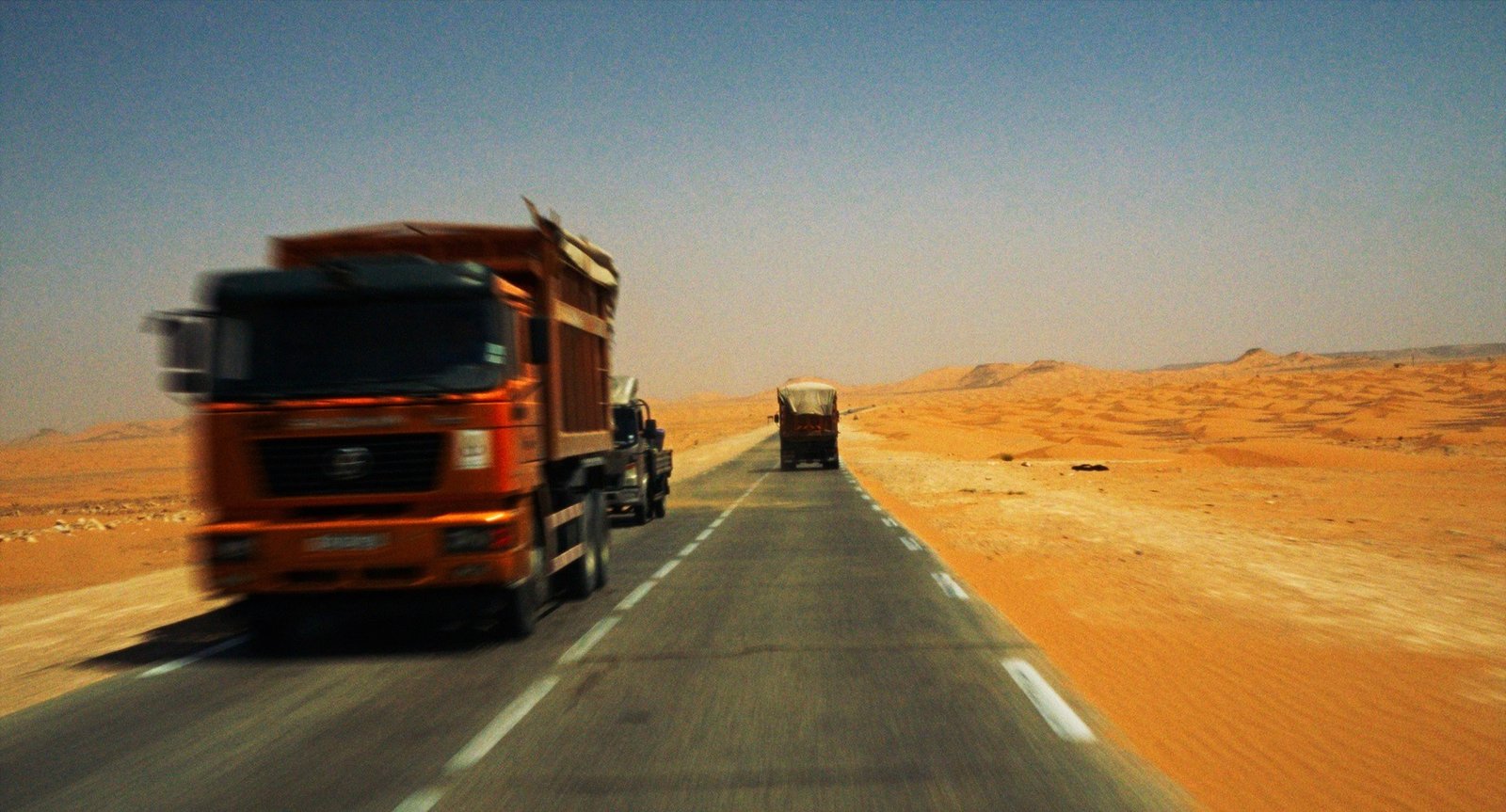
“It’s a dilemma: do I drive in the state I’m in, or do I not drive and lose out on the job?” Although very ill, lorry driver Slimane (the ever-excellent Slimane Dazi, whose face looks as if it were carved out of stone) nevertheless accepts a well-paid offer: a weekly route to El Menia that guarantees him work for at least two years. So off he sets on the road down south in his lorry number 634 with his usual partner, the mechanic Smaïn (Smaïl Ameur-Zaïmeche), who takes the wheel, as Slimane – though a tough and experienced man – is too weak to drive. The kilometres and the landscapes roll by, the dunes and rocky terrain come into view, but an ambush lies in wait for the pair. Robbed and in a pitiful state, they are helped by a couple in a pick-up truck (a researcher played by the Spanish actress Liah O’Prey and a musician played by Sofiane Saidi) whom they happen to come across in the middle of a completely desolate landscape. But death looms large and they must find a way out…
Moving almost intuitively, yet deliberately structured around a minimalist narrative thread that pays little heed to logic, the film succeeds marvellously in capturing the hypnotic atmosphere of the Sahara by striking a balance between a very prosaic approach (the harsh daily life of the close-knit community of lorry drivers cooped up in their cabs, the extreme loneliness when trouble strikes, the solidarity amongst those stranded, and so on) and unexpected detours (an impromptu jam session, a Michelangelo Antonioni-style drift through the dunes, the search for a lost manuscript by the libertarian figure Isabelle Eberhardt, a life-saving forklift truck, Camelia Jordana in a guest role, and much more). The whole film draws on several genres (a touch of comedy in the relationship between Slimane and Smaïn, highwaymen, drama and prayers, interrogations led by a police lieutenant played by Nabil Djedouani, a history lesson, etc.). A blend that is gradually unravelled and masterfully filmed in a refined style against backdrops that are at times breathtaking, adding yet another high-quality milestone to the career of a director forging his own path independently (with his own production company and on a shoestring budget) along a highly personal trajectory (“it stings a bit, but it’s good”) and on a mission “to the South”, where “you always find the people you love.” Lovers of freedom will appreciate it.
Algerican Road was produced by Sarrazink Productions and co-produced by Nana Prod (Algeria) and the Red Sea Fund (Saudi Arabia).
(Translated from French)
