
– Stéphane Demoustier weaves together suspense tinged with guilt surrounding an accidental death and a generational portrait of a troubled youth in search of love and identity
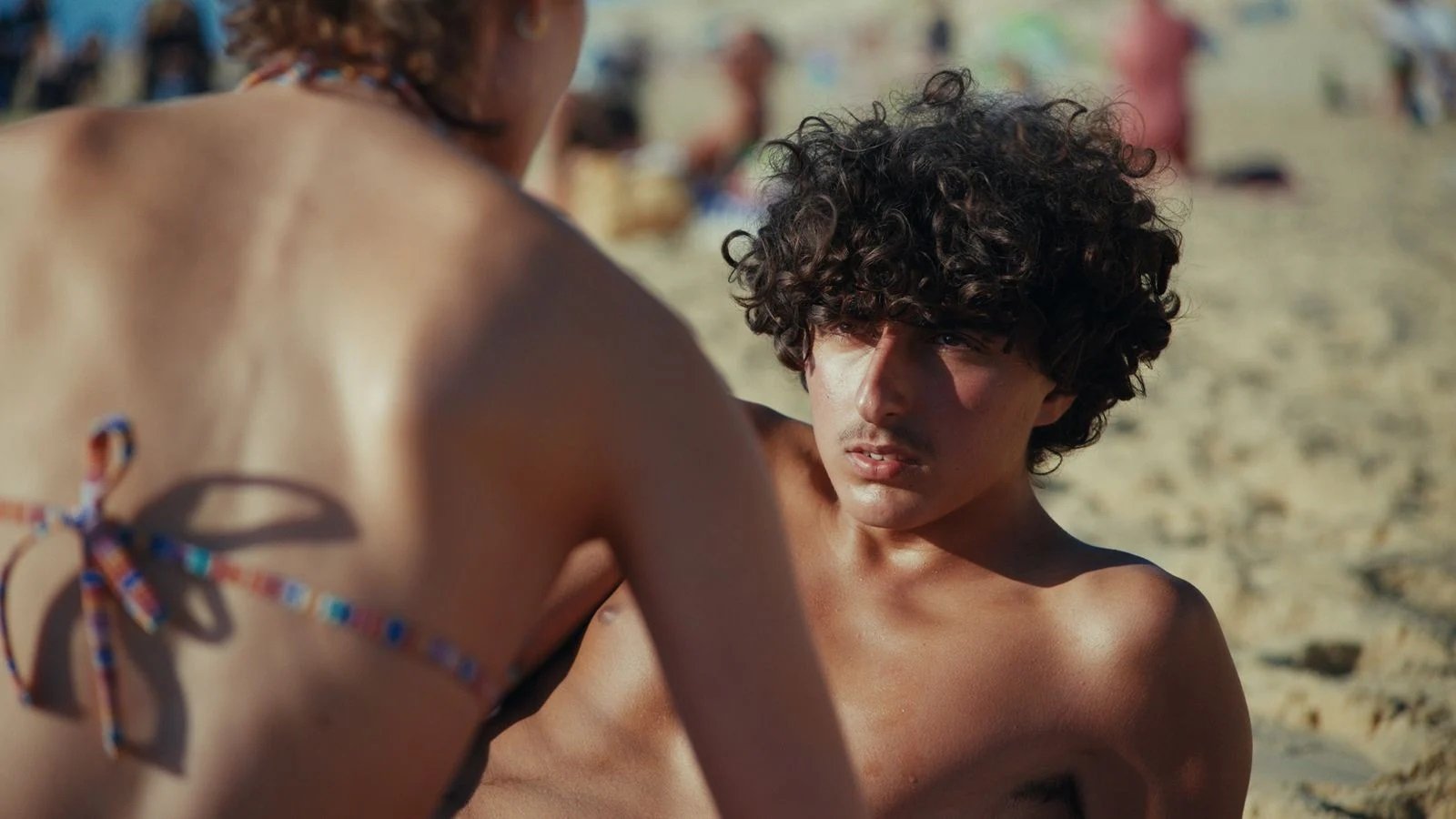
Hadrien Hussein and Martina La Manna in La Chaleur
“It’s beautiful, tragic, dramatic – No, it’s gentle and yet there’s a sense of momentum, of vitality; it’s sensual.” Just like the very different perceptions of two young people in their late teens listening to the prelude to Wagner’s Lohengrin on a beach, La Chaleur, Stéphane Demoustier’s new film, which will be released by Memento in French cinemas on 8 July, plays out a gripping cinematic score full of contrasts and genres, confirming the filmmaker’s talent for always taking unexpected turns. Following the clay tennis courts of 40-Love, the Parc de la Villette in Cléo & Paul, the courtroom in The Girl with a Bracelet, the prison (and Corsica) in Borgo, and the colossal Parisian construction site in The Great Arch, the director has chosen to explore a new dual setting by adapting Victor Jestin’s eponymous novel: a seaside campsite in south-west France, scorched by the sun and lulled by the crashing waves, and a generation of young people hungry for the thrills of their age yet harbouring an underlying unease about the unknown future.
“If you know anything, you’ve got to tell me.” Since the previous evening, Marouane (Hadrien Hussein, making his screen debut) – a shy young man who has only just passed his A-levels and struggles to fit in with groups, let his guard down and attract girls’ attention – has been going through a real psychological ordeal. In the dead of night, a trivial altercation provoked by the popular Oscar (Noé Houssard) turned into a nightmare: an accidental fall, a death and a body that Marouane, in a panic, impulsively buried on the beach. With no witnesses to the event, our very own Raskolnikov is now plagued by pangs of guilt and the fear of being exposed. This anxiety is heightened by his parents (Zakariya Gouram and Cécile Ducrocq), who keep postponing the family’s planned departure (Marouane has a little sister, played by Marguerite Demoustier) from a campsite where the fun summer activities continue (“have fun and be happy”). Whilst lifeguards and police begin searching for the missing boy, Marouane struggles to keep up the pretence but is also pleasantly surprised to find that pretty Italian girl Giulia (Martina La Manna) is taking an interest in him…
As the viewer is immediately privy to Marouane’s terrible and deeply burdensome secret, the film follows in the wake of its endearing protagonist – who has lost his bearings and been swept into a deeply unsettling downward spiral from which he cannot see a way out – whilst the investigation weaves its web around him (and his lies) against the backdrop of the hyper-hedonistic seaside atmosphere. This psychological imbalance is amplified by the director through a number of stylistic devices bordering on auditory hallucination (Pierpaolo Saccomandi’s music interweaving with the sounds of the surrounding natural environment), yet which fits seamlessly into an almost documentary-style portrayal of the setting (the campsite and its layout, from tents and campervans on the beach to communal relaxation areas) and of youth (relationships with parents, the obsession with sleeping with girls embodied by Tristan Richard, and so on). A blend that comes to life through the lens of David Chambille, making La Chaleur a captivating, introverted, slow-burn thriller (spanning 36 hours), subtly intelligent in its sociological portrayal through subtle details, and underpinned by a very well-constructed screenplay (like a game of blind man’s buff, a game of chess or a current carving its way through the sand) centred on the timeless themes of the individual versus the group, Eros versus Thanatos, and youth (“you have to make the most of it, these are your best years”) versus responsibility (“they don’t realise the consequences of their actions”).
La Chaleur was produced by Petit Film (France) and co-produced by Wildside (Italy), Panache Productions (Belgium) and La Compagnie Cinématographique (Belgium), in association with The Dreaming Sheep Company (Switzerland). Charades handles international sales.
(Translated from French)
