
– Set in Germany in 1834, Peter Meister’s satire sends a group of toxic men off on a bear hunt, where the real prey is the truth – and the participants themselves
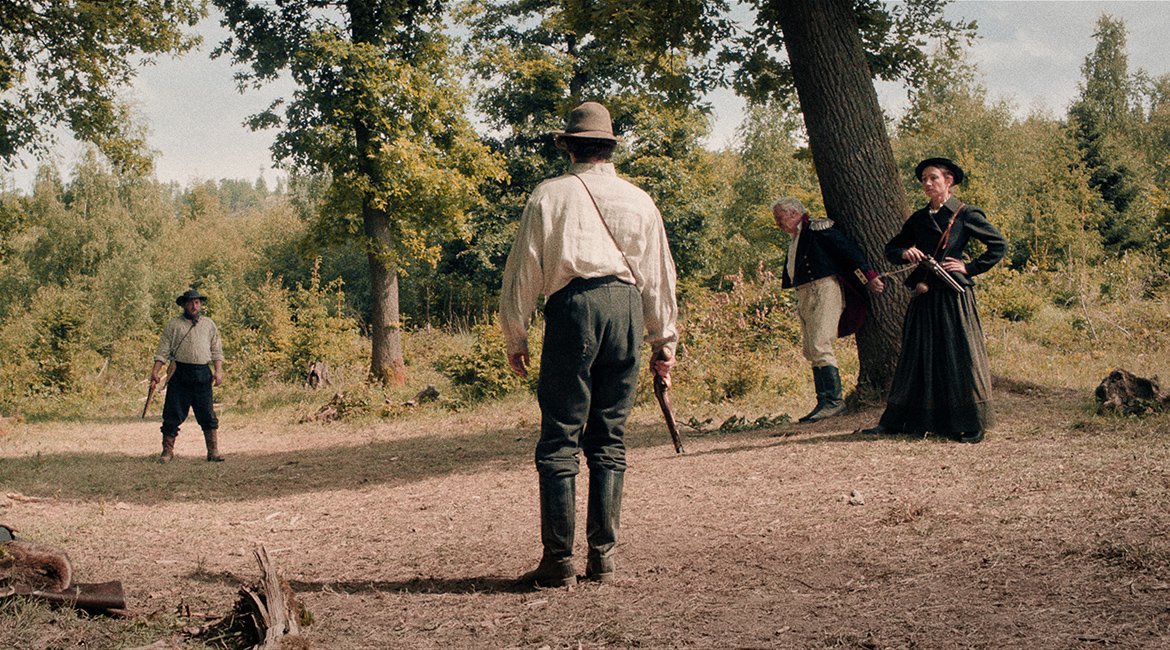
l-r: David Scheid, Christopher Schärf, Bernhard Schütz and Aenne Schwarz in Bearhunting
“Peace to the shacks! War on the palaces!” The slogan on the pamphlets distributed by German writer and revolutionary Georg Büchner in the Grand Duchy of Hesse in 1834 sets the tone for Bearhunting, Peter Meister’s second feature, which has just celebrated a shared world premiere in the Munich International Film Festival’s New German Cinema section and at the Shanghai International Film Festival.
Set two centuries ago, during Büchner’s pamphlet war on the powers that be, Bearhunting is a tragic satire with western elements, which explores what happens when fake truths are manufactured to control and weaponise people. It also asks what is worth fighting for in an age when it is difficult to tell truth from falsehood. In a small village in Hesse, tensions are running high in the build-up to the French July Revolution. Those in power squander taxpayers’ money, people go hungry, soldiers are murdered, and bakers are robbed. In an attempt to protect his own position, the Major-General (Bernhard Schütz) offers a bounty for a non-existent bear, sending self-absorbed and insecure men off on an initially entertaining hunt that turns into a war that no one can win. Two Austrian brothers, Heinrich (David Scheid) and Gustav (Christopher Schärf), who could not be more different from one another, also take part in the hunt.
Gustav is a slight, arrogant publisher who looks down on his brother and dreams of a position at the Grand Duke’s court. Heinrich is a stocky, essentially good-natured chap who is torn, on the one hand, between the revolution and a better life in America, and on the other, between two women: Agnes (Pheline Roggan), a former mistress of the Grand Duke, and Minna (Aenne Schwarz), Heinrich’s wife. The contrast between the two brothers, as well as their very Austrian way of speaking, adds a touch of tangy humour to the film. Meister also demonstrates a keen sense of how to use dark humour to poke fun at the political establishment.
The men taking part in the hunt are all driven by their greed for the bounty, which turns them into the perfect prey themselves. When it becomes clear that Gustav has secretly reprinted Büchner’s leaflets, the hunters become the hunted.
The role of women in the film is ambivalent. On the one hand, they are seen as objects of pleasure (especially by Heinrich and the Major-General); on the other hand, this gives them a certain leverage over the men. Moreover, the women – above all the shepherdess and Agnes – see right through the fake bear hunt and strive to liberate themselves from the toxic masculinity they are surrounded by. But just how far are they willing to go for it?
The film could be understood as a call for a gentle revolution. The soundtrack by the band The Düsseldorf Düsterboys, which oscillates between poetic folk, tropicalism and living-room punk, lends the movie a timeless quality. In an era of fake news and divisive rhetoric being wielded as weapons, Bearhunting‘s parable of manufactured hysteria feels uncomfortably relevant, as do its warnings about the dangers of complacency.
Bearhunting was produced by Germany’s Frisbeefilms GmbH & Co KG, in co-production with ZDF – Das kleine Fernsehspiel. Its distribution is being handled by Port-au-Prince Pictures.
