
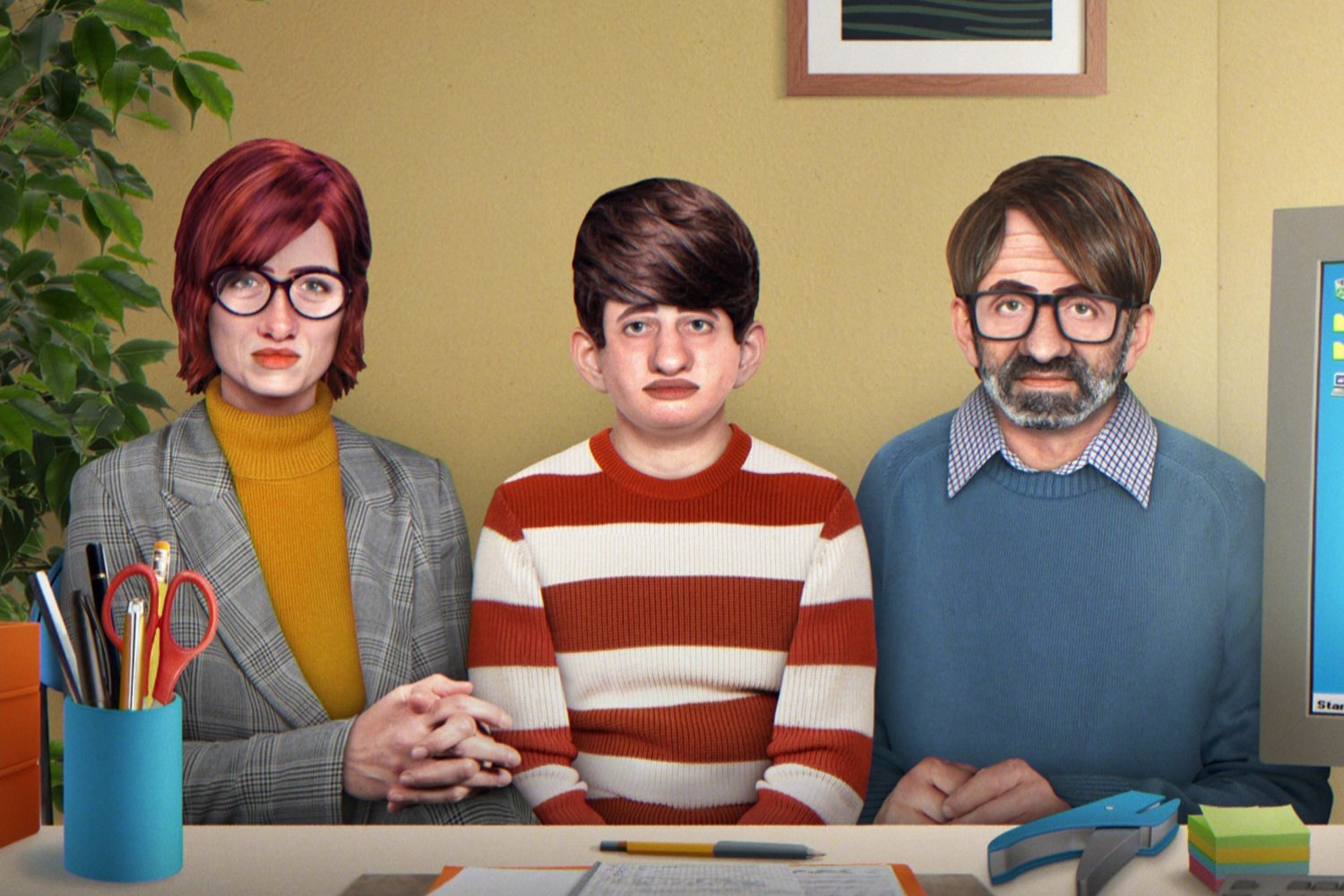
– Dimitri Planchon and Jean-Paul Guigue deliver a uniquely charming first feature film which uses humour to draw on a slightly quirky realism, creating a modest story based on misunderstandings
“Why focus on other people’s opinions?” This question asked by a school guidance counsellor whom the father of the high-schooler protagonist of Blaise, by Dimitri Planchon and Jean-Paul Guigue (unveiled in Cannes’ ACID line-up and competing in the Contrechamp competition this week as part of the 45th Annecy Animated Film Festival), tends to take for his own personal therapist, pervades this highly singular and delightfully serious yet gently ironic first feature film. And the originality of the story has been firmly established over time since it’s derived from Planchon’s trilogy of eponymous comic books and an animated series (thirty 30-minute episodes) for Arte.
Angst over other people’s judgements, resulting in misunderstandings, lies and countless comedic complications, is the speciality of Blaise (who’s 16 years old and desperate not to stand out) and his parents, Carole (whose aim is to win the love of her small team in her new job, where a bad reputation precedes her) and Jacques (who suddenly discovers, to his great narcissistic surprise, that his spouse’s best friend has thought he’s an idiot for close to 30 years). It’s the same for Joséphine – the only child of Carole’s big boss at Durieux-Valois – who takes a shine to Blaise, mistaking his mutism for mysteriousness and depth. These feelings frighten the teenage boy a little (as well as attracting him, obviously, since the fear-attraction mechanism operates at all levels of the film), leading him to pretend he’s a product of the working classes, which leads Joséphine, in turn, to hide her upper-class roots. These attempts to hide from their own selves (“I didn’t throw myself at you, I slipped on the carpet”) see all the characters advancing somewhat wonkily. But they evolve, nonetheless, albeit sometimes kicking and screaming, amidst a tense social atmosphere where revolutionary violence soon rears its head…
Like the cut-paper technique which gently distorts its characters’ traits, Blaise operates subtle shifts and plays wonderfully with the reality it so accurately depicts (parent-teen relationships, the awkwardness of our first romantic steps, modern loneliness, the need for recognition, the radical nature of the current political climate, etc.). The filmmaking duo (supported by co-screenwriter Clémence Lebatteux) modulate the original tone of their work perfectly, flirting with the smaller absurdities of life and social conventions, and with funny futile exercises and misunderstandings. It’s a funny, always warm-hearted but nonetheless incisive premise (notably featuring a long and interesting Engels quote) which turns Blaise into an intelligent and far less innocent (in the positive sense of the word) work than its very pleasant, playful, light-hearted appearance would have us believe.
Blaise was produced by KG Productions. Best Friend Forever are steering world sales.
(Translated from French)
