
– CANNES 2026: With his first instalment of a two-part opus, Antonin Baudry tries his hand at an epic tale which borrows as heavily from picaresque novel codes as from superhero films
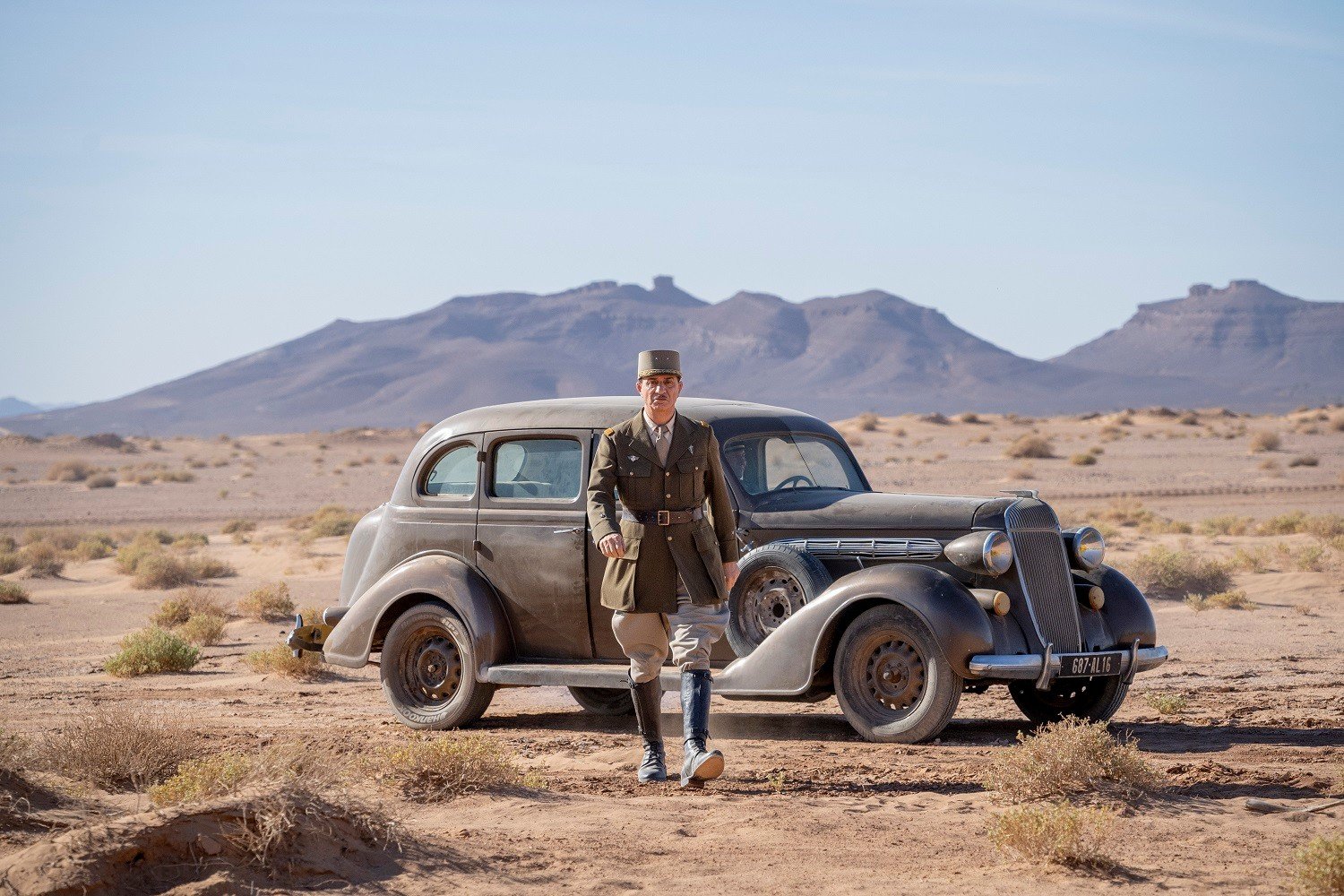
Simon Abkarian in De Gaulle: Tilting Iron
Presented out of competition, against all expectations De Gaulle: Tilting Iron looks set to be the blockbuster of the 79th Cannes Film Festival, in the absence of any rival US candidate. Before launching his film career, Antonin Baudry worked in politics for some time, an experience he shared in 2010 by way of the comic book Quai d’Orsay, for which he also wrote the screenplay. It was in 2018 that his first film, The Wolf’s Call, was released, to great public and critical acclaim, and so this historical action two-parter – a huge-scale project in French film terms – is, in fact, only his second film. These five or so hours of fiction aim to look back on a relatively brief period in General Charles de Gaulle’s life, between 1940 and 1944.
With no mention of his childhood or younger years, we see De Gaulle (Simon Abkarian) alone at the beginning of the story, under enemy fire the day before the Armistice, and then in London attempting to found a free France. His early supporters are a Polish plumber, some fishermen from Brittany and a priest in a cassock. As the days go by, he ends up assembling an ad hoc army, his very own Avengers team, some might say, with whom he resists the official government’s capitulation and then American imperialism. Far from home, De Gaulle begins by taking back land in Africa, setting off for war like it’s an adventure. His strategic vision (and his soldiers’ courage) imposes itself in the Battle of Bir Hakeim, a real tour de force and film within a film which marks a turning point halfway through the war. The story also follows Fernand, a young Parisian who joins the resistance without delay.
Antonin Baudry strikes a curious balance, simultaneously desecrating and glorifying De Gaulle. Of all the films he could have made, he decides not to choose at all: De Gaulle: Tilting Iron is at once an adventure film, a war film and a superhero film. Or if he does choose, it’s to eschew the biopic and refuse any kind of psychologising, leaving almost all of De Gaulle’s personal life unexplored, with the General essentially shown in action and secretly experiencing doubt. In the eyes of reason, embodied by Churchill (with whom De Gaulle forges a brotherly relationship which might had slid into bromance in the hands of other actors), he has all the makings of a Don Quixote or a reckless dreamer. But if De Gaulle has his head in the clouds, he also has his feet planted firmly on muddy ground.
The film makes no apologies over its blatant virility, with only two fleeting concessions to female characters. That’s arguably what filters through while watching the film: there’s no pretence. This diptych is designed to be a blockbuster with all the relevant mise-en-scène attributes, with the notable exception of its cast. The heroic General is by no means untouchable. His determination makes him a hero, but he’s not immune to ridicule, with the filmmaker occasionally incorporating some slightly heavy-handed comedy moments. Ultimately, Simon Abkarian helps us to forget the myth in order to foreground an undeniably heroic character, making measured use of De Gaulle’s trademark inflections (and such trademarks, like uniforms, matter) to create a film hero who’s as convincing as he is unexpected.
De Gaulle: Tilting Iron will be followed by La Bataille de Gaulle: j’écris ton nom, which is set to be released a month later in French cinemas. The two films were produced by Pathé Films, TF1 Films Production, Logical Pictures – Logical Content Ventures, Ness Films, Auvergne-Rhône-Alpes Cinéma, Laurent Dassault Rond Point, Stags Participation II and Belgian firm Beside Productions. Pathé Films are also overseeing world sales and distribution in France.
(Translated from French)
