
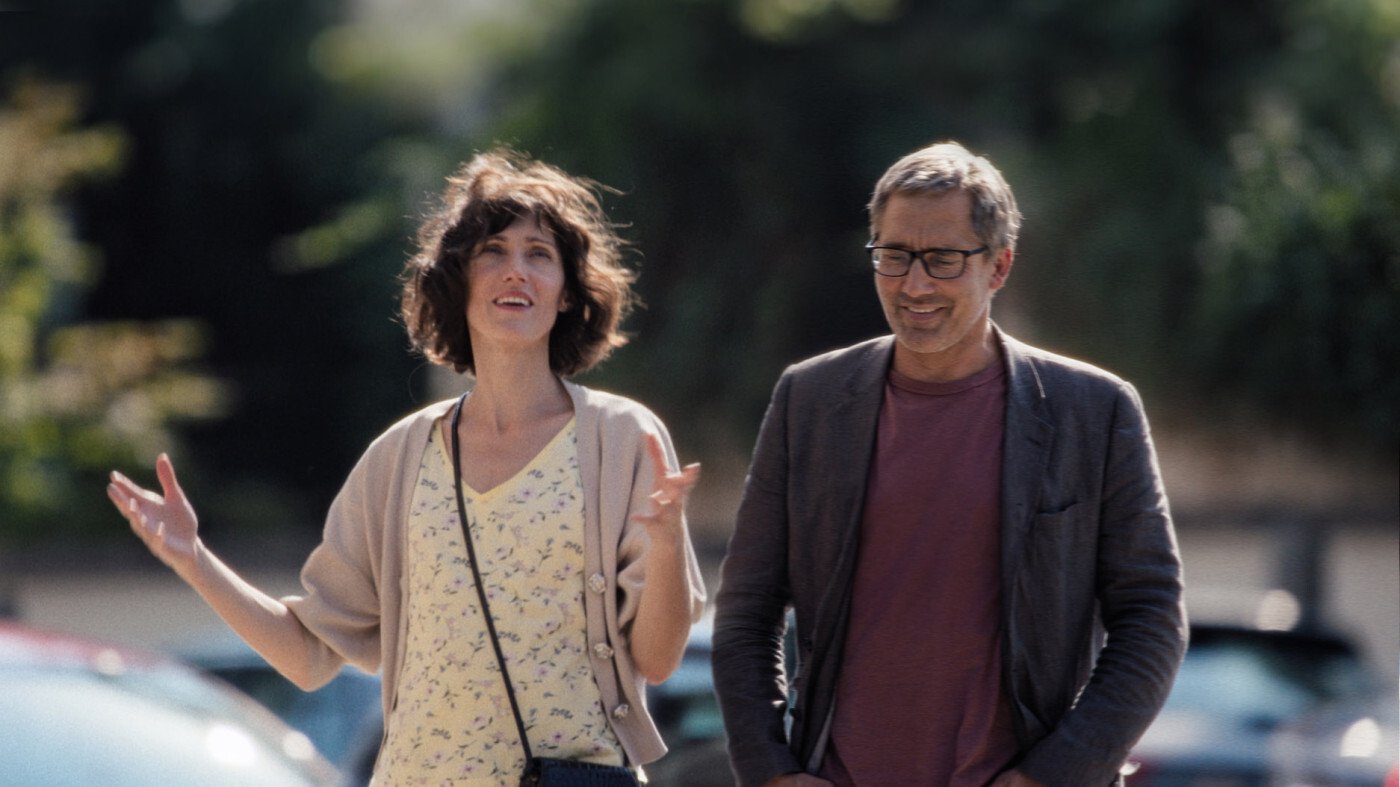
– Bohdan Karásek refines dialogue-driven cinema into an incisive study of middle-age ambivalence, centred on an accomplished woman confronting the gulf between social fulfilment and private doubt
Marie Švestková and Jiří Havelka in Everything As It Should Be
Czech filmmaker Bohdan Karásek emerged as a notable new voice with his 2019 feature debut Karel, Me and You, which was recognised at the Czech Film Critics’ Awards (see the news). His sophomore feature, Everything As It Should Be, premieres in the Special Screenings section of the Karlovy Vary International Film Festival, and confirms his interest in intimate, talk-driven studies of personal uncertainty. Where his debut dealt with the life choices and expectations of thirty-somethings, this new film shifts into early middle age, tracing a woman’s ambivalence at a moment when her life appears, from the outside, to be falling neatly into place.

Monika (Marie Švestková), a successful doctor, spends the day with her ex-husband, Peter (Jiří Havelka), with whom she has remained close despite the collapse of their marriage. Their relationship broke down after they were unable to conceive a child. Now pregnant by her second husband, Lukáš (Lukáš Bouzek), Monika finds herself unsure whether this long-desired development is truly what she wants. What begins as a casual coffee meeting gradually stretches across the day, becoming a kind of walking confession, in which old intimacy, unresolved tenderness and present-day anxieties resurface.
Karel, Me and You earned Karásek the label of a Czech mumblecore filmmaker, with acknowledged debts to Éric Rohmer. Everything As It Should Be moves slightly away from that tag, while retaining a distinctly Rohmerian interest in conversation as a form of personal investigation. Much of the film consists of Monika and Peter wandering through Liberec, their exchange shifting from reminiscence and polite catching-up to more melancholic reflections on ageing, partnership, parenthood and the compromises that define adult life.
The film remains a dialogue-driven, peripatetic, intimate two-hander, built from contemplation, confession and hesitation rather than conventional dramatic incident. Yet Tomáš Uhlík‘s (Brutal Heat) cinematography and Karásek’s own editing lend the material a livelier rhythm than its premise might suggest. Longer takes accompany the central pair as they move through the city, allowing the conversation to breathe, while the editing keeps the film from becoming static or overly theatrical. The result is a modest but fluid piece of conversational cinema — closer to a chamber drama in motion than a static exercise in filmed dialogue.
Karásek, who writes, directs and edits, is careful not to drown Monika’s doubts in unbroken melancholy. Although the film is heavy with dialogue – and, in Monika’s case, extended monologues – it makes room for the occasional joke or small comic interruption. These lighter touches matter, keeping the film from becoming a solemn case study in midlife dissatisfaction. Monika’s crisis is not born of obvious failure: she has professional status, a new marriage and the prospect of motherhood. The tension lies instead in her suspicion that the life she has chosen may not correspond to what she actually feels.
Rather than treating midlife uncertainty as the privilege of drifting men or disappointed romantics, Karásek frames it through an accomplished woman confronting the uneasy gulf between social fulfilment and private doubt. The film’s scale is deliberately modest, and its restrained dramatic stakes may limit its reach beyond festival audiences attuned to minimalist, dialogue-driven Central European auteur cinema. But as a study of middle-age ambivalence, emotional residue and the instability of seemingly settled lives, it confirms Karásek’s sensitivity to the quiet crises of contemporary relationships, and to female subjectivity.
Everything As It Should Be is produced by Beginner’s Mind and co-produced by Czech Television and Magiclab. Artcam Films handles the domestic theatrical release on 23 July.
