
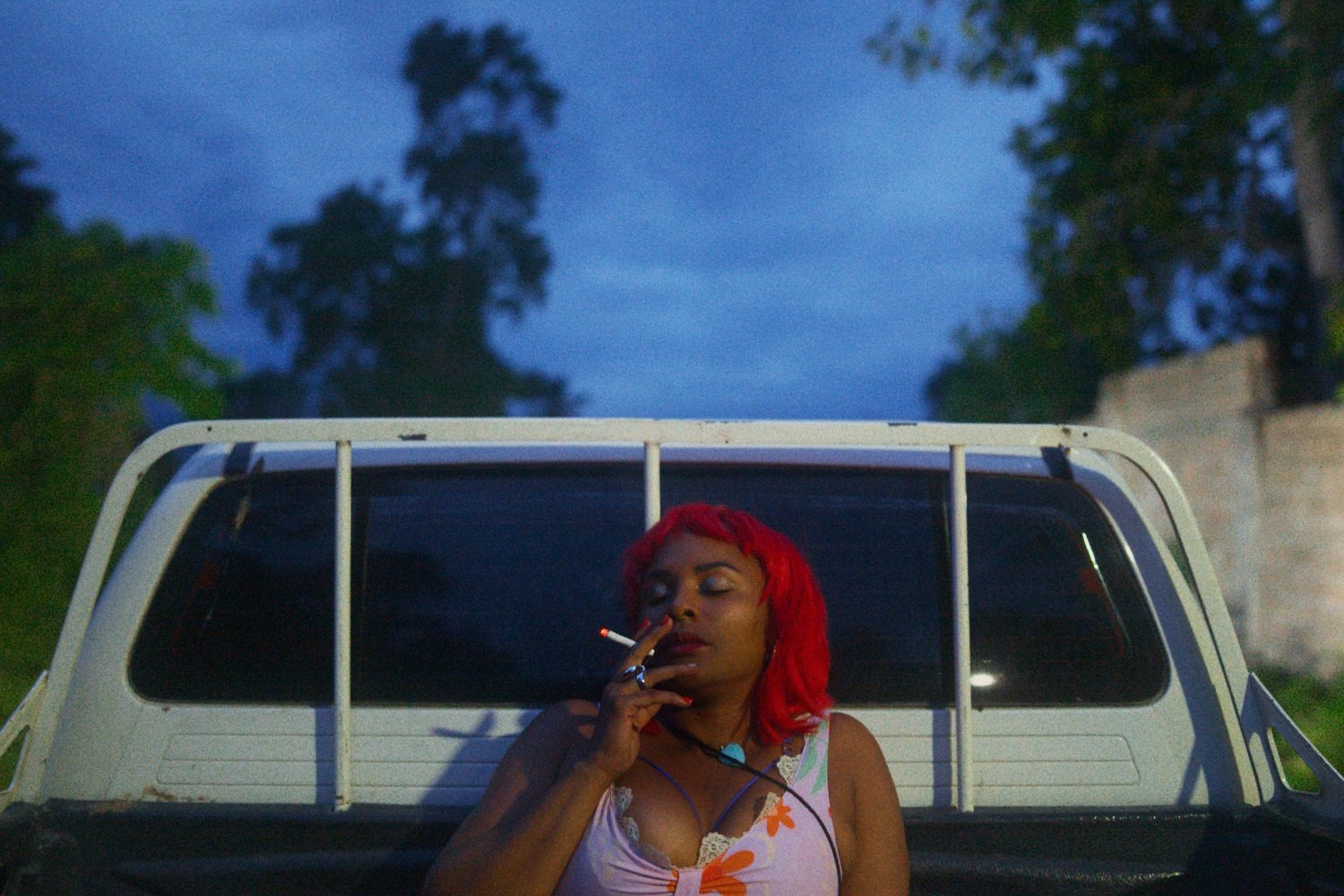
– CANNES 2026: Gessica Généus delivers a flamboyant drama about a young sex worker living as a free woman and a young evangelist consumed by doubt in Haiti
Gessica Généus in Marie Madeleine
In Jacmel, Haiti, a church and a brothel stand opposite one another, reshuffling the cards in the eternal struggle between good and evil. With Mary Magdalene, Haitian actress and filmmaker Gessica Généus turns biblical parables on their head. She returns to the Cannes Film Festival in the Cannes Première section after unveiling her first fiction feature, Freda, in 2021, where it was presented in Un Certain Regard. With this new film, she continues her cinematic exploration of contemporary Haitian society, highlighting its contradictions and points of tension.
Mary Magdalene and Joseph would most likely never have met had it not been for the unfortunate geographical proximity between her brothel and his church. One beautiful morning, as day breaks over a calm sea, Joseph — the pastor’s not entirely acknowledged son — comes to the aid of a young woman covered in blood who has lost her senses. At the hospital, there is no room for Mary Magdalene, whose appearance suggests that her possible miscarriage can only be the consequence of her life as a sex worker. So Joseph takes her back to her sisters-in-arms at the brothel located directly opposite the church he is in the process of building. As the days pass, a strange relationship develops between them, built on affection and camaraderie, shared wounds and mutual care. Joseph is engaged to Mélody, a young woman from the parish, while Mary Magdalene drifts through life in a kind of alcoholic haze, largely indifferent to the judgement of others. Yet both are sensitive to beauty, the only thing that allows them to resist the tragic impulses of existence, and they gradually forge ties as strong as blood.
Through this double portrait born of an unlikely encounter, Gessica Généus turns her gaze towards a Haitian society marked by fractures that seem irreconcilable: between the intense religiosity of part of the population, intoxicated by faith, and the apparent resignation of precarious women, young and old alike, who have nothing but their bodies as a means of survival and addiction as their only horizon. From Mary Magdalene emanates a profound melancholy pierced by flashes of joy, as though she were floating above her own life. Joseph, meanwhile, can only question a faith that his congregation seeks to direct and contain whenever it opens itself too much to the surrounding world. Responding to the chaos of the city is the sensorial quality of certain musical sequences, suspended in time and hovering above the narrative to give both the fiction and its characters room to breathe.
Mary Magdalene, with her feet firmly on the ground while her mind dreams among the clouds, is played with hypnotic charisma by the director herself, while Béonard Monteau — a slam poet and writer in real life — lends Joseph the fragility essential to his emancipation.
Mary Magdalene was produced by SaNoSi Productions (France), and co-produced by Ayizan Productions (Haiti), Stenola Productions (Belgium), Bidibul (Luxembourg) and Metafilm (Canada). International sales are handled by Pyramide.
(Translated from French)
