
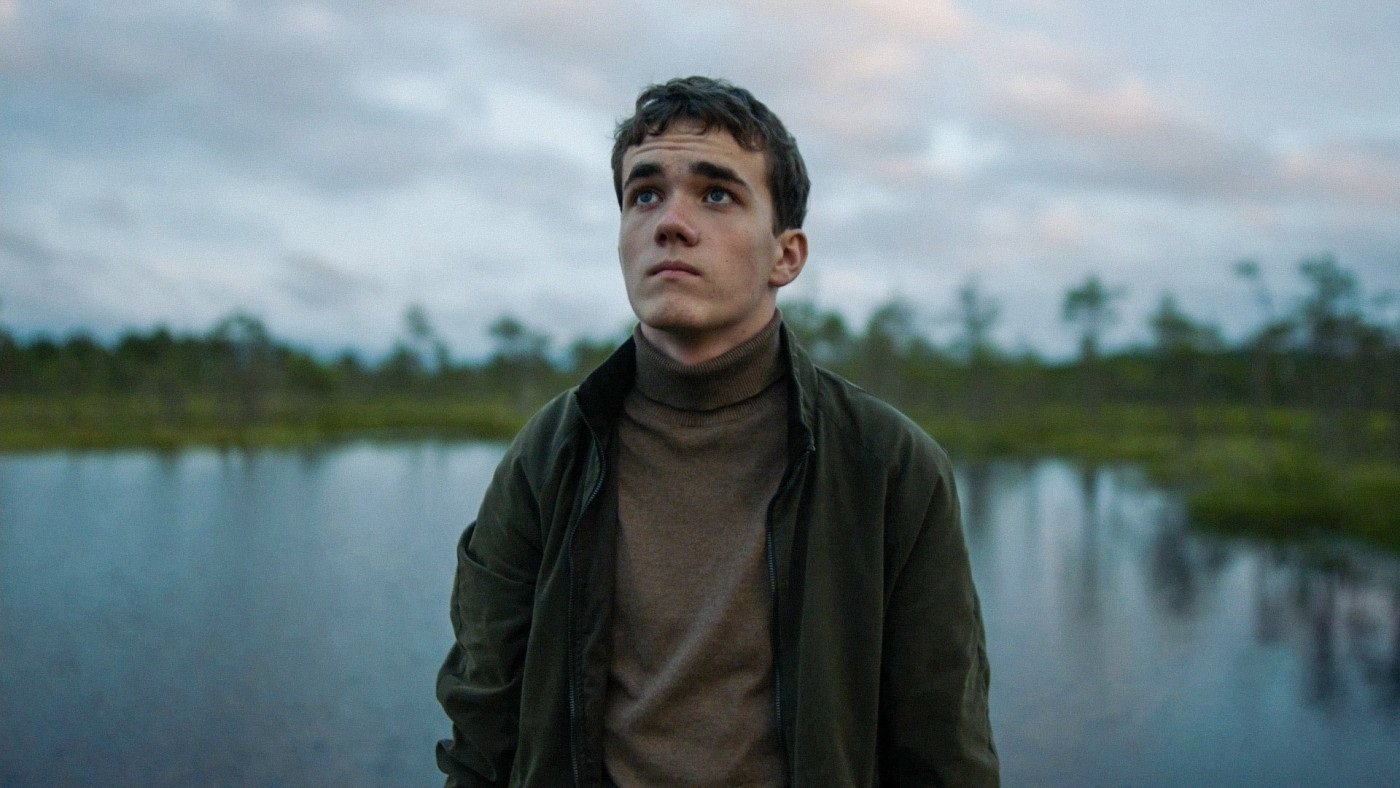
– Ivan Pavljutskov’s accomplished debut follows a teenager whose moral awakening unfolds between a hostile school environment, a fractured home and the spectral calm of the Estonian countryside
Tõru Kannimäe in Morten
World-premiering in Karlovy Vary‘s Special Screenings, Ivan Pavljutskov‘s Morten centres on a 15-year-old boy of the same name (played by Tõru Kannimäe), who lives in the countryside with his distracted mother and volatile uncle. He travels into town for school, retreating whenever possible into analogue photography. Introverted, observant and emotionally stranded, he is, at first, an alienating protagonist, yet Kannimäe’s guarded performance gradually makes his silences compelling. Rather than demanding immediate sympathy, the film allows the boy’s uncertainty, pride and occasional cowardice to emerge alongside his sensitivity.
At school, Morten drifts between classmates who offer friendship and others who exploit his desire to belong. When he becomes trapped in a chain of blackmail, vandalism and increasingly serious betrayals, the film enters more familiar coming-of-age territory. Yet screenwriter Reeli Reinaus avoids reducing the conflict to a simple opposition between victim and bullies. Morten is pressured, but he also makes choices; his passage towards adulthood depends less on defeating his tormentors than on recognising his own complicity.
This moral ambiguity is mirrored by the film’s visual and spiritual dimension. Cinematographer Ants Tammik renders much of Morten’s world in cold, gloomy tones, transforming homes, classrooms and railway journeys into emotionally constricted spaces. The palette becomes warmer and more porous around groups of young people and, above all, during Morten’s encounters with Emili (Emili Rohumaa), the enigmatic girl he meets in the woods and marshlands. Their conversations introduce a philosophical register, without entirely abandoning adolescent awkwardness.
Emili’s status remains deliberately uncertain. She may be Morten’s girlfriend, as he claims, but she often feels more like an imagined companion, or mental projection – a figure embodying the intimacy, freedom and certainty absent from his everyday life. Pavljutskov never resolves that ambiguity, and the decision gives the film its most haunting quality. Nature becomes neither a picturesque refuge nor a simplistic symbol of purity, but a liminal space where Morten can temporarily invent another version of himself.
The same restraint shapes the depiction of his dysfunctional family. His absent father, neglectful mother and aggressive uncle could easily have become stock explanations for adolescent damage. Instead, the film treats them as unstable presences whose failures affect Morten without fully defining him. The result is raw but not miserabilist, and philosophical without becoming excessively pretentious.
Morten occasionally loses some of its initial mystery when the school plot takes precedence, while its deliberate opacity may keep viewers at a distance. Nevertheless, its tonal control, sombre beauty and unusually complex young protagonist set it apart from more conventional youth dramas. This is a coming-of-age film in which maturity is presented not as sudden clarity, but as the painful acceptance of responsibility.
Morten was produced by Estonia’s Kopli Kinokompanii and Lithuania’s Fralita Films.
