
– Michele Fiascaris turns nocturnal London into a seductive surveillance maze in a stylish neo-noir about voyeurism, obsession and the treachery of images
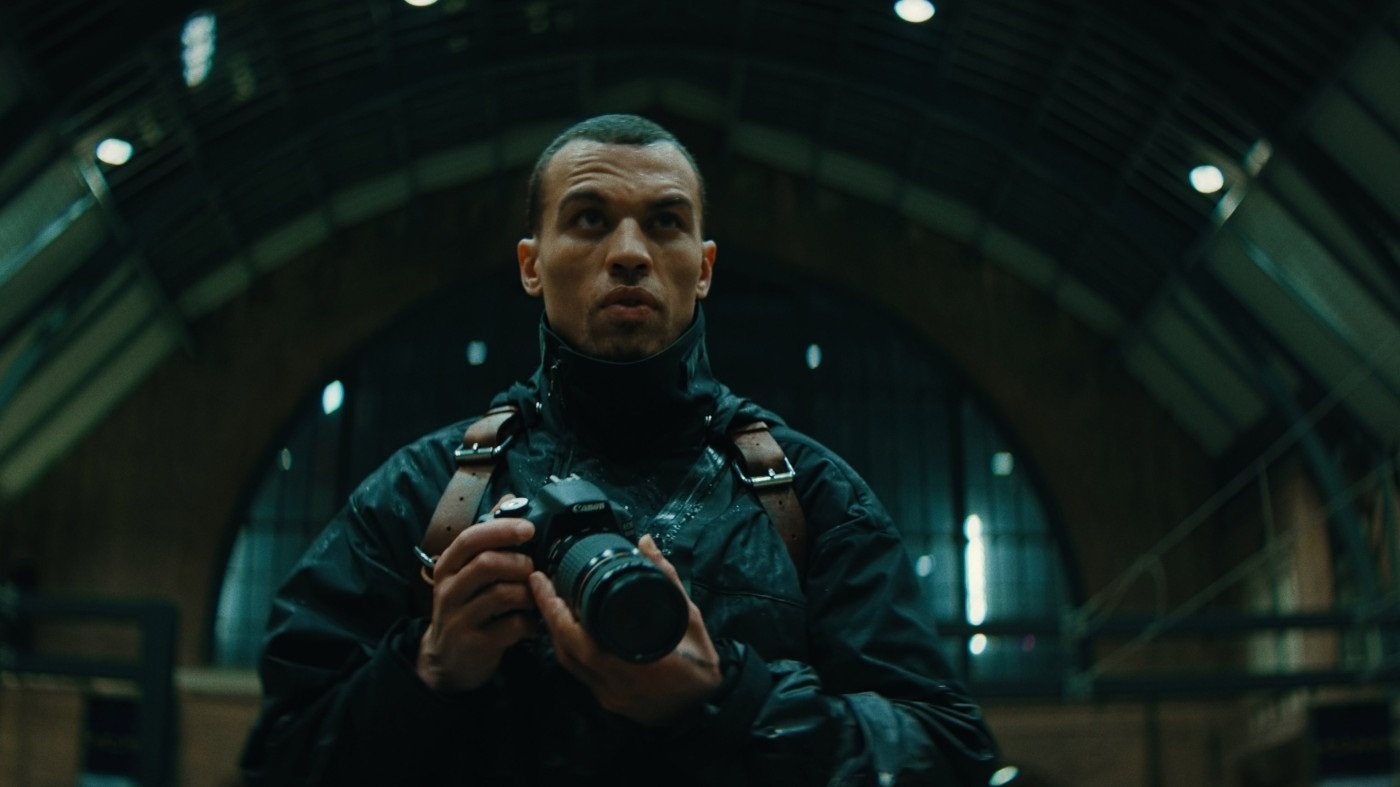
Dudley O’Shaughnessy in Rain Catcher
London has rarely looked quite as seductive, or as threatening as it does in Rain Catcher, Michele Fiascaris’s visually assured feature debut. Unfolding almost entirely after dark, this twisty neo-noir transforms the Barbican’s concrete towers, elevated walkways and illuminated windows into an urban labyrinth where observation quickly gives way to obsession. The film played in the Proxima competition of this year’s Karlovy Vary International Film Festival.
Here, Dudley O’Shaughnessy plays Miles, an underground photographer who prowls the capital’s streets and peers into strangers’ homes through a telephoto lens. Publishing the resulting images anonymously as “Rain Catcher”, he has acquired a vast online following without achieving anything resembling financial stability. His practice occupies a murky ethical territory: Miles may present himself as an artist documenting the city’s hidden life, but his success depends upon violating the privacy of people who have never agreed to become his subjects.
The balance of power shifts when Miles begins noticing the same mysterious woman – played with formidable economy by Kate Dickie – lurking inside his photographs. Soon, his identity is exposed, his work sabotaged and the people around him appear to be in danger. The voyeur has become the spectacle, forced to experience the vulnerability he has so casually imposed upon others.
Fiascaris and co-writer Filippo Polesel expand their 2018 short into a densely constructed psychological thriller, moving between criminal intrigue, urban horror and increasingly unstable subjective experience. Comparisons with Rear Window and Blow-Up are almost unavoidable, whilst the film’s collapsing distinction between dream, hallucination and reality gradually pushes it into more Lynchian territory. Nevertheless, Rain Catcher possesses enough personality to avoid feeling like a mere assemblage of references.
Much of that identity comes from Evgeny Sinelnikov’s cinematography. Neon reflections, rain-soaked surfaces and vertiginous views turn London into a city that seems simultaneously immense and claustrophobic. Woozy camera movements and Aeph’s alienating electronic score draw the audience into Miles’s deteriorating perception without immediately revealing which threats are real. O’Shaughnessy anchors these stylistic flourishes with a committed performance, making Miles morally compromised yet recognisably human rather than simply repellent.
The screenplay occasionally strains under the weight of its reversals. Miles’s developing relationship with his energetic neighbour Yumi, played by Jessie Mei Li, requires several convenient leaps, while some supporting characters function more as pieces in the mystery than fully realised individuals. The dialogue can also be blunt when articulating the feature’s ideas about exploitation, celebrity and the commercial value of controversy.
Yet Fiascaris largely maintains control of his serpentine narrative, revealing information at a pace that keeps the mystery engaging without reducing it to a mechanical puzzle. Beneath its polished genre surface, Rain Catcher offers a pointed examination of images as instruments of possession: who has the right to look, who profits from being seen and what happens when the camera turns back on its operator. Stylish, unsettling and confidently performed, it marks Fiascaris as a genre filmmaker with both considerable technical command and ambition.
Rain Catcher was produced by British firms Yellow Pill Films Ltd and Featuristic Films. Cercamon is handling international sales.
