
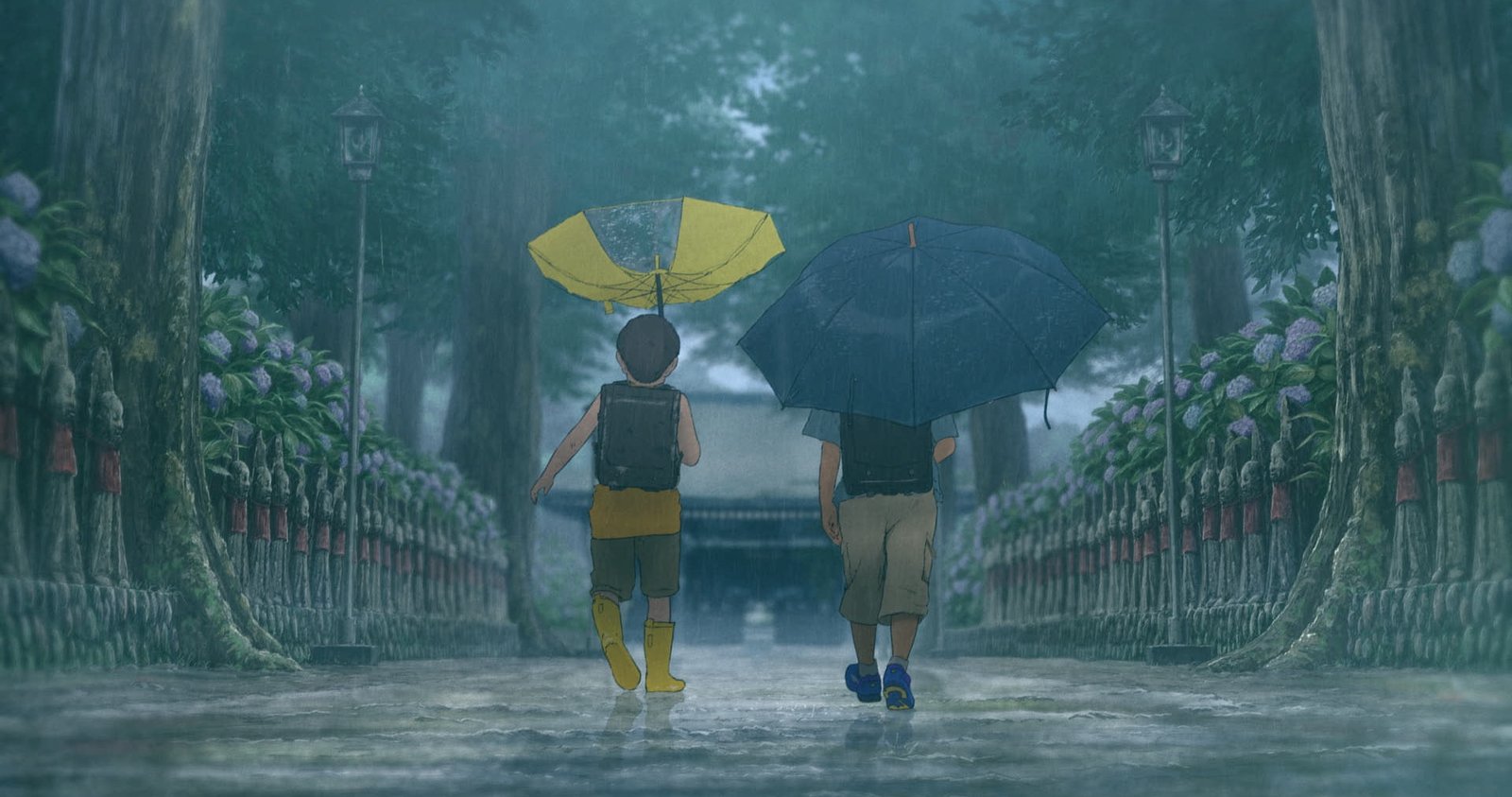
– CANNES 2026: Kohei Kadowaki makes his feature debut with an animated diptych of two boys, in which one event defines the trajectory of their adolescence
The ends of childhood friendships often weigh heavy on the heart. It is no different for the two protagonists of Kohei Kadowaki’s feature debut, We Are Aliens, whose tumultuous story we see spiral in animated form over the course of pre-teen, teenage and young-adult years in small-town Japan. The young director writes, directs and edits this unusual portrait of two boys in crisis, which has just enjoyed its world premiere in the Directors’ Fortnight at the Cannes Film Festival.
In third grade, Tsubasa (voiced by Amane Okayama) makes friends with Gyotaro (voiced by Ryota Bando), an eccentric boy with erratic behaviour and a distinctive mole next to his left eye. After Gyotaro takes the blame for an incident committed by Tsubasa, their friendship is shattered forever. While the former is permanently ostracised by their peers, the latter falls in with delinquents but recovers, eventually marrying their childhood friend Konatsu. Yet Gyotaro, outfitted in a perpetual yellow T-shirt, continues to haunt him.
Kadowaki uses 2D computer animation to emulate a hand-drawn style, with the characters’ outlines occasionally trembling around the edges. In this way, he creates a blend between the well-known style popularised by Studio Ghibli and more cartoonish, anime-esque character expressions. Faces, on occasion, contort and expand in rage or shock, bringing a sense of dynamism to a film where wide-eyed expressions become a dominant way to depict the boys’ feeling of disillusionment. As their innocence increasingly frays around the edges, this also becomes heavily reflected in the animation style, as the lines become less clean and their faces are filled with rough shading. Character expressiveness merges with full-bodied sound design to edge into the semi-surreal, which increases as the movie goes on, adding a pinch of genre quality.
These more adventurous touches to the style are where the film starts to distinguish itself, just as the cinematographic aspect bends and stretches in parallel. Kadowaki frames characters from distorted angles – quite frequently, as if staring up at them from under the ground or from beneath a surface – and emulates wide-angle lensing. He also swaps out bright colours for a pastel palette, whose gravity is felt in greater proportion as the film goes on and as the story moves from charming childhood friendship to one with severe consequences.
Kadowaki immediately equips the nearly two-hour We Are Aliens with several distinctive traits. First, he makes a bold choice to have the title card hit at nearly halfway through the film, thus creating a diptych that encompasses, first, Tsubasa’s perspective, then Gyotaro’s. He also initially de-centres the romantic components of the story – a welcome choice – which later becomes more convoluted as Konatsu is reincorporated into the narrative.
The filmmaker ends with an unnecessary and somewhat conventional didactic push, making an extremely clear appeal to have empathy for outsiders through a late-movie montage that undermines the intricacy of the character dynamics established earlier. Regardless of its shortcomings, We Are Aliens remains a very intriguing start for its young director, who combines a darker-than-anticipated story with an inventive use of a combination of recognisable styles.
We Are Aliens is a production by Japan’s NOTHING NEW and France’s Miyu Productions. Its world sales are overseen by Charades.
