
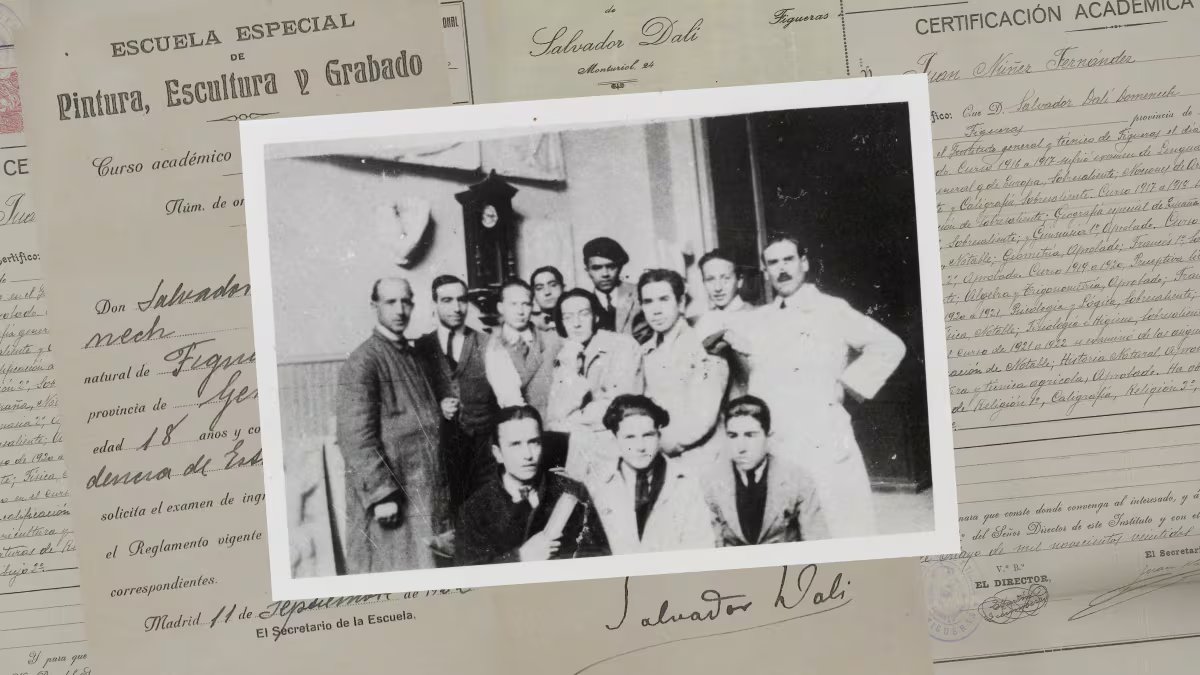
A century has passed since the day that forever changed the life of Salvador Dalí: his second dismissal, this one permanent, from the Special School of Drawing, Sculpture and Printmaking at Madrid’s prestigious San Fernando Fine Art Royal Academy. In such a rigid, rule‑bound environment, Dalí felt out of place — and perhaps for that reason, this academic period has been overshadowed in scholarly writing. What dominates the narrative of those years in Madrid — which he described as the happiest of his life— are his escapades and artistic exchanges with Federico García Lorca, Maruja Mallo, and Luis Buñuel, his companions at the Residencia de Estudiantes, a pioneering cultural and academic residence, and a circle of mutual inspiration.
But thanks to the archives of the Complutense University of Madrid (UCM) — in 1970, the Royal Academy was converted into its School of Fine Arts — EL PAÍS can now reconstruct Dalí’s student years through grade certificates, letters from his father, and an almost‑unknown disciplinary file. These documents have circulated very little. There are records of occasional consultations by students or researchers —including the Hispanist Ian Gibson — a request from the Museo Reina Sofía art museum for an exhibition, and even an inquiry from a group of Korean filmmakers working on a movie about the artistic genius.
Dalí’s file (AGUCM 136/06-17, 40) and grade records (AGUCM 107/09-08) are preserved in the UCM’s historic archives, while the enrollment books, one of his father’s letters, and the expulsion ruling can be consulted in the Historical Archive of the Faculty of Fine Arts Library. Both archives operate with minimal staff, which means no one can devote full time to digitizing or promoting this extraordinarily valuable material. The inquiry made by this newspaper about Dalí prompted the digitization of the documents, which will now be displayed on the archive’s website.
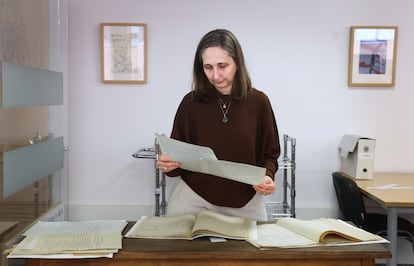
“We provide a cross-functional service. We have an administrative role, but also a historic one. Not as many people come here to request materials as at a museum,” says Ana Rocasolano, director of the UCM’s general archive, which is located in the law department. “This university has an enormous, overwhelming heritage because of the importance it has always had; but its primary mission is not heritage — it’s education.”
Dalí moved to the Residente de Estudiantes in September 1922. Once there, he applied to the art school. Preserved today are the letter in which he requests to take the entrance exam, a chiaroscuro drawing of a sculpture, and the receipt for the application fees. Until about 30 years ago, the Faculty of Fine Arts kept an identical entrance exercise. Since 2008, there has been no specific exam, but the university entrance cutoff score is very high: 9.9 out of 14 this academic year.
Recognizing Salvador Dalí’s artistic talents, his father agreed to his enrollment as painter at the Special School of Painting, Sculpture and Printmaking in Madrid, 435 miles from their home in Figueres, Girona. On September 11, 1922, the painter’s fees for the entry exam were paid, and he was already living at the Residente de Estudiantes.
Dalí sent an undated application letter to the director “begging” to be able to take the exam, in an exquisite handwriting that had been highly praised by his previous teachers.
He attached his birth certificate and his secondary‑school grades in order to be exempted from all entrance requirements besides the chiaroscuro sculpture drawing exercise, as these demonstrated that he had “sufficient” academic training. He was 18, and his mother had died the previous year.
Dalí also included a notarized document signed by his father, Salvador Dalí i Cusí, who was their town’s notary and with whom he maintained a tumultuous relationship. The elder Dalí would eventually disinherit his son.
The archive also features what was known as a personal academic transcript. This document included Dalí’s grades — which varied greatly — from the General and Technical Institute of Figueres for six courses, from 1916 to 1922. Dalí was a mediocre science student, but stood out in drawing, religion, calligraphy and history of literature. As early as his teen years, he wrote in his diary that one day, he’d be an art star, and he was.
At the time, Dalí was 18. His mother, Felipa Domènech, had died the previous year. That was why he had traveled to Madrid accompanied by his father, Figueres notary Salvador Dalí i Cusí — who plays a prominent role in this story — and his sister Anna Maria. Recognizing his artistic talents and hoping for his son to have a rewarding career, his father encouraged him to enroll in the school so that he could become an art teacher in the future. Dalí passed the entrance exam and enrolled in five first-year courses.
In 1920, two years before Dalí arrived at the school, female students had signed a protest letter which led to the recognition of their right to enroll in all courses. Up until that point, they had been barred from taking life drawing classes over concerns about nude models, and from painting outdoors because they were not allowed to leave their homes without being accompanied by a family member. Mallo was enrolled in the school at this time.
Dalí spent his first months in Madrid coming and going from the San Fernando Academy at Calle Alcalá 13, where the museum, no longer a school, remains to this day. At the time, he had next to no social life. His peers at the Residencia would later remember how the extremely reserved, nearly mute young man would shut himself up in his room, searching for his own painting style. He shifted between cubism, futurism and metaphysics, and in addition to self-portraits, created several still lifes, like the ones he presented at his debut solo show in the first exhibition of the Iberian Artists’ Society in 1925.
There is no document that attests to Dalí having passed the entry exam, but he seems to have, because he was enrolled at the school. On September 30, 1922, he signed up for five courses: perspective, modeling, ancient and medieval art history, and statue drawing.
For the 1923-1924 school year, Dalí signed up for nine subjects, indicating that he passed his classes the first year. His second-year courses were color theory, life drawing, printmaking and history of modern and contemporary art. He likely did not pay a fee for this last course, having earned honors in ancient and medieval art history. That is why the previous grade is noted on his transcript. Each course cost between 10 and 25 pesetas (roughly $4 to $11 in today’s money). He continued living at the Residencia de Estudiantes.
After being suspended in 1923, which was triggered, according to Dalí, by a student revolt demanding that painter Daniel Vázquez Díaz be appointed as their teacher, he enrolled in the 1924-1925 academic year in the same courses he had taken the previous year. He started his second year of studies from zero. During the months he was away from the school of drawing, he studied with Francisco Bores, Moreno Villa and Benjamín Palencia at the Academia Libre, an independent art academy directed by Julio Moisés.
In an undated letter, Dalí’s father requests a certificate of studies from the school so that his son could defer military service.
Finally, on September 11, 1925, Dalí’s father wrote on his notary letterhead to the school, informing them that his son would be studying in Figueres that academic year and would sit for exams in Madrid as an independent candidate. “Because he must undergo military training, he will not be able to enroll as a regular student this academic year.” Since he has already “dared to bother” them, he asks Manuel Menéndez about his son’s “aptitude” for art. “What I wish is for him to devote himself to the teaching of drawing and painting in order to earn a professorship […]”
Dalí was becoming heavily influenced by what he was reading in books, catalogues and magazines, and his carefully crafted appearance ensured he never went unnoticed. Extremely thin, he wore his hair long with sideburns, oversized shoes, a trench coat, stockings, and gaiters — all in the style of Victorian painters. Later he would cut his hair and, after discovering Diego Velázquez, El Greco, and Hieronymus Bosch at the Prado Museum in Madrid, he began growing his signature mustache.
After a few months, he began socializing with his peers, and school faded into the background. “At the Residencia, Dalí and Maruja Mallo discovered many things, and many of the people they spoke with led them to rethink their situation,” says Estrella de Diego, who has been a member of the Academy for the last decade.
In his first year, Dalí enrolled in five courses and passed all of them except for modeling in the February exam session. Five of his classmates also failed, which was unusual.
This forced him to retake the exam for the modeling course in June 1923, but his professor did not sign off on its documentation until September.
In his first year, Dalí earned top honors in the course on ancient and medieval art history. During his secondary‑school studies in Figueres, he had already demonstrated an exceptional command of art‑historical knowledge.
Presumably, the honors he earned in the first-year art history course allowed Dalí to avoid paying tuition for the second-year modern and contemporary art history course (1925-1925). He once again received the highest grade.
In a letter to the school director dated September 11, 1925, the elder Dalí looks for confirmation that his son won “the second-year art history prize and that said prize consists of 700 pesetas, to be collected from the school,” seeking instruction on how to do so.
There are no grade records for the 1923–1924 academic year because Dalí had been suspended. When he re‑enrolled the following year, he had to register again for all four subjects. He earned a “diploma of merit” (equivalent to an outstanding grade) in preparatory studies of color.
“At this time, even the most traditional painters complained that the school was overly academic. The Residencia offered them a sense of camaraderie that the Academy, which must have been dull, did not,” says de Diego, a contemporary art professor at the UCM. “However, the school gave them some very important tools for drawing. They taught the basics to [Pablo] Picasso, Maruja and Dalí.”
Raquel Monje, dean of Fine Arts, agrees. “The school was a very conservative space,” she says. “It took many years for that to change! Our greatest strength is that academia now coexists with what’s happening in the outside world.”
Dalí easily passed his first year (1922-1923), except for his printmaking course, which he was forced to retake. He even earned top honors in ancient and medieval art history. What the records do not mention is his failed assassination attempt on Alfonso XIII on March 3, 1923 — the day the king inaugurated the school’s library. Gibson asserts in two books that a tragedy could have occurred. According to his account, Dalí — who had been anti-monarchist up to that point — planned with his friend Josep Rigol to make a “bomb to protest, not to kill” the king, as Rigol recounted, by filling an empty milk container with gunpowder. They placed the explosive in a vase on a staircase banister, but fortunately, the fuse did not ignite. Estrella de Diego says this account is questionable: “There is no evidence.”
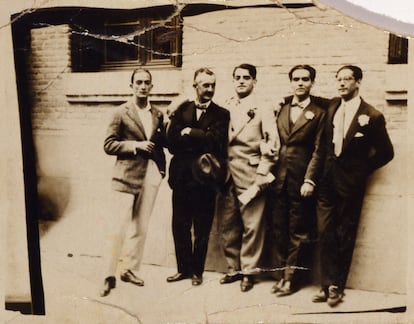
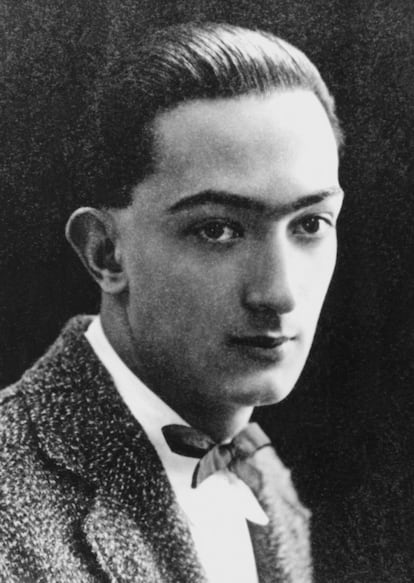
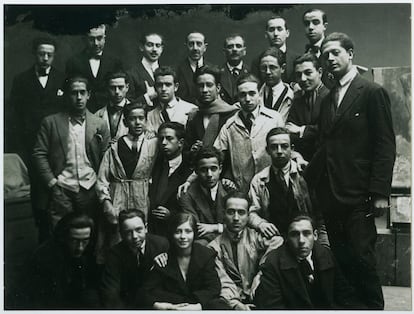
The Prado Museum in Madrid has a photograph of Dalí and Maruja Mallo’s class visiting the art gallery alongside the king. If the bomb did indeed exist, no one found out about it at the time, and in March 1923, Dalí was neither sent to jail nor home. But by September, his academic progress had stalled out. He was suspended for one year for leading a student revolt against the school’s decision — a very conservative one — to reject painter Daniel Vázquez Díaz for a professorship on the grounds that he was too avant‑garde.
A furious letter to the director from Dalí’s father is preserved in the archives. “Dear Sir, and with the utmost respect. After speaking with the students, teachers and staff at the school, I have confirmed my entirely favorable opinion of my son,” he begins. “Unable to abide by the Disciplinary Council’s decision, I have no choice but to accept his punishment with resignation.” He then predicts: “His conduct in school and his academic performance will be so impeccable that they will come to regret having punished him so severely.”
There are no administrative documents in Dalí’s file that confirm his first expulsion from the school in 1923, but it is referenced in the 1926 paperwork, which coincides with his permanent dismissal. What is preserved is a letter from his father. It is dated November 23, 1923, which means his son must have been expelled at the beginning of the academic year for leading a protest after painter Daniel Vázquez Díaz was rejected for a teaching post.
The father’s tone is furious: “His conduct in school and his academic performance will be so impeccable that they will come to regret having punished him so severely.”
The three professors who were to examine Dalí on fine arts theory on June 14, 1926, drafted a report that led to his expulsion. According to their account, at 12:30 p.m., when asked to draw three balls containing exam questions, Dalí replied verbatim: “No. Since all the professors at the San Fernando School are incompetent to judge me, I am withdrawing.”
Nine days after the incident, which led to Dalí’s expulsion, a meeting of professors was convened. Its minutes note that Rafael Domènach i Gallissà did not serve on the examination committee, even though he taught fine arts theory, so as not to be accused of bias. He chose to recuse himself following a heated confrontation with Dalí who, according to the disciplinary council, had been proclaiming around Barcelona that he had earned a passing grade in modern and contemporary art history and received an award, even though Domènach i Gallissà had initially failed him.
According to the Spanish artist, a new tribunal had been formed due to the “injustice committed.” According to the council, Domènach i Gallissà had not examined Dalí — and therefore had not failed— because the artist had been in Paris organizing an exhibition. The documents highlight the professor’s “chivalry.”
The disciplinary council notes that Dalí had been informed of his permanent expulsion, and notice of the “correction” had been hung on an announcement board to “serve as an example” to other students.
On October 22, 1926, the general directorate of fine arts upheld the penalty imposed on Dalí by the school, which in its view had acted with the utmost propriety. The decision pertaining to school regulations regarding his conduct during the exam, as it could have caused “a disturbance to academic order and discipline.”
Dalí carried out his year-long suspension in 1923-1924, but he did not stop studying entirely, and continued learning at the Academia Libre, an independent art academy, directed by Julio Moisés. In September, he once again enrolled at the Academy. His grades were better than they had been during his first year. He earned a “diploma of merit” (outstanding) in color theory and for the second time, honors in art history.
One course strained Dalí’s relationship with the school to the breaking point. According to the disciplinary council, the painter had been “proclaiming around the artistic center of Barcelona” that his professor Rafael Domènach i Gallisà had failed him and that given this “injustice,” a new panel had been convened that passed him and awarded him a prize of 700 pesetas (around $250 in today’s money).
But according to the council, Domènach i Gallisà had not examined Dalí (and therefore, failed him) because the former had been in Paris organizing the 1925 International Exhibition of Modern Decorative and Industrial Arts. The rumor came to the attention of the teacher, and he was supported by the school. But Dalí’s insolence did not end there. He studied the 1925–1926 year independently while completing his military service in Girona, and he registered in April to sit the exams.
There are two versions — one, predictably embellished — of what happened on June 14, 1926. As Dalí later recounted in his writings, after dodging the question of his fine arts theory exam, he replied to the examining board: “I know more about Raphael than all three of you put together. I refuse to answer.” And, as his friend Antonio Pitxot claimed in his book Sobre Dalí (On Dalí), examiners replied: “Well, then, come back another year, because this one is already a fail and moreover, you’re expelled.” Pitxot wrote that Dalí always ended this anecdote with: “Imagine — asking me about Rafael…” A characteristic bit of bravado.
But the minutes of the examination board and disciplinary council, as well as the ruling by the general directorate of fine arts, describe a highly tense confrontation that culminated in a permanent expulsion, not a temporary suspension. Dalí’s first offense was failing to show up for the first exam session — students only had two chances at the time — and he was informed of the next date via telephone. Domènach i Gallisà, despite being the subject’s professor, chose not to examine him so as not to be accused of bias following their previous confrontation. Three other professors made up the examination board. According to their minutes, Dalí stated, “No. Since all the professors at the San Fernando School are incompetent to judge me, I am withdrawing.”
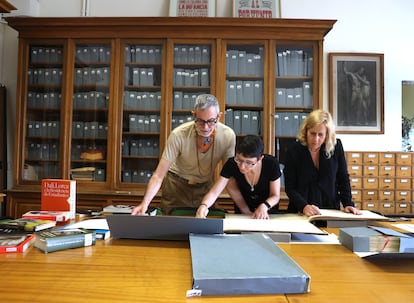
The Faculty of Fine Arts safeguards “hundreds of thousands of documents” that librarians Javier Pérez Iglesias and Laura Bomati would like to digitize, given the volume of inquiries — especially about little‑known local artists and, increasingly, women artists. If they could, they would start with the registry books.
“What we accomplish in this department is thanks to people who are passionate about it,” says the dean. “For example, a professor and a group of students might get involved in a small project. But as always, we’d need funding to do more.”
Credits
Design: Ruth Benito
Development: Fernando Anido
Graphic design: Inés Arcones
Coordination: Brenda Valverde Rubio
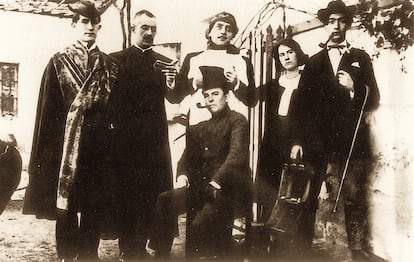
Featured image: Salvador Dalí and his classmates at the Special School of Painting, Sculpture, and Engraving (Academy of San Fernando). 1922–1923. GALA-SALVADOR DALÍ FOUNDATION
Sign up for our weekly newsletter to get more English-language news coverage from EL PAÍS USA Edition
