
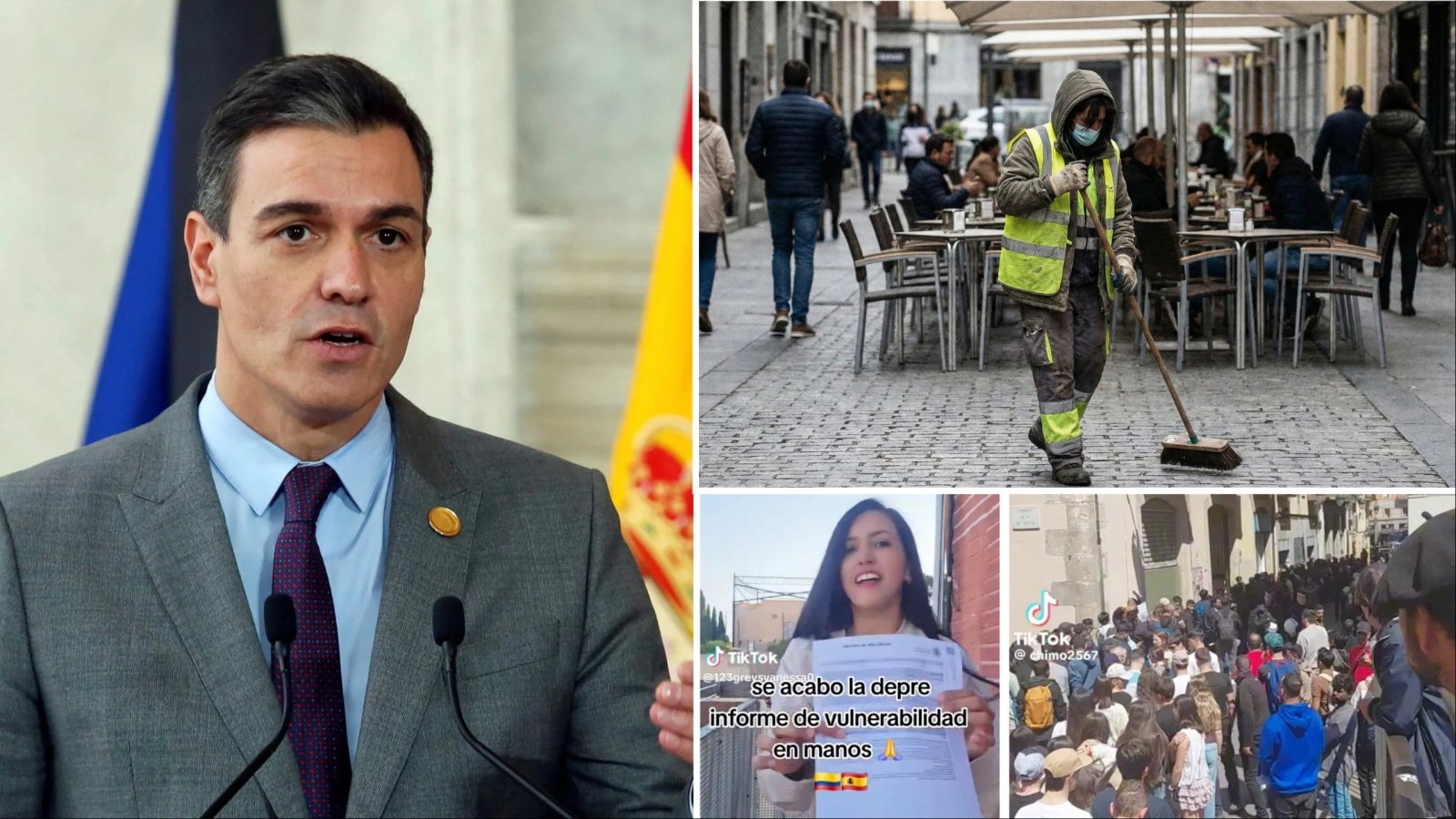
SPAIN’S Prime Minister Pedro Sanchez had a foot-in-mouth moment during a speech to mark the final day of the country’s historic migrant amnesty scheme.
Sanchez raised eyebrows when he hailed the country’s safest region, Extremadura, as also its least-foreign while launching a €505 million plan to integrate previously undocumented migrants.
Sanchez made the remark while unveiling the new Integration and Citizenship Plan at the College of Architects in Madrid, on the same day he talked up the success of Spain’s extraordinary migrant regularisation scheme.
He told the audience that Extremadura, the rural southwestern region bordering Portugal, had ‘barely four percent’ foreign residents — the lowest share in Spain — and was ‘also the safest region in our country.’
“And the one with the cheapest housing, both for purchase and for rent,” he said.
His argument was that immigration posed no threat to Spaniards’ safety or living standards, the message behind the plan’s campaign slogan, ‘Where do they come from? They come to build the country.’
But the many critics of the scheme were quick to point that his example proved their point, not his.
Right-leaning daily Vozpopuli seized on the contradiction. The government, it said, was pushing to regularise hundreds of thousands of migrants on economic grounds while holding up a region that has almost none.
The figures behind the claim are real. Just 4.42% of Extremadura’s residents held foreign nationality at the start of 2025 — 46,556 people — against a national average of 14.1%, according to INE population data.
That is less than a third of the countrywide rate.
The region is also Spain’s safest, recording just 34.6 crimes per 1,000 inhabitants in 2025, well below the national rate of 50.4. Even so, offences there rose 4.9% on the year.
The plan itself commits more than €505 million over the coming year.
It runs on four strands: regularisation and ‘orderly’ migration, with more than 100,000 vocational training places; employment; coexistence, including some €30 million for co-official language classes and anti-discrimination work; and ‘effective citizenship’, with over €260 million to shore up public services.
Sanchez also announced a new State Agency for Human Mobility.
The launch coincided with the close of the regularisation scheme, whose window ran from April 1 to June 30.
Backed by a popular legislative initiative carrying more than 700,000 signatures, the one-off process grants a year’s residence and the right to work to migrants who were in Spain before January 1.
Yet Extremadura’s thin foreign population is less a triumph than a warning. It is Spain’s fastest-emptying region, and demographers say incomers are now its only engine of growth.
The corner of Spain Sanchez chose to prove immigration is no threat is the one the country can least afford to leave empty.
Click here to read more Politics News from The Olive Press.
