
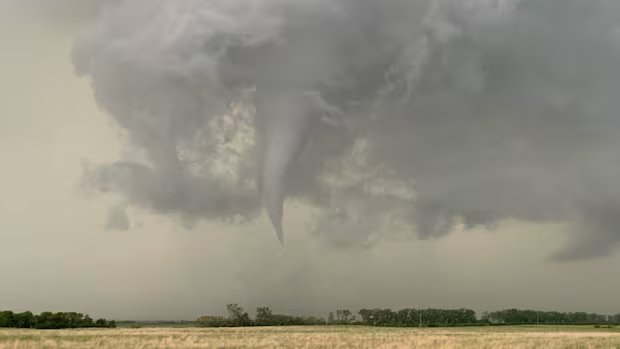
The tornado that touched down in an area of southeastern Saskatchewan on Tuesday had an intensity rarely documented in the province.
Environment and Climate Change Canada said the tornado in the Northgate/Oxbow/Alameda area caused major damage to a home on a farmstead and has been given a preliminary rating of EF3, which is considered a “strong” tornado.
Such tornadoes have wind speeds between 225 and 265 km/h.
“When you get those kinds of winds, you’re talking about not just the roof coming off a house, but walls going down and some large stands of forest being completely destroyed,” said David Sills, the director of the Northern Tornadoes Project at Western University.
The tornado is believed to have been on the ground for 20 to 26 minutes, according to estimates from an Environment Canada meteorologist and a storm chaser.
“It’s going to be a pretty lengthy investigation because [there was] a lot of damage to that particular area,” Sills said.
“Also, we know from chaser accounts that this storm appears to have been generating a tornado for about at least 40 kilometres, maybe more. And it might have actually crossed the U.S. border and then gone that far.”
An EF3 is in the third-highest category of tornadoes on the Enhanced Fujita scale, which was adopted in Canada in 2013. It is a modification of the original Fujita scale the country had been using to rate tornado strength and intensity by wind speed and damage.
Despite its reputation as being part of “tornado alley,” Saskatchewan rarely gets tornadoes this strong.
Sills said there had been only five F3 or EF3 tornadoes in Saskatchewan since 1980, but the province is a “big, wide-open place.”
“I’m imagining we probably get some tornadoes that may be stronger that just don’t hit anything,” he said. “And we never really know what the rating is because you need the damage to get the rating.”
Last such tornado was in 2010
The last F3 or EF3 tornado in Saskatchewan caused an estimated $13.2 million in damage in Kawacatoose First Nation on July 2, 2010. Five homes were completely destroyed, 15 others were significantly damaged, and there was damage to the water treatment plant, cellphone tower and power poles.
There was only one minor injury. A house, garage and barn in the Semans, Sask., area were also significantly damaged by the tornado.
Back then, the tornado was rated an F3 on the old Fujita scale, meaning its wind speeds were between 250 and 320 km/h.
Environment Canada says over 90 per cent of tornadoes in Canada are rated as “weak,” EF0 or EF1, with wind speeds between 90 and 175 km/h.
The strongest tornadoes, EF4s and EF5s, are rarely recorded in Canada. But while there’s an increased risk of injury or death, Sills said it’s possible for people in completely destroyed homes to survive without getting hurt.
“If you get in the right spot in the house, away from doors and windows or in a basement, that kind of thing, you can actually make it out without a scratch,” Sills said. “But if you’re somehow exposed or vulnerable to debris, then things change.”
Exact conditions needed for twister
Sills said southern Saskatchewan, especially the extreme south, is the region of the province that gets the most tornadoes and has the highest risk of getting the really powerful ones.
Terri Lang, a meteorologist with Environment Canada, said it’s the area that can get all of the elements that need to come together for tornadoes.
“But given how we’ve seen things have been changing over the last few years, we’re seeing more and more stronger cells go through central and northern Saskatchewan,” she said.
Lang said the main components that lead to a tornado include heat and moisture.
“And we’re coming into the season when we’re getting lots of moisture,” she said. “When the crops are growing, they give off a tremendous amount of moisture, and a lot of people call it ‘corn sweat.'”
Lang said there also needs to be a “trigger,” such as a cold front, a warm front or a low pressure system, but the main component is what’s happening in the upper atmosphere.
“The winds themselves have to kind of veer or turn, and that allows the storm to grow instead of collapse upon itself,” she said. “It’s allowed to grow, and it can continue along.”
Lang said the conditions have to be exact to produce a tornado. Some storm chasers from the United States came away from this week disappointed because the atmosphere didn’t produce and all of the elements didn’t come together just perfectly, she said.
Lang said Saskatchewan only gets big heat from May to September, but there’s a big drop-off in tornado activity by early to mid-August, when the crops mature and a big source of moisture is lost.
