
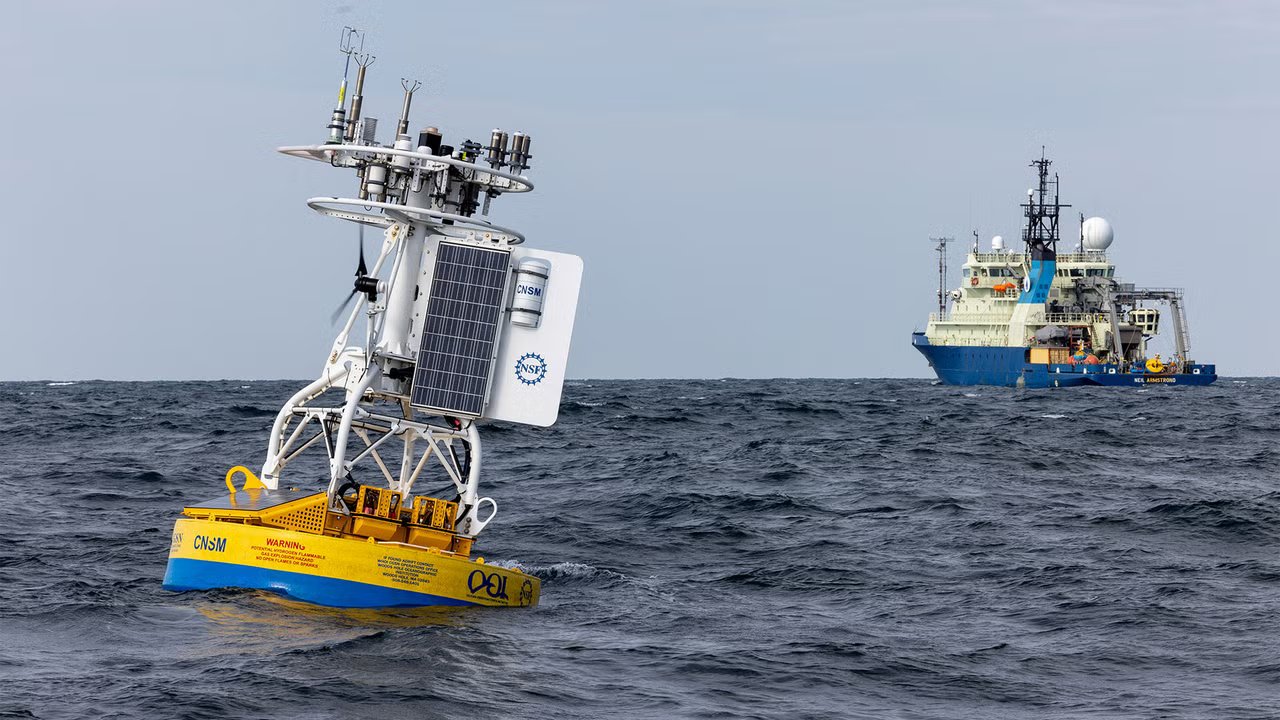
The Ocean Observatories Initiative (OOI), a network that provides access to real-time ocean data that is relied on by scientists, researchers, and students, is being restructured with major cuts eliminating most of the project’s ocean monitoring efforts.
According to a recent statement from Jim Edson, Principal Investigator, NSF Ocean Observatories Initiative, the Trump administration’s recent slashing of the National Science Foundation (NSF) funds will nearly wipe out most of OOI’s areas of focus. Edson gave a timeline for bringing the network’s initiatives to a close through what he called the NSF’s “descoping plan.” The OOI leader said that in-water infrastructure from three projects will be removed over the next approximately 15 months, with four out of five arrays ending by Summer 2027. That said, he says the “previously collected OOI data will remain accessible through the OOI Data Center.”
What does the Ocean Observatories Initiative do?
OOI, which was first created in the early 2000s, provides 24/7 ocean-monitoring. The Ocean Observatories Initiative, a $368 million project, uses 900 advanced instruments to constantly monitor the ocean with state-of-the art systems. Through the network, scientists have been able to study marine biodiversity, climate change, and current environmental events. The project has enabled researchers to access data from even the deepest and most hard-to-reach parts of the ocean via a worldwide pen-access format.
“Powered by state-of-the-art cyberinfrastructure, data is freely available to scientists, educators, and the public through the OOI Data Portal,” OOI says. Therefore, in addition to the world’s top researchers, anyone with an internet connection, including students, teachers, or those working on their own independent projects, have been able to access cutting-edge, real-time information about the world’s oceans. While the network won’t cease to exist, under Trump, it’s about to become a sliver of what it once was.
Why is the initiative losing funding?
OOI is funded by the National Science Foundation (NSF), an independent federal agency focused on science and engineering research. The NSF itself has been responsible for major scientific breakthroughs, including MRI technology and vital research on climate change. However, it’s faced steep budget cuts under Trump.
Recently, the administration dismissed all of its 22 board members in an April 24 email from the White House. “On behalf of President Donald J. Trump, I’m writing to inform you that your position as a member of the National Science Board is terminated, effective immediately,” read the note.
The board was first established in 1950 and is made up of leading scientists and academics whose job it is to identify critical issues related to scientific discoveries and research and approving funding. The White House didn’t give board members any reason for their dismissal at the time, but in an email to NPR, the administration cited a 2021 Supreme Court case, U.S. v. Arthrex, which questioned whether “non-Senate confirmed appointees can exercise the authorities” that had been granted to the National Science Board by Congress.
It’s certainly not the first time the Trump administration has worked to eliminate funding for science research. In 2025, the Trump administration cut or froze around $3 billion in previously approved research grants from the National Institutes of Health (NIH) and NSF. While some of the funds were reinstated, around $1.4 billion were frozen at the start of this year. The Environmental Protection Agency (EPA) and the National Oceanic and Atmospheric Administration (NOAA) have faced major proposed reductions, as well, most of which have targeted climate-change research and green energy initiatives.
In a recent proposal, the administration laid out its plans to continue overhauling science research funding, sharing the view that major cuts are necessary to ensure taxpayers aren’t paying for a “‘woke’ policy agenda” that doesn’t “reflect the values of the vast majority of the American public.”
What are experts most concerned about losing?
In the wake of the overhaul, those who study the ocean are concerned about repercussions. For starters, the OOI is also a part of a global network called the Global Ocean Observing System (GOOS), and some experts say that if funding for ocean monitoring resources sink, it will disrupt efforts to combat climate change, as well as destabilize severe weather forecasting on a global scale.
Sabrina Speich, an expert on global ocean monitoring at the Ecole Normale Supérieure (ENS) in Paris, who recently co-authored recent research on the “critical dependence” of ocean heat monitoring, says the importance of OOI’s role can’t be overstated. “Ocean heat content is the most robust indicator of climate change we have – not just of what is happening in the ocean, but of the entire climate system,” Speich says, per The Guardian.
“Lose them, and you lose your ability to track not just ocean warming but the climate system as a whole – they are a proxy for variables that become unavailable the moment the observations stop. Forecasts would continue – but they would degrade, sometimes dangerously so. Atmospheric observations alone are not sufficient,” said Speich.
Alexander Chase, is a microbial ecologist at Southern Methodist University, a private research university in University Park, Texas. Chase tells Fast Company that OOI is vital for
providing researchers with long-term observational ocean data that is key in understanding how different areas of scientific study relate.
“Longterm observations like what this program provides allows a bridge across disciplines,” Chase explains, adding that heat monitoring, as Speich’s research focused on, relates to just about everything on the planet. “That heat and energy stimulate all of life on earth,” Chase says.
Therefore, losing the better part of the program doesn’t just limit ocean research, but it “limits our ability to predict how” ocean changes impact other ecosystems, too.
