
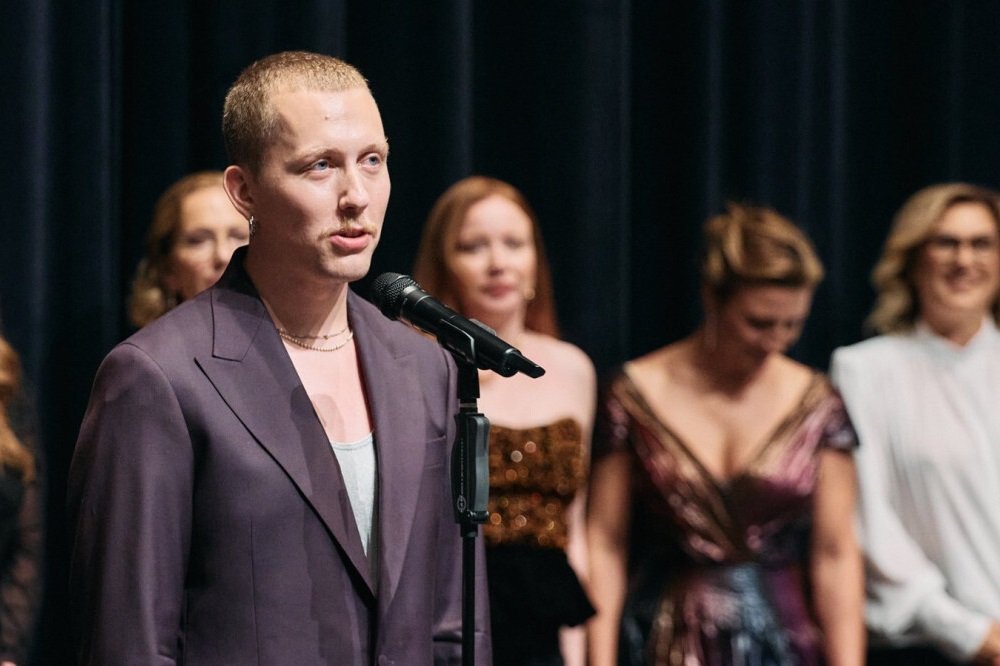
– The Czech director chatted with us about turning queer identity, drag culture and rural family comedy into mainstream cinema, shaped by “radical positivity” and “radical hope”
(© Film Servis Festival Karlovy Vary)
Czech director, producer, and composer Šimon Holý premiered his new feature film, the touching summer dramedy Chica Checa, in the Karlovy Vary International Film Festival’s Crystal Globe Competition. In conversation with Cineuropa, he discussed his shift towards a more mainstream audience, the phenomenon of pop icon Helena Vondráčková within queer culture, working with Pavla Tomicová, and his upcoming plans as a producer.
Cineuropa: Your previous work focused on the younger generation whereas your latest film shows a distinct shift towards mainstream. What prompted this change?
Šimon Holý: That shift didn’t happen overnight. Developing and financing it took a very long time, so the concept has been with me for years. I just wanted to try my hand at making a more mainstream film that speaks to the general public, using a very classic cinematic language.
In past interviews, you’ve stated that you don’t consider yourself a queer filmmaker, but queer themes are prominent here. Have you changed your mind?
The truth is, queer characters appeared in all three of my previous films, they’re just a bit more hidden. This time, they carry significant identity-political weight because the story demanded it. The characters had to address their identity so the audience could understand why things happen. In a mainstream format, you have to explain motivations a bit more clearly.
How did you come up with this particular combination of themes?
The core premise, that a mother has no idea her son does drag and impersonates Czech pop singer Helena Vondráčková, originally came to me in a dream. Around that time, I was watching my own mum dealing with repairing our crumbling house, which became a wonderful metaphor for the state of a person’s life. I also have a very warm relationship with my mother. I wanted to use this family warmth to introduce a serious queer theme without alienating people. Rather than militant, aggressive activism, I wanted activism that embraces you in a parental way, along the lines of: “Let’s stop fighting and just try to be kind within the family.”
To what extent is the film autobiographical?
The biographical elements are more about specific real-life details. For example, the relationship of the main character, Lukáš, whose boyfriend lives in a different country and is of a different ethnicity, mirrored my own personal situation at the time. My fiancé back then urged me to include some markers of our relationship in the storyline. As a foreigner, he saw how Czech society operates. He argued that the character should be a person of colour because it brings an entirely different dynamic. I thought it was a brilliant idea for the Czech audiovisual world, where minorities are rarely shown with any depth.
The lead female role is played by Pavla Tomicová. How did her casting come about?
Initially, I didn’t want to cast her to avoid repeating past collaborations, and I envisioned a different kind of character for the mother. But we failed to find anyone suitable, despite intensive auditions. Pavla was actively chasing the role, so we auditioned her. It took all of ten seconds. Her chemistry with actor Jan Cina, playing her son, was instant. Pavla understood that I didn’t want classic “Euro-arthouse” minimalism with blank expressions. She brought exactly what I’m familiar with from the countryside: women who express emotions through grand gestures and looks.
Why was Czech pop singer Helena Vondráčková so vital to the film?
In a Czech context, that symbolism is essential. Older drag queens from the 1990s say that if you can’t impersonate Helena Vondráčková, you shouldn’t be doing drag at all. She represents a milestone; we’ve been watching her for six decades. Her lyrics are often about fighting through losses and painful break-ups, which are precisely the themes we explore in our film. She’s our epitome of absolute camp and pop. For international audiences, it’s enough to know she’s a major pop star but, locally, it gives the film a deeper layer.
Choosing drag as a central motif creates a sharp contrast with the rural setting. Do you worry that this exoticizes the countryside?
I hadn’t looked at it that way. I just love drag. Traditional cross-dressing shows routinely sold out in community centres in small Czech towns throughout the nineties and noughties as mainstream entertainment for everyone. Today, right-wing politicians are weaponizing it as a populist bogeyman, which is utter nonsense. This made it feel all the more appropriate to place drag queens in a rural setting, to show that ordinary people are completely fine with it.
So the film is political after all?
Yes, with the rise of conservative governments across Europe, it’s become a highly political appeal for individual freedom. I call it “radical positivity” and “radical hope.” People don’t have the energy to watch endless misery anymore. Our film shows politics on a personal level and offers a happy ending, demonstrating that marginalised groups have every right to choose their own path.
What else are you currently working on?
I’m working with producer Marek Novák of Xova Film to prepare First Dates, which we’ll shoot next year. We’re also working on Mazel Tov, David! produced by Helium Film, and applying to the Czech Audiovisual Fund and to French co-producers for support. We’ve also secured Creative Europe MEDIA slate funding, via our production company První řada, for Pavel Nosek‘s debut film, Scars, and for my next feature, Miracle, a drama about domestic abuse and reproductive rights. In terms of television, we’re producing We Are Here, which is the first broadcaster-backed queer docuseries for Czech Television. We’re also collaborating with Austrian director Andreas Horvat and producing Czech-Ukrainian filmmaker Natalia Golovchenko’s new film.
