
Mamoru Oshii is unequivocally one of the most important and influential creators in all of anime. His work has transcended borders, even influencing some of the most prestigious Hollywood films, such as The Matrix, and earning the admiration of auteurs like Guillermo del Toro. He is a definitive icon, but back in 1985, his future was in turmoil. After releasing his most ambitious film, Angel’s Egg, he struggled to find work for three years. This bleak yet visually transcendent work redefined what visual storytelling can be, yet 40 years on, it still perplexes viewers.
Oshii has since reflected on the film’s troubled reception and felt that the film was underappreciated. At an in-conversation event at TIFF 2014, Oshii said the following about the film: “It’s kind of like my poor daughter, and I wished that she was more exposed to the world.” This idea of exposure is interesting. Despite being released as an OVA (Original Video Animation) in Japan, the film had limited availability on physical media until recently, following its 4K restoration. My first real exposure to the film was through a now seemingly deleted Chris Stuckmann video, where he breaks the film down. In that video, he even mentions that you should watch it if you can find it.
That hasn’t stopped audiences from experiencing this work. As of writing, the film has been watched by 218,000 members on Letterboxd, and that number will likely continue to grow now that it is being widely released in 4K, with Anime Limited handling UK distribution and GKIDS handling US distribution. With greater access comes the perfect opportunity to re-examine the film through a historical lens and explore the legacy of Angel’s Egg and how it continues to resonate with audiences even today.
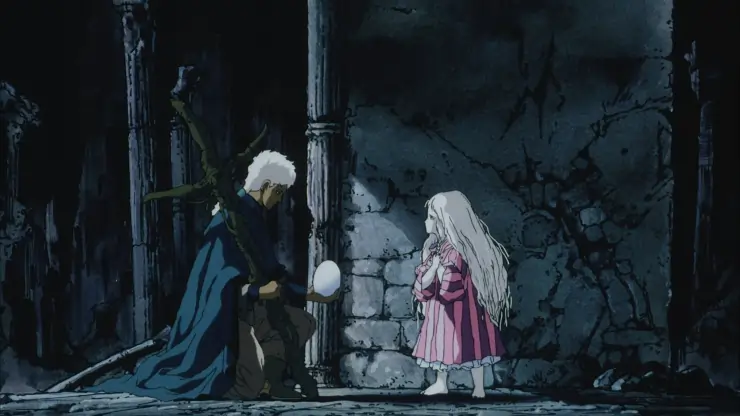
To describe the plot as simple is to misunderstand what the film is truly about. It abandons traditional narrative conventions in favour of a metaphorical, visual experience in which surreal imagery carries more narrative weight than any line of dialogue could. Put simply, the film follows a nameless girl carrying an egg through an underwater city. She encounters a man who is searching for a bird he saw in his dreams. It seems simple enough, but this description fails to capture the strangeness of the film—for within the first ten minutes, we see a mysterious orb descending from the sky, covered in stone statues.
The opening is pure atmosphere, a tone that carries throughout the film’s runtime. Angel’s Egg is an intense and immersive experience that, on first viewing, may leave you both perplexed and emotionally overwhelmed, far removed from how the film initially presents itself. Just under 80 minutes long, it makes perfect use of every second to tell its story, accompanied by a score that is nothing short of haunting, yet magical in its presentation.
Given that it tells its story visually, it would be jarring if the film’s animation were lacking, but that is not the case here. The film is nothing short of transcendent, a true visual oddity. Much of the film’s colour comes from its characters, as the environments, while not entirely monochromatic, embrace a dark, muted palette that remains strikingly vivid. The character designs themselves are breathtaking, particularly the girl’s hair, which flows delicately in the wind, an effect that must have been incredibly demanding to animate.
However, over the course of the film’s history, no one has denied that it looks gorgeous. What has remained a point of contention in critical discourse is what the film is about. Its surrealist storytelling is bold throughout, whether in sequences where fishermen chase shadows that resemble fish, discussions surrounding Noah’s Ark and the loss of hope, or a literal great flood that engulfs the world the characters inhabit.
What Oshii’s exact intentions were regarding the film remain unclear. What is clear, however, is that many of the film’s concepts stemmed from a Lupin the Third project that Oshii had been developing but which never came to fruition. In a translated interview from the Angel’s Egg guidebook, included with an issue of Animage, he discusses the differences between Lupin and Angel’s Egg (more on this later), as well as the presence of Christian imagery in his work. He states: “When I make my original works, Christianity always ends up present. Different people have all kinds of ‘backgrounds,’ and I believe that in my case it went no further than a Christian world. It is true, however, that inside me there is something like a spiritual emotion, a strange notion of the end.”
Many view the film as an allegory for Oshii’s loss of Christian faith. In an interview with Animerica in 1996, Oshii stated, “I really liked the Bible as a little boy. While a student, I planned to enter a seminary at one point but didn’t. Even now, though, I still read the Bible sometimes,” while also noting that he does not consider himself a Christian. However, according to the same guidebook mentioned earlier, he clarified his interpretation, explaining instead that the egg to him represents dreams and hope, he said “I think that the egg might represent ‘dreams’ or ‘hopes’. That is, the things which aren’t here at the moment and only exist in the realm of possibility. However, I believe that in the real world, you won’t meet people who have faith in dreams or hopes.”
Still, once a work is released into the world, the creator’s intentions begin to matter less than how it is interpreted. The literary theory “Death of the Author,” proposed by Roland Barthes, argues against interpreting texts based on the creator’s intentions, instead placing meaning in the hands of the reader (or, in film’s case, the viewer). In that sense, this film can be a vessel for infinite possible meanings, whether it’s about faith, hope, dreams or loss of faith. It is up to the audience to decide that. It’s also what makes this film so powerful. After two viewings and researching for this piece, I feel like I’ve come closer to understanding, but I still feel I have so much to uncover.
This is why I think the film continues to resonate even today. Whether viewed as a portrait of the loss of faith or as an exploration of hope, it speaks to something universal. Everyone, even those who are not religious, wants to believe in something during dark and hopeless times, whether that belief brings peace or sustains the hope that the bird inside the egg might be alive. In my own life, I have searched for something to believe in, something to give my life purpose. Ultimately, I discovered that film was what gave my life meaning. However, for some, that hope and faith can be shattered, and I think this film does a perfect job of capturing that.
Beyond interpretation, its influence is undeniable. Religious themes, philosophical ideas, and striking imagery featured in Angel’s Egg would continue to permeate Oshii’s later work, becoming, in a way, a signature hallmark of his style. Oshii’s career would not rebound until his involvement with Patlabor in 1988. He personally directed the first two theatrical features of the franchise; the first film, in particular, includes a Noah’s Ark reference similar to that in Angel’s Egg. Patlabor also feels like a testing ground for the more philosophical science fiction he would go on to master in Patlabor 2 and his subsequent works.
His adaptation of Ghost in the Shell, which remains his most acclaimed work to date, continues this thematic richness, as the film questions humanity through the lens of consciousness, identity, and the existence of the soul. Ghost in the Shell also transcended borders, serving as a key inspiration for The Matrix, from its code, which is a clear homage to the film’s opening credits, to the recreation of several shots and the exploration of similar themes. However, The Matrix is far from a mere copy, instead using Oshii’s framework to tell an original story.
The story ideas and thematic concepts that appear in Angel’s Egg and Oshii’s later work did not simply emerge out of thin air. As mentioned earlier, many of these themes and narrative concepts were originally intended to be featured in Oshii’s cancelled Lupin the Third project. In this sense, it could be argued that, without the collapse of that film, we might not have gotten Angel’s Egg, nor the ideas he would later explore in his subsequent masterworks, with Angel’s Egg serving as a kind of trial run.
Angel’s Egg is a film that, even now, I feel I barely understand—yet I cannot help but be enamoured by it. Every frame of this work is visually striking and bold. A one-of-a-kind film that would likely never be made today. This is partly because the amount of work required to replicate it would be nearly impossible in the modern animation landscape, but also because the level of trust Oshii places in his audience is something we are seeing less and less of in contemporary filmmaking. This film is timeless and worth experiencing, even 40 years on even if it is to witness the foundations of anime’s greatest creators.
Angel’s Egg is in UK cinemas the 17/18th June
Discover more from
Subscribe to get the latest posts sent to your email.
