
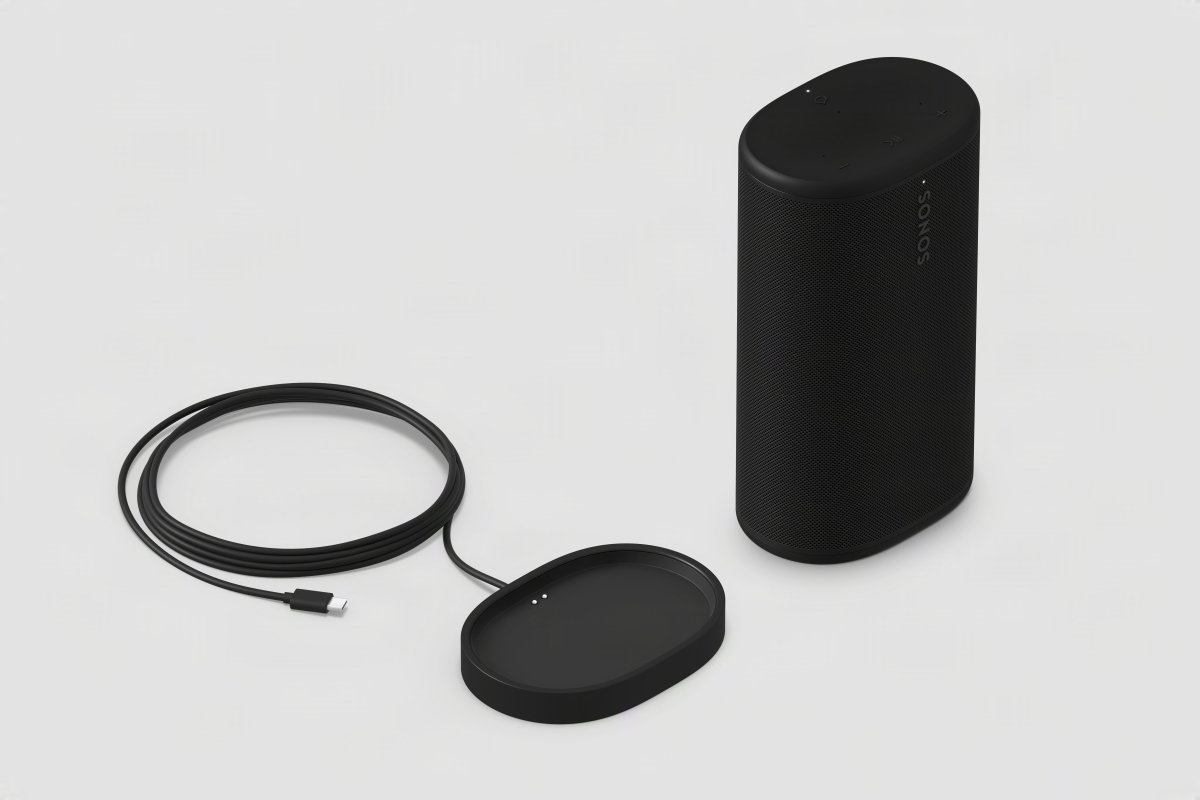
I work from home, so I typically listen to audio through headphones or AirPods. But I’ve always wanted a desk speaker that doesn’t take up too much space, which made the new Sonos Play a fitting first Sonos product to review.
The Play, launched in March, is Sonos’s first new device in more than a year. The $299 speaker is a hybrid: part home speaker, part portable. It sits on your desk in a pill-shaped dock, but at 1.3 kilograms, with a “utility loop” on the back, it’s easy to carry around the house or take outside.
While testing it, I often started a podcast at my desk and carried the Play to the kitchen while I cooked or made coffee. The advantage over wearing AirPods is that you remain aware of your surroundings — no more missing what someone across the room is saying. And you don’t need to rely on voice commands to control playback; the Sonos Assistant and Alexa are both built in.
Physical controls are another advantage. Skipping tracks or adjusting volume with greasy hands is awkward on AirPods; the Play’s buttons are more forgiving. That said, the controls themselves are easy to miss — they’re the same color as the silicone top and barely raised above the surface. After a few days I had memorized their positions, but the learning curve is a minor frustration that better contrast or more tactile buttons could have avoided.

The speaker is sturdy and IP67-rated, meaning it can handle rain and brief submersion — I ran it under a tap without issue. It can also charge your phone in a pinch, doubling as a power bank, which is a welcome feature for outdoor use.
For sound, the Play relies on dual-angled tweeters, a mid-woofer, and three digital amplifiers, with two passive radiators to reinforce bass outdoors. The result is balanced and detailed at moderate volumes — instrument separation is particularly good. The soundstage is narrow, though, meaning the music can feel somewhat contained rather than expansive, and at higher volumes the mix loses some of its clarity.
The Play is well-suited to a desk or a patio; it isn’t trying to fill a room. For that, Sonos’s Era 100 SL — which launched alongside the Play — is the better choice. Two Play units can be paired into a stereo configuration, either through the app or, more cleverly, by holding the play/pause button on both speakers simultaneously. It’s a useful feature that makes a noticeable difference for music, though less so for television audio — which these speakers aren’t really designed for anyway.

Sonos has also built in Trueplay, which uses the speaker’s microphones to automatically calibrate sound based on the room. Earlier versions of this feature required waving your phone around the space to tune the audio — an awkward workaround that would have made little sense on a portable speaker. The new implementation handles it automatically.
Sonos has had well-publicized struggles with its app — disappearing speakers, glitchy volume controls — and while the company has made meaningful improvements, a few rough edges remain. Sync between the Play and my MacBook was occasionally laggy, for example, and playing or pausing audio on YouTube sometimes produced a noticeable delay before the speaker responded.
Switching audio between speakers worked reliably through AirPlay but failed repeatedly in the Sonos app until I installed the Apple Music integration — and even then, the process is more cumbersome than it should be.
The “Apply” button in the Sonos app, required to confirm speaker changes, feels like an unnecessary extra step. AirPlay handles the same action with a single tap.
Pocket Casts integration has a resuming bug: podcasts restart from the beginning rather than picking up where you left off.
Overall, the Sonos Play is a solid speaker that largely delivers on its premise. The app issues are real but not dealbreakers, and Sonos has shown it is willing to iterate. If portability isn’t a priority, the Era 100 ($219) or Era 100 SL ($189) offer more volume for less money. If you want something more rugged and truly portable, the Sonos Roam 2 or JBL Charge 6 are worth considering. But if you want a speaker that works equally well on a desk and a back porch, the Play makes a convincing case for itself.
When you purchase through links in our articles, we may earn a small commission. This doesn’t affect our editorial independence.
