
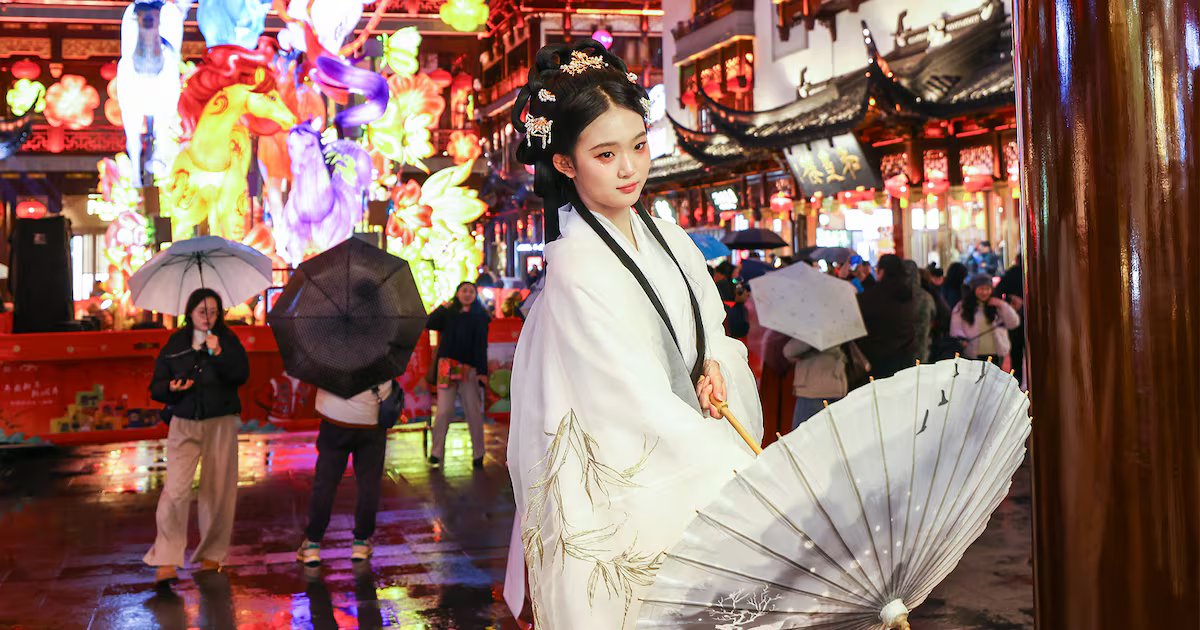
China ushered in the Year of the Horse with a wave of festivities on Feb. 17, but the travel rush that began two weeks earlier will keep retailers busy until mid-March. The 40-day Chunyun season is one of the country’s peak travel periods, offering brands a prime opportunity to capture spending around Lunar New Year.
“Demand for high-end travel within China is booming,” said Zhang Chen, vice president of Alibaba’s online travel platform Fliggy, pointing to private domestic tours that can easily reach 27,000 yuan ($3,900) per person for five days, excluding flights but including accommodation near retail districts. That package “exceeds the cost of many international group tours.”
Traffic on the national railway network is expected to increase five percent, reaching 540 million passenger trips during the season this year, according to the China State Railway Group. Although the Chinese New Year period is largely domestic in nature with many visiting relatives during Spring Festival, it has also become a barometer for overseas tourism demand.
“Chinese travellers are still a really important shopping market and the highest-spending tourism market in many countries around the world, although maybe not quite on the same level as pre-pandemic,” said Sienna Parulis-Cook of Dragon Trail, a China-focused marketing agency.
Consumer confidence in China is slightly stronger than last year, with luxury market forecasts pointing to a modest recovery. Air travel is projected to rise five percent during the holiday period compared with a year ago, reaching 95 million air passenger trips, according to the country’s Civil Aviation Administration.
But experts caution that higher overall visitor numbers may not translate into a boost for global fashion brands. Feedback from payment platform Alipay, as well as retailers in Europe, shows that Chinese tourists are “more likely to be seeking out local brands” this year, said Parulis-Cook, noting that retail has become “less of a priority” overall.
Zhang explains that, instead of letting shopping dictate their itineraries, “today’s travellers are prioritising the richness of local experiences, culinary exploration and personal interests, whether that’s enjoying the beach, historic architecture, concerts or cultural traditions.”
While this suggests some Chinese New Year travellers will be spending less at retail, others will still be eager to shop. But with travel preferences continuously evolving, where can brands expect to reach this key group of holidaymakers in 2026?
The Mainland Staycation Boom
City breaks that double as domestic shopping hubs continue to offer ample opportunities. Beijing, Shanghai, Hangzhou and Shenzhen, as well as Guangzhou, Harbin, Chengdu and Chongqing, are this year’s favoured destinations, according to Chinese travel service provider Trip.com.
While some global fashion brands have streamlined their China store networks or exited second- and third-tier cities, others upgraded their retail footprint in the months leading up to the new year period.
Between October and December, more than 38 luxury brands opened or renovated stores across the country, including Chanel, Ralph Lauren and Boucheron, according to a report by China Daily citing LuxCo Intelligence. Louis Vuitton and Christian Dior generated $17.8 million and $11.1 million in MIV (media impact value) respectively in the month between mid-December and mid-January, after opening new Beijing stores, according to Launchmetrics.
Unsurprisingly, more than 70 percent of travellers within mainland China prioritise either sun or snow destinations for Chunyun, according to a Mintel survey. Northern and western regions including Xinjiang, Qinghai, Gansu and Inner Mongolia have experienced a surge in bookings on Fliggy. A large share of reservations recorded by travel agent Shanghai Spring and Autumn Tourism were ice-and-snow tour routes to Harbin, Urumqi and Shenyang.
In the afterglow of the 2022 Beijing Winter Olympics, cold-weather destinations remain popular. With Chinese New Year falling during peak ski season, the holiday is an important sales opportunity for outdoor and skiwear brands, as well as luxury players targeting the après-ski experience. Ski brand Bogner has been boosting its presence by staging events at Jilin’s Songhua Lake and Hebei’s Wanlong, two of China’s more than 750 ski resorts.
For favoured sunshine destinations, Fliggy found that southern coastal provinces such as Hainan, Fujian and Guangxi — as well as the inland southern province of Yunnan — have all seen bookings nearly double this year as travellers seek warmer climates.
“Like Sanya, Xiamen is closely tied to the strength of their coastal leisure offering and their ability to deliver an easy, all-in-one holiday experience that helps people unwind and spend time together during Chinese New Year,” said Gloria Gan, senior research analyst at Mintel China, about the cities located in Hainan and Fujian respectively.
Ms Min, a Chinese luxury brand based in Xiamen, will open a showroom for out-of-town guests looking to shop over the new year. Company president Ian Hylton says he expects both footfall and spending during the period to increase on last year .
Trip.com has identified a group of newer destinations gaining momentum in the south of the country, with several cities recording triple-digit growth in bookings year over year. Among them are Shantou, Jieyang and Chaozhou, all in Guangdong province, and Jinghong in Yunnan’s Xishuangbanna Dai autonomous prefecture.
Following a recent slump in Hainan’s travel-retail sector, China’s tropical island saw a rebound in visitor numbers over the Western New Year period, from Dec. to Jan. Late last year, Hainan introduced an enhanced offshore duty-free policy designed to give the island’s economy, including its travel retail sector, a boost.
“We’re optimistic about the new opportunities brought by island-wide special customs operations,” Ge Yongqi, general manager of Hainan Tourism Investment Group Co., recently told People’s Daily. “We continue to explore resources along the highway and help boost rural tourism.”
The island’s 988-kilometre scenic highway loop has become a sightseeing experience in its own right. Hainan is not alone. Other self-driving spots such as Chenzhou in Hunan and Shangrao in Jiangxi have emerged as popular destinations for holidaymakers seeking flexible road trips over the holiday period.
Luxury mall developers have taken note. Swire Properties said it will launch a Taikoo Li shopping centre in Sanya, Hainan, by the end of this year, and another mall in Xi’an, the capital of Shaanxi province, in 2027.
Culturally rich cities with ties to ancient history, including Xi’an and Quanzhou, are expected to draw more visitors this year. Night-time experiences, lantern displays, Tang dynasty-style streets and folk performances all allow weary urban visitors to “slow down and…reconnect with a sense of cultural identity,” says Gan.
Growing interest in such destinations has prompted global luxury brands to incorporate deeper cultural stories and new motifs into holiday campaigns and product lines.
In Loewe’s campaign, which paid tribute to a traditional children’s tale, nostalgia took centre stage. Balenciaga’s depicted a more cosmopolitan atmosphere, with young actors on a Shanghai city break shopping for red lanterns and festive bing tang hulu fruit sticks.
Short-Haul Leisure Adventures

Beyond the mainland, China’s special administrative regions of Hong Kong and Macau are also expected to draw crowds. A Macao Government Tourism Office official estimated that the gambling hub would record around 1.4 – 1.5 million visitor arrivals during this year’s Chinese New Year break.
In Hong Kong, retailers are bracing for a six percent year-on-year increase in mainland visitors during the Feb. 15–23 period, reaching 1.4 million people, according to Hong Kong’s Travel Industry Council.
Hong Kong-based fashion brand Shanghai Tang is anticipating a double-digit increase in footfall during the holiday period. “A lot of [our recent growth] is being driven by a resurgence of travel to Hong Kong,” said company chairman Derek Sulger, adding that its service of a Lunar New Year outfit made by the company’s master tailor has been fully booked for months.
Beyond Hong Kong, top outbound destinations by bookings include Singapore as well as Bangkok, Thailand; Seoul, South Korea; and Kuala Lumpur, Malaysia, according to Trip.com.
Kashif Ansari, chief executive of Malaysia-based property firm Juwai IQI, predicted that Malaysia could win in terms of the volume of Chinese visitors while Dubai will attract the biggest spenders. Ansari also highlighted the appeal of Singapore and Thailand.
Forecasts from the China Trading Desk suggest that Thailand could once again emerge as the most popular destination, after public concern for the safety of Chinese tourists there appeared to dissipate. The country topped Trip.com’s list of international destinations searched by Chinese travellers since January 2026, using the keyword “shopping”. The United Arab Emirates and Australia also placed in the top three.
“Practical factors play an important role here, including geographic proximity, relatively streamlined visa processes, and well-developed infrastructure,” said Gan, outlining the enduring appeal of such destinations.
Other key factors for Chinese visitors are the local hospitality offering and the service culture. Last year saw a notable expansion of ultra‑luxury hotels into Thailand (Aman Nai Lert Bangkok, The Standard Pattaya Na Jomtien and Grand Nikko Bangkok Sathorn) and into Japan (Patina Osaka, and Fairmont Tokyo). Both countries have strong reputations for hospitality.
However, ongoing geopolitical tensions between China and Japan are expected to dampen Chinese interest in Japanese destinations, hitting department store giants like Isetan Mitsukoshi and Takashimaya. With Beijing warning citizens against travel to Japan “in the near future” and Seoul easing visas for Chinese tour groups, South Korea has emerged as this year’s alternative hotspot.
Chinese tourist bookings for South Korea during the nine-day holiday from mid-February are up 52 percent while arrivals in Japan are forecast to plunge by as much as 60 percent from last year’s holiday, according to market researcher China Trading Desk. The firm also highlighted the growing appeal of Vietnam, noting that bookings have doubled since last year.
Australia remains a mainstay for Chinese tourists, with destinations like the Great Barrier Reef and landscapes in the Outback accessed via retail hubs such as Adelaide and Perth.
Exploring Mid-Haul Destinations

Fflur Roberts, head of luxury goods at Euromonitor International, suggests that more Chinese travellers will opt for mid-haul hubs like Dubai this year, rather than long‑haul destinations in Europe and North America.
As part of a three-day Chinese New Year programme at Dubai’s Mall of the Emirates, the mega-mall launched a showcase of buzzy Chinese brands including Susan Fang and Pronounce, alongside a Huangmei opera performance. Most malls in the city now have a significant number of Mandarin-speaking staff and stores offering WeChat Pay and Alipay.
Other Middle Eastern destinations have grown in popularity in recent years, with Saudi Arabia on the radar for a modest but growing number of Chinese travellers. Package tours to Turkey, covering destinations like Cappadocia and Konya via Istanbul, are also gaining traction.
Europe is seeing “robust growth” in bookings as a whole, according to Trip.com, but it is novel destinations like Norway that increasingly appeal to Chinese travellers for Lunar New Year escapes, thanks to the Scandinavian country’s otherworldly fjords and Northern Lights experiences.
The firm points to a recovery in Chinese travellers to Western Europe’s fashion capitals. Last month, bookings to Paris and London for the Lunar New Year period were both up 26 percent, while Milan was up 22 percent compared to last year’s figures. But the fastest growing European destination this year is Spain, according to Trip.com’s Kate Xiong-Britton.
“We are starting to see clear signs of renewed momentum from China [around Lunar New Year],” says Helen Brocklebank, chief executive of Walpole, the organisation that represents the British luxury industry including retailers.

However, other luxury insiders say that any rise in bookings to Europe hasn’t yet translated to sales for the region’s upmarket department stores.
“January has been quiet on that front in Europe, and we have not heard of a change in the trend since then. Chinese clientele in the UK is especially scarce,” said Selvane Mohandas du Ménil, managing director of Paris-based International Association of Department Stores, in a mid-February email.
Russia’s decision to offer visa-free access to Chinese travellers until September has prompted local hotel chains to launch promotions on Chinese social media channels. Fliggy confirmed that bookings to Russia are experiencing strong growth. Despite most luxury brands pulling out of Russia over the war in Ukraine, many products are still widely available through grey market channels in Moscow, St. Petersburg and even some cities in Siberia which are much closer to China.
Shifts in Chinese New Year travel patterns have spread spending across new domestic destinations, established Asian hubs and mid-haul adventure markets. But as itineraries become more experience-driven and consumers become even more discerning, fashion brands must give visitors a compelling reason to open their wallets.
Those that invest early to entice Chinese travellers before departure and meet them seamlessly along their journeys will be best placed to do so.
