
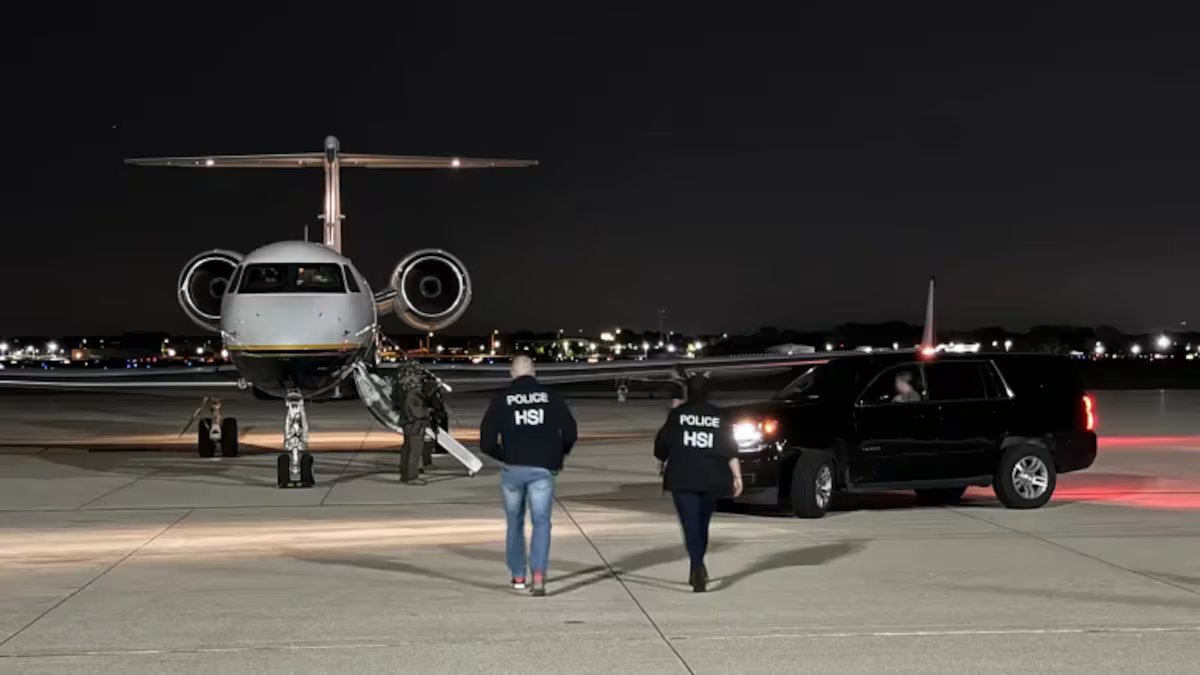
Mexico has once again sharpened its criticism of the United States and its security policies abroad. The latest moves by Donald Trump’s administration have upset Mexican President Claudia Sheinbaum’s government, specifically the actions by one branch of the U.S. law enforcement apparatus, the FBI. A few days ago, the bureau announced with great fanfare that it would place on display in a museum the small aircraft that transported drug trafficker Ismael “El Mayo” Zambada to the United States a little more than two years ago.
The unusual museum exhibit has reinforced a belief in Mexico that the FBI planned and carried out El Mayo’s abduction and subsequent transfer across the border. Sheinbaum has said her government will present a report on the matter this week.
The president addressed the issue again on Monday during her morning press conference, the third time she has done so in recent days, clearly frustrated by the way Washington has handled the bilateral relationship.
“It is very important to bring to light how this arrest was carried out. It is highly relevant both to the current U.S. authorities and to those who were in office at the time,” she said.
El Mayo — who now faces a possible life sentence and has asked the judge for leniency regarding his prison conditions — was abducted in 2024 when Joe Biden was president. Under both Biden and Trump, the U.S. government has consistently denied any involvement in the kidnapping.
Sheinbaum first raised the issue on Friday during a visit to Michoacán, following the FBI’s announcement on Wednesday that the aircraft would be added to the collection of a museum near the airfield in New Mexico where the plane carrying El Mayo landed. El Mayo’s removal from the criminal landscape triggered an internal war within the Sinaloa Cartel, plunging much of northwestern Mexico into a cycle of brutal violence that at times appears to ease, only to flare up again.
Even before that, Sheinbaum had addressed the matter after former U.S. ambassador to Mexico Ken Salazar, who was in office when Zambada was abducted, published his memoirs. In the book, Salazar suggests that Sheinbaum’s predecessor, Andrés Manuel López Obrador (2018–24), the longtime leader of her political party Morena, was worried about what El Mayo might tell U.S. authorities regarding his administration and the links between organized crime and politics.
“If president López Obrador had any concern, it was rather about U.S. participation in Mayo’s capture,” Sheinbaum retorted.
The dispute over the Zambada affair is only the latest in a series of tensions between the Mexican and U.S. security agencies. The most recent — and most significant — stemmed from another complaint by Sheinbaum over U.S. involvement south of the border.
In April, the deaths of two U.S. intelligence agents in an accident in Chihuahua revealed that they had previously taken part in an operation against a synthetic-drug laboratory in the state’s mountainous region. Sheinbaum reacted angrily, calling it an unacceptable intrusion by the United States on Mexican soil. Her party, Morena, seized on the episode to criticize the local government, led by the opposition National Action Party (PAN), and demand the governor’s resignation.
It is unclear how much Sheinbaum’s criticism irritated officials on the other side of the border. What is clear is that, weeks later, the U.S. Justice Department took the unusual step of unsealing an indictment charging Sinaloa Governor Rubén Rocha, along with nine other regional politicians, with drug trafficking and other crimes. Those charged included a general who had previously served as the state’s security secretary and a sitting senator. The general, Gerardo Mérida, surrendered to U.S. authorities days later, while Rocha temporarily stepped aside from office. The indictment fuelled opposition attacks, with critics continuing to brand Sheinbaum’s administration and Morena as a narco-government.
Whether the two episodes were connected or not, relations between the two countries — which were smooth and productive during the first months of Trump’s return to the White House — have cooled noticeably. On Monday, Sheinbaum went so far as to suggest that the U.S. Justice Department’s policy of reaching cooperation agreements with criminals amounts, in practice, to protecting criminal groups.
“It’s very important to point out the protection that has been granted to a group in the United States,” the president said. “Because they designated them as terrorist organizations, but at the same time they’re giving them protection.”
Criticism from Sheinbaum has been further fuelled by a recent report published by the news outlet Pie de Nota, which claims that the FBI, along with other U.S. law-enforcement agencies, played a role in organizing Zambada’s abduction.
If confirmed, the case would inevitably draw comparisons with that of Dr. Humberto Álvarez Machain, who was abducted in Mexico in 1990 on orders from the U.S. government and taken across the border. The DEA accused him of helping keep one of its agents, Enrique Camarena, alive while he was being tortured by Mexican criminals before his murder five years earlier.
Sign up for our weekly newsletter to get more English-language news coverage from EL PAÍS USA Edition
