
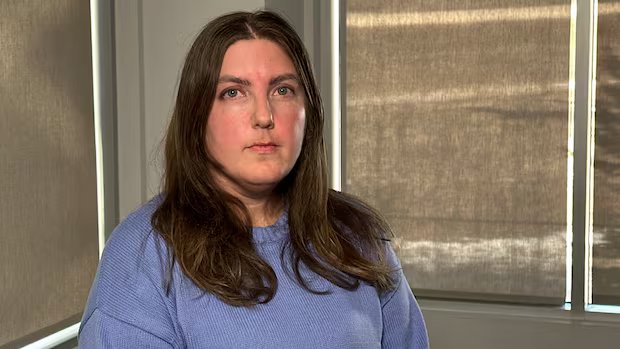
When Samantha Kirkpatrick sued the contractor who did a shoddy job building her garage, she says she never imagined the paralegal she hired to represent her would walk away with her $13,000 settlement.
The 38-year-old Calgary woman says John McDonald appeared trustworthy when she hired him in October 2023 after researching her options online.
He said he was a military veteran, he advertised paralegal services in Alberta and B.C., held a licence from the Saskatchewan Law Society, and served on the board of Alberta’s association for paralegals.
He was also representing others suing the same contractor.
But Kirkpatrick is now almost a year into a battle to get McDonald to hand over the settlement the contractor paid out.
“This completely blindsided me,” said Kirkpatrick, who says she feels duped and has taken her concerns to police.
A Calgary woman got a $13,000 settlement in a civil case against a contractor but says she’s never received a cent of the money her paralegal negotiated. Her case is raising questions about the lack of paralegal regulation and consumer protection in many provinces.
When McDonald went silent after banking the money, Kirkpatrick soon realized she had nowhere to turn for help.
Legal experts say almost anyone can be a paralegal in Alberta and there is no protection for clients if something goes wrong.
Canada has a mishmash of rules when it comes to regulating the trade, depending on the province you live in. It ranges from no regulation in Alberta to full oversight in Ontario, says Lisa Trabucco, an assistant law professor with the University of Windsor.
Typically, paralegals are trained professionals who support lawyers or can do limited independent legal work.
They can be cheaper and effective in simple, lower-stakes cases, but that shouldn’t come at a higher risk, Trabucco says.
“Alberta, particularly, is problematic in that sense. People just operate without any oversight,” she said.
There is little recourse if something goes wrong because independent paralegals may not carry insurance, have valid education or adhere to professional codes of conduct, she added.
Complaints, investigations
Seven other people say they have had problems after hiring McDonald, including withheld settlements, incomplete work or missed deadlines, CBC News has confirmed.
None of the allegations have been proven.
Go Public has also learned Calgary police launched two fraud investigations into complaints brought by McDonald’s former clients. One was closed with no charges, the other is ongoing.
The Law Society of Saskatchewan told CBC News it has opened an investigation connected to McDonald’s licence there.
When asked about Kirkpatrick’s and another former client’s complaints, McDonald responded in an email to Go Public: “As both [matters] … are before regulators in two different provinces, it would be inappropriate for me to comment while those matters remain alive.”
McDonald said he is in the process of shutting down his paralegal services and referring clients to other practitioners, and that he’s now working in an unrelated field.
Missing settlement
Receipts show Kirkpatrick paid McDonald $2,827.18 over a two-year period to represent her and that his fees were paid in full.
When the settlement with the contractor came in last July, McDonald told Kirkpatrick he had deposited the money into his account to be delivered later, according to emails between the two that Kirkpatrick provided to CBC.

On Aug. 5, McDonald wrote to Kirkpatrick saying the contractor had paid the settlement “all in cash” and confirmed he had “deposited it into my account,” but the bank was holding the funds for five business days.
Kirkpatrick says no confirmation, receipt or statement were provided.
She says McDonald then went silent, ignoring dozens of her calls and emails between July 2025 and January 2026.
“I didn’t expect him to run off with my settlement,” said Kirkpatrick.
Association has little authority
Kirkpatrick filed complaints with the law societies of Alberta and B.C., along with the Alberta Association of Professional Paralegals (AAPP), but says they have so far gone nowhere.
“I’m very disappointed. There doesn’t seem to be anything that professional bodies can do,” Kirkpatrick said.
Canadian law societies prohibit mingling client’s and lawyer’s personal funds and require audited trust accounts.
It’s not clear if McDonald has a trust account and, because Alberta paralegals are unregulated, if funds are mishandled, clients can only sue or go to the police.
The AAPP has little authority to discipline members or protect consumers.
Michelle Haigh, director of the AAPP’s professional conduct and disciplinary review committee, says while most Albertan paralegals practise without incident, if a paralegal goes rogue, “there’s no regulatory body to stop him or take over his trust account or anything like that.”
Self-described ‘cowboy’ court agent
McDonald said as much in an AAPP newsletter dated March 31, 2023, in which he wrote that “anybody” in Alberta can call themselves a paralegal with “no minimum education requirements, no regulatory handcuffs, and no protection for the public.”
He described himself as a “cowboy” court agent, less interested in rules and conduct codes and more motivated by “top dollar settlements.”
“… this is the nonlawyer Court Agent who is neither interested in nor opposed to regulation but who probably will not qualify when it comes,” he wrote.
McDonald ceased to be a board member in November 2025, the AAPP said.
Regulation in Ontario
Ontario is the only province that regulates the profession, licensing 11,488 paralegals.
The Law Society of Ontario can investigate complaints, discipline licensees and provide access to a client compensation fund when things go wrong.
“Regulation ensures a disciplinary scheme and also professional responsibility and ethics and accountability if you screw up,” said Trabucco.

B.C. is in the process of bringing in paralegal regulation, and the Law Society of Saskatchewan also licenses qualifying legal professionals.
“It would be lovely if there was a national standard,” said Trabucco, adding that it would help build trust with consumers.
Money, trust gone
AAPP vice-president Vanessa Wilson says regulating paralegals in Alberta would give her organization the legal freedoms afforded to the Alberta Law Society, which can issue warnings about suspended members.
“We’re simply not allowed. Our hands are tied in any sort of warnings or disclosure of that nature,” Wilson said.
“The allegations made by Ms. Kirkpatrick are very saddening. She’s not the only one who has unfortunately run into these issues. If we were regulated, we could do more.”
CBC News contacted the Law Society of Alberta and Alberta’s Justice Ministry to confirm that paralegals in Alberta are self-governed and to ask whether there are any plans to pursue regulation. Both declined interview requests.
As for Kirkpatrick, she says she’s lost faith in the system that appears to have allowed McDonald to keep her money — if he still has it.
“I don’t think he has the money. I think it’s gone,” she said.
Go Public is an investigative news segment on CBC-TV, radio and the web.
We tell your stories, shed light on wrongdoing and hold the powers that be accountable.
If you have a story in the public interest, or if you’re an insider with information, contact gopublic@cbc.ca with your name, contact information and a brief summary. All emails are confidential until you decide to Go Public.
