
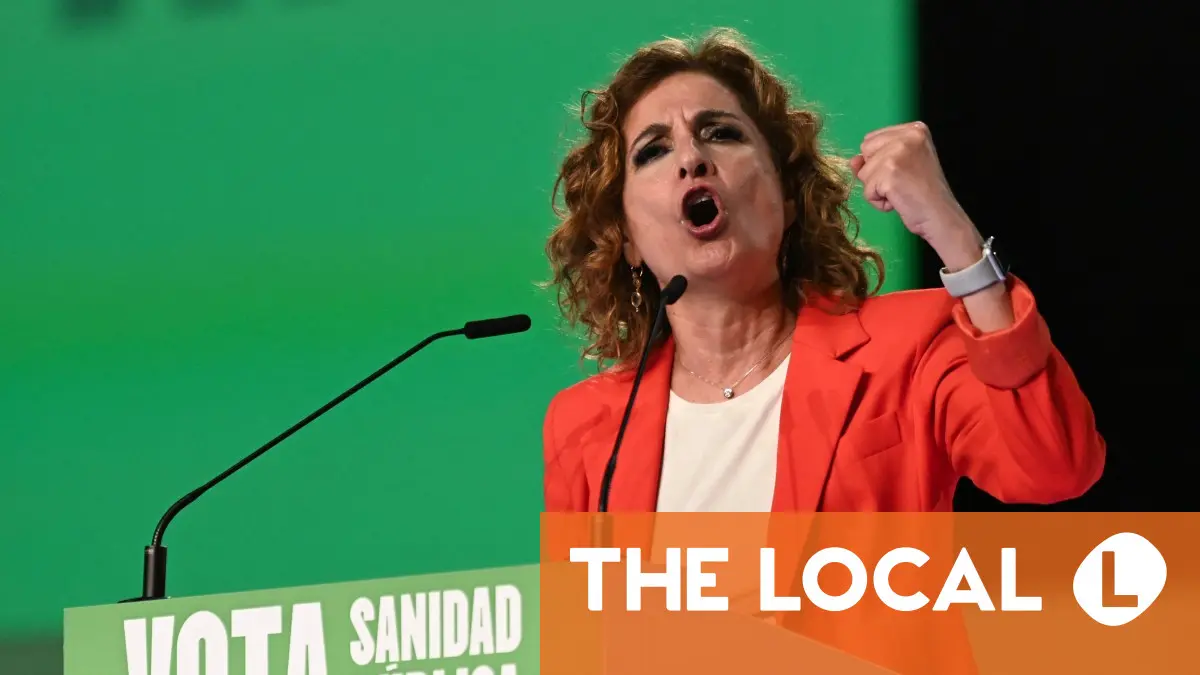
Spanish Prime Minister Pedro Sánchez’s Socialist party suffered a beating in regional elections in Andalusia over the weekend, but it’s still unclear who will govern. Here’s what you need to know about the vote.
The Socialists won just 28 seats in the 109-seat regional assembly in Andalusia — the party’s worst-ever showing in its former electoral stronghold — in Sunday’s polls in Spain’s most populous region.
The mainstream conservative Popular Party (PP) won the largest share of the vote, just as it has in elections held in three other regions in the last six months – Aragón, Extremadura, and Castilla y León.
Sánchez resists
Corruption investigations involving family members and former senior political allies have eroded Sanchez’s popularity at home, even as clashes with US President Donald Trump over Iran and Israel over the war in Gaza have boosted his standing abroad.
“Neither in this vote nor in previous ones has he found the formula to respond to the consolidation of a right-wing bloc that increasingly feels in a strong position to govern Spain,” centre-left daily El País wrote in an editorial on Monday.
Despite the limited room for manoeuvre of his coalition government in parliament, Sánchez has refused to bring forward the next national election, as demanded by the opposition, and has vowed to stand again.
“Each of these defeats weakens him,” Paloma Román, a political science professor at Madrid’s Complutense University, told AFP.
But “we are used to quite spectacular turnarounds that can allow him to remain optimistic”, she added.
Sánchez wrote a political memoir in 2019 called “Resistance Manual” about resilience and his path to power.
PP falls short
The PP is in opposition at national level and is polling ahead of the Socialists ahead of next year’s national election.
“Spain wants change,” the party’s national leader Alberto Núñez Feijóo said on Monday after final results in Andalusia were released.
But while the PP came out ahead with 53 seats, that is down from 58 in 2022 and below the 55 needed for an absolute majority in the assembly to govern alone.
The PP similarly won three other recent regional votes convincingly but fell short of a majority each time.
The party “will have a very difficult time” obtaining an absolute majority at national level as well, said Ana Sofia Cardenal, professor of political science at the Open University of Catalonia.
“I think this succession of regional elections has made that quite clear,” she told AFP.
The PP’s path to power appears, for now, to depend on maintaining good relations with the far-right Vox.
“At the moment they have no other choice, because the Popular Party has, in a sense, broken alliances with everything that is not to its right,” Román said.
Vox growth slows
Vox, which advocates a tougher line on immigration, appears to have lost momentum, although it remains influential.
The party has seen rapid growth in recent years but picked up just one seat in Andalusia, bringing its total to 15.
The result nevertheless allows it to position itself as a kingmaker in the region.
“This is Vox’s major victory,” said Cardenal.
“They are not growing in votes, they are consolidating their electoral base, but they are essential in all right-wing governments because the PP needs Vox in order to govern.”
One of Sunday’s biggest surprises was the strong showing of the left-wing regional party Adelante Andalucia, which went from two seats to eight.
