
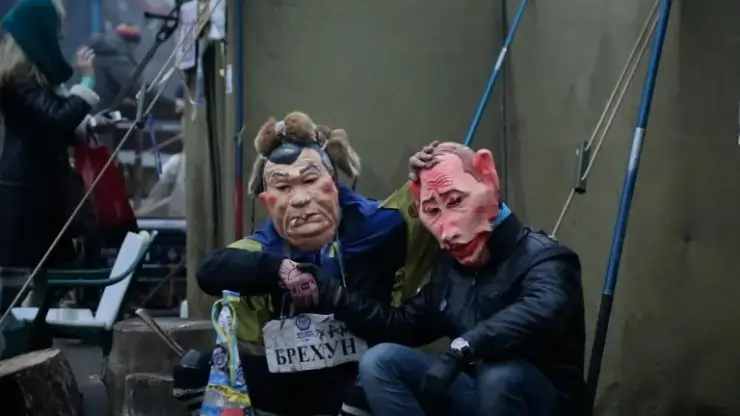
My thoughts need a bit of a preface. War has a way of introducing ugly contradictions, in a degenerative way, while the sheer horror of the facts blurs the bigger picture. If it weren’t for reporting practices, these would remain uncharted and unaddressed. But with an eye to the exponentially enlarging wave of Ukrainian titles that have been landing in my email box, I have to pause for a second: within the exposure offered by international platforms (and the impressive, although somehow still insufficient, solidarity), Ukrainian filmmaking insists on blooming.
A visual language is established for creatives to communicate war. I am not here to judge the effectiveness of this, but in doing so, they are actively protecting Ukraine’s collective memory. Among the many probing questions, an image recurs, looping: the image of the uniformed and armed crowds risking their physical integrity and sanity for the inevitable battle to enter and survive the war zone in the guard of a country, a home, a life, really. This takes me back to the shattering reality of an ongoing war and to the grounds, the rooting grounds of this filmmaking, where, together with the filmmaking practice itself, life is limping for survival. So, where are the limits of accounting for war?
To get to the point, Time Machine Maidan has set off an avalanche of reflections for the medium itself. Follow me here: internationally acclaimed directors Roman Liubyi and Volodymyr Tykhyy rewind us to the European Maidan Uprising of 2013. A young man’s voice guides us around the street imagery of the time. The camera is his eyes, he who, a now-dead soldier, roams and ponders with poetic suspension the lost opportunities of a promised, heroic future, dictated by the ‘freedom or death’ tenet.
Ironically, this voice approximates the wandering ghostly presence of Alexander Sokurov in his Russian Ark, and I guess it’s due to precedents like these that I was able to feel time (all 86 minutes of the runtime) as dissolved in an interplay between opposition, revolt, and reexamination of these two. But time is also subverted by the familiarity of the aesthetics of the image: social media journalism.
With the same ironic outlook, those angry, violent Euromaidan weeks marked the utilisation of social media as a unifying route for civilians. Later on, a few months after this successful (in its scope) uprising, and due to the bottom-up reaction to the corrupt state, the Russian government deemed this public movement a threat. This led not only to strategising the long-term invasion through the subsequent Ukrainian political loophole but also to reinforcing its barricades by deploying an eroded media framing of the happenings in Ukraine.
More than 10 years after the events, this documentary steps into a (seemingly) burgeoning filmmaking era for Ukraine, with reworked, archival material. Real scenes of the events that previously composed the backbone of other documentaries, such as Euromaidan: Rough Cut, support the memories of a narrator—a military-dressed boy of many faces who holds a gun and a smile for the future. In many ways, Time Machine Maidan speaks about the destructive (to some, heroic) past from a destroyed (to some, reclaimed) future.
I am told that the filmmaking team (with backing from the exceptionally active Babylon’13 collective) is juggling the documentary’s premiere while serving the front line. And here’s where it gets tricky again for me: how could filmmaking acts ever respond to politics and the visible (yet unwatchable) reality without reproducing (and propagating) any of these?
★★★★
Premiered at the 2026 Sheffield DocFest as part of the International Competition / Dir: Roman Liubyi, Volodymyr Tykhyy / Ukraine, Germany
Discover more from
Subscribe to get the latest posts sent to your email.
