
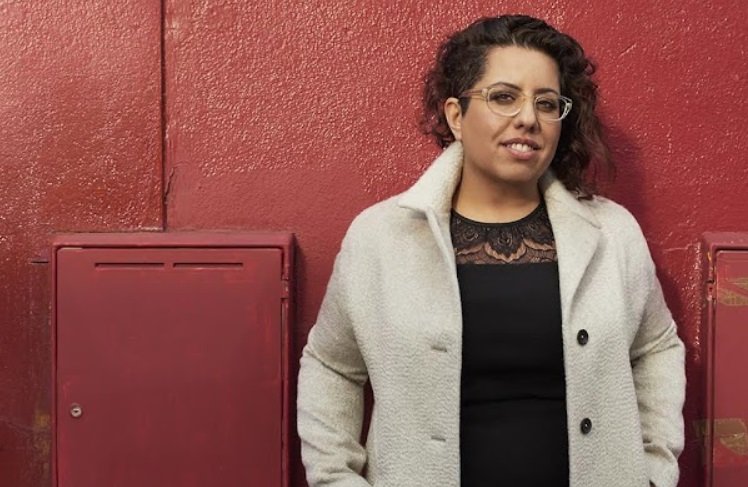
“I had this idea of a John Hughes-type movie, a romantic comedy, or perhaps an unromantic comedy”
– The Iranian-born director reflects on her collaborative approach to working with actors, the relevance of feminist themes and her slate of upcoming projects
(© Mary McCartney)
Tina Gharavi, the director of Virginia Woolf’s Night & Day, freshly world-premiered at SXSW London, met up with us to discuss the origins of the movie, the actors’ input and her upcoming projects.
Cineuropa: What are the origins of the project and its development? How did the passing of time change it?
Tina Gharavi: The script was in development when I first had an interview with writer and producer Justine Waddell, and producers Christopher Figg and Meg Thomson. I asked why they had chosen me to direct it, since I was an Iranian woman with limited experience at the time. They explained they wanted an alternative vision of how a period film could be told, which is something I felt I could convey. I had this idea of a John Hughes-type movie, a romantic comedy, or perhaps an “unromantic” comedy, where you were in love with the characters and could feel their emotions, where their lives mattered and where we were inside their viewpoints. I wanted the opposite to a traditional period drama, which can sometimes feel theatrical or staged.
One of our key rules was that nobody would stand in rooms talking about people elsewhere. The characters are always moving, caught in the frenzy of storytelling. Then, obviously, it was a long journey to get the right script. I worked closely with Justine to get that draft right, and it went through several iterations. Financing really came together about six years after I joined the project, mainly when we started to get the cast on board. Haley Bennett had always been the actress I saw as the lead; I had been obsessed with her work for many years. I thought she was incredibly underrated, but I knew she was phenomenally talented. I think you’ll see in the film that she is the life, soul and heart of it.
How much of that character is Haley Bennett herself? And the same goes for the other actors: what did they add of themselves to the characters?
When it comes to Haley, there is no better actor for me and no better director for her than there was in this kind of collaboration. Her way of working and my way of working are really complementary. She’s a live wire and incredibly intelligent, as most of my cast were. You have thinking people on a set really developing their characters, adding nuance and layers. What Timothy Spall brought to the father was much more sophisticated than what was on the page. He said: “I don’t want to portray him as a mean patriarch.” Underneath it all, he has this insecurity; he’s also trapped, upholding something he doesn’t completely believe in. Likewise, Jennifer Saunders didn’t want to play Mrs Hilbery as a fool. She understood that, much like Katharine, if she’d been born in a different era, she would have been like her daughter, but since she was born a generation earlier, her choices were different. There was a lot of humanism and empathy that came from the actors’ thoughtful engagement. Jack Whitehall was another wild stallion. He writes all the time, and the “duck” line in the movie was his contribution.
Many of the film’s themes, including freedom, self-determination and resistance to patriarchal expectations, are still relevant today. How did your perspective as an Iranian-British director influence the way you approached the story?
We’re often told that we can have it all. Liberalism and feminism have progressed in the West, yet there is still a real struggle to reconcile these demands. I don’t know any woman who has had children who doesn’t feel some level of conflict around that balance. I spoke to a mother yesterday who said she felt like a failure, but she isn’t. She’s simply trying to balance raising children and having a career, and that tension is still there. That’s what film is for: shared sensemaking. We go to the movies together, experience something and talk about it afterwards. That’s the power of cinema, and there are definitely stories I’m interested in that are not necessarily about women.
What are you currently cooking up?
My main project at the moment is a TV detective series in development in Iceland and France, called The Fox. I’m also making a documentary about a samurai called The Last Samurai. And then there is The Good Iranian, about an Iranian women gangster film I developed a while back. It’s been difficult to get it off the ground, but it’s still on the slate. And then, FOROUGH: Let Us Believe in the Beginning of the Cold Season is about Iranian poet Forough Farrokhzad, who wrote about sexuality from a female perspective. She’s often described as something like our Sylvia Plath, but in many ways, she is even more significant within the Persianate world.
