
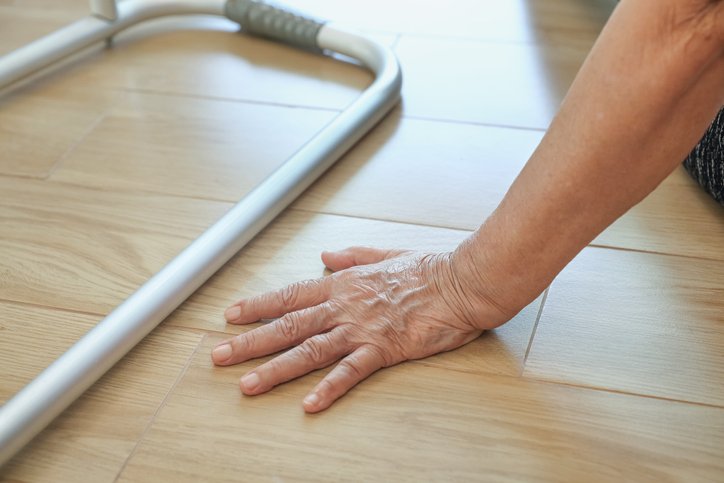
It’s an alarming but puzzling health trend: The death rate from falls for seniors has more than tripled in the past 30 years. One cause may be the overprescription of medicines.
Though there isn’t direct proof that the explosion in medications for older Americans is causing more frequent and more deadly falls, the trends are hard to ignore.
Four of every 10 older adults take five or more medications, triple the rate from two decades ago. More than 7.5 million seniors were simultaneously prescribed eight or more medications for at least 90 days, Medicare records show.
The phenomenon of taking five or more medicines at the same time has become so common that it now has its own term – polypharmacy – and there is no doubt that it increases the risk of dizziness, confusion, and loss of balance.
At the same time, the Centers for Disease Control and Prevention has reported that falls are killing unprecedented numbers of older Americans – 41,000 in 2023 alone. By contrast, in nearly 60 other high- and middle-income countries, death rates from falls actually decreased over the past three decades.
In other words, older Americans are on more medications than ever, and they are falling more than ever, with worse consequences.
As a geriatrician for the past four decades, I have seen significant change in my patients. At the start of my career, I worked with many older people who were high functioning, both cognitively and physically, until they had a fast terminal decline in their 60s or 70s. Today I see more people in their 80s, 90s, and 100s who have a longer and slower terminal decline. Life expectancy has gone up, but the extended years tend to be in a more frail condition.
In my experience, some of the increase in serious falls can be attributed to people living longer – they have accidents during the more fragile years when a slip or a trip means more serious trouble.
Another reason might be that we are getting better at documenting falls. In recent years death certificates have become more specific about the cause of death, including falls.
But it’s hard to ignore the simultaneous boom in medications. A Wall Street Journal analysis of Medicare records found that 3.9 million seniors take 10 or more drugs at once, and more than 419,000 people are prescribed 15 or more meds at the same time.
What should be done?
For starters, seniors should consult with their doctors to see if their full prescription list is truly necessary. Too often an older adult has been seeing many different specialists, each prescribing drugs for a specific body part, without any one doctor considering the cumulative effect on a person’s cognition or balance.
It makes sense to trim the prescription tree.
To combat falls, I would focus most on the total number of medications, especially some I consider “bad actors.” That would include many sedating medications prescribed for sleeping, anxiety, and pain. Many drugs geared at improving mental health problems in younger patients are also prescribed off-label to seniors for difficult dementia related behaviors or insomnia – those tend to increase risk for falls. Many seniors are on sleeping aids such as temazepam (Restoril) and Ambien; antidepressants such as Prozac and Zoloft; sedating anti-anxiety drugs such as Alprazolam, Diazepam, Xanax, and Valium; stimulants such as Adderall and Ritalin; antipsychotics such as Olanzepine or Clozapine, muscle relaxants like Cyclobenzaprine, and antihypertensives such as Lisinopril and Losartan. It’s also wise to review use of pain medications and muscle relaxants.
The American Geriatrics Society now maintains a list of 100 prescriptions that are potentially inappropriate for people over age 65 when drug side effects may outweigh any health benefits. But even that so-called Beers Criteria list of drugs isn’t a silver bullet: It’s about medications taken individually. So many people are on medical cocktails that it often is hard to estimate the ultimate result of mixing together multiple meds.
One other key for consumers and medical professionals is that we need to start taking falls more seriously. If an older person shows signs of a heart attack, stroke, or pneumonia, we all know we should get to the doctor. Unfortunately, falls are sometimes viewed as an inevitable part of senior life that go unreported and unexamined. It’s true that sometimes a fall is a fall, but oftentimes it is a signal for another less visible health problem, like low blood pressure, or infection, or, yes, a head-fogging mix of medicines.
The older we get, the more difficult falls are to recover from. I often ask my clinicians in training: What’s the biggest risk factor for a fall? And the answers usually are: sleeping drugs or other meds, or rugs on the floor, or living in a place with stairs. These are all good answers, but not the most likely one.
Turns out the biggest risk factor for a fall is a previous fall.
Many falls are preventable. Let’s strip away the overmedication of seniors that cause many of them.
Author bio:
Dr. Nick Schneeman is a geriatrician and chief medical officer for Lifespark, a complete senior health company based in Minnesota.
Photo: Toa55, Getty Images
