
In an era dominated by artificial intelligence, social media, smartphones, and endless digital entertainment, there is very little time left for children to simply play with toys. Walk into any restaurant today and you will often witness the same scene: children staring at screens while their parents scroll through their own phones. Everyone is connected, yet somehow nobody is interacting.
That is what makes Toy Story 5 such a fascinating and surprisingly relevant film.
Some will argue that the franchise has outlived its purpose and that talking toys no longer resonate with modern audiences. In some ways, they are right. Children today are growing up in a very different world than the one that inspired the original Toy Story. Toys are no longer the center of many children’s lives. But that observation is only half the story.
Toy Story 5 is not really about toys becoming obsolete. It is about what happens when imagination, friendship, and human connection are gradually replaced by technology.
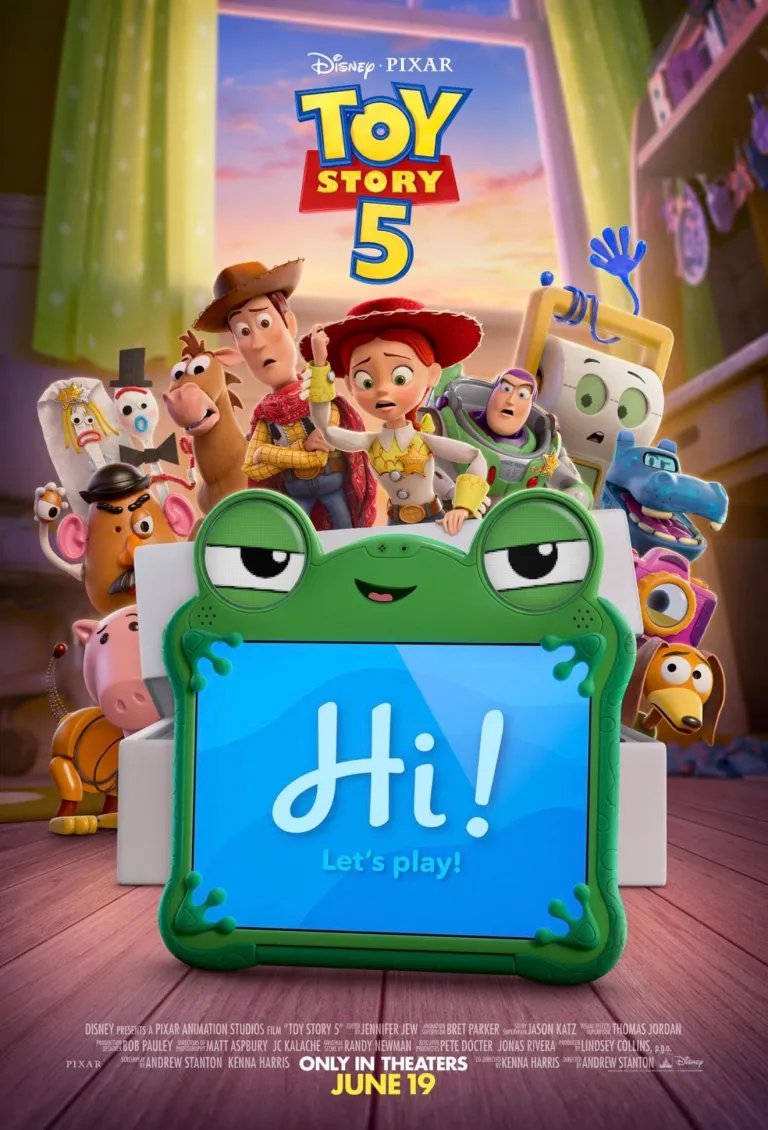
Directed by Andrew Stanton and Kenna Harris, and written by the same creative team, the film reunites many of the franchise’s iconic voices, including Tom Hanks as Woody, Tim Allen as Buzz Lightyear, Joan Cusack as Jessie, Annie Potts as Bo Peep, Tony Hale as Forky, Wallace Shawn as Rex, John Ratzenberger as Hamm, Blake Clark as Slinky Dog, and Keanu Reeves as Duke Caboom. New additions include Greta Lee as Lilypad, a frog-shaped smart tablet that becomes central to the story.
The film opens with Bonnie, now eight years old, struggling to fit in with her peers. While she still owns the beloved toys that have accompanied her throughout childhood, they spend more and more time sitting on the shelf. Bonnie’s classmates are immersed in tablets, gadgets, and digital entertainment, leaving her feeling isolated and increasingly disconnected from those around her.
Hoping to help their daughter feel less lonely, Bonnie’s parents buy her a tablet called Lilypad. What begins as a thoughtful gift quickly becomes her primary source of comfort and companionship. As Bonnie grows more attached to the device, Woody, Jessie, Buzz, and the rest of the gang begin to fear that they are no longer an important part of her life.
Their concerns deepen when they witness Bonnie being ridiculed by other children for still caring about her toys. Embarrassed and hurt, Bonnie starts pulling away from the very things that once brought her happiness. Refusing to give up on her, the toys embark on a journey of their own, determined to help Bonnie rediscover confidence, friendship, and the value of genuine social interaction.
What makes Toy Story 5 so compelling is that it does not attack technology. The film never argues that tablets, social media, or digital entertainment are inherently bad. Instead, it asks a much more important question: what happens when they begin to replace real human interaction?
The film is less interested in the existence of technology than in the consequences of overreliance on it. It explores what can happen when children spend more time looking at screens than looking into the eyes of their friends, parents, and classmates. In that sense, Toy Story 5 is not really about toys at all. It is about balance.
Pixar understands that the world has changed dramatically since the original film. Rather than fighting against that reality, Toy Story 5 embraces it. The film openly acknowledges that toys may no longer occupy the same place in children’s lives that they once did. Yet it also reminds us that some things remain timeless.
The diminishing role of toys becomes a metaphor for something much larger: the gradual loss of imagination, face-to-face communication, and meaningful social connections. The film functions almost like a fire alarm, warning parents and children alike that if we stop paying attention to the importance of play, friendship, and real-world interaction, we risk losing something essential.
What surprised me most is how intelligent the film is. Beneath the humor, adventure, and emotional moments lies a remarkably thoughtful piece of social commentary. This is not a film interested in lecturing its audience. Instead, it quietly asks difficult questions about how we communicate, how we form relationships, and what kind of world we are creating for future generations.
In fact, I suspect some viewers may dislike what the film is trying to say. Not because its message is wrong, but because nobody enjoys being confronted with their own habits and behaviors. Nobody wants to be told that perhaps we spend too much time on our phones. Nobody wants to hear that children may be losing important social skills because digital interaction is replacing real-world experiences.
Ironically, that criticism may be the greatest compliment the film could receive.
Toy Story 5 holds up a mirror to modern life. It asks parents to consider how much time they spend looking at screens. It asks children to consider what they may be missing when digital companionship replaces real friendship. Most importantly, it challenges all of us to think about the value of imagination, play, and genuine human connection.
That is why I believe Toy Story 5 may be appreciated more by those who still recognize the importance of these values than by audiences who simply want another nostalgic adventure. For some, its message may feel uncomfortable. For others, it may feel necessary.
For me, Toy Story 5 is a stronger continuation of the franchise than its immediate predecessor because it has something meaningful to say. It understands that the world has changed, yet it never loses sight of the emotional truths that made the series special in the first place.
The toys may no longer occupy the same place in children’s lives, but the emotions they represent remain as relevant as ever.
In the end, Toy Story 5 is an entertaining family adventure, a heartfelt coming-of-age story, and one of Pixar’s most thoughtful examinations of modern childhood. It is a film about loneliness, friendship, growing up, and the importance of maintaining human connection in a world increasingly dominated by technology.
Whether audiences embrace its message or reject it, there is no denying that Pixar has delivered one of the franchise’s most intelligent and relevant chapters to date.
★★★★☆ Rating: 4/5
The post Toy Story 5 Review: Pixar’s Most Important Warning Yet first appeared on Movie Reviews. TV Coverage. Trailers. Film Festivals..
