
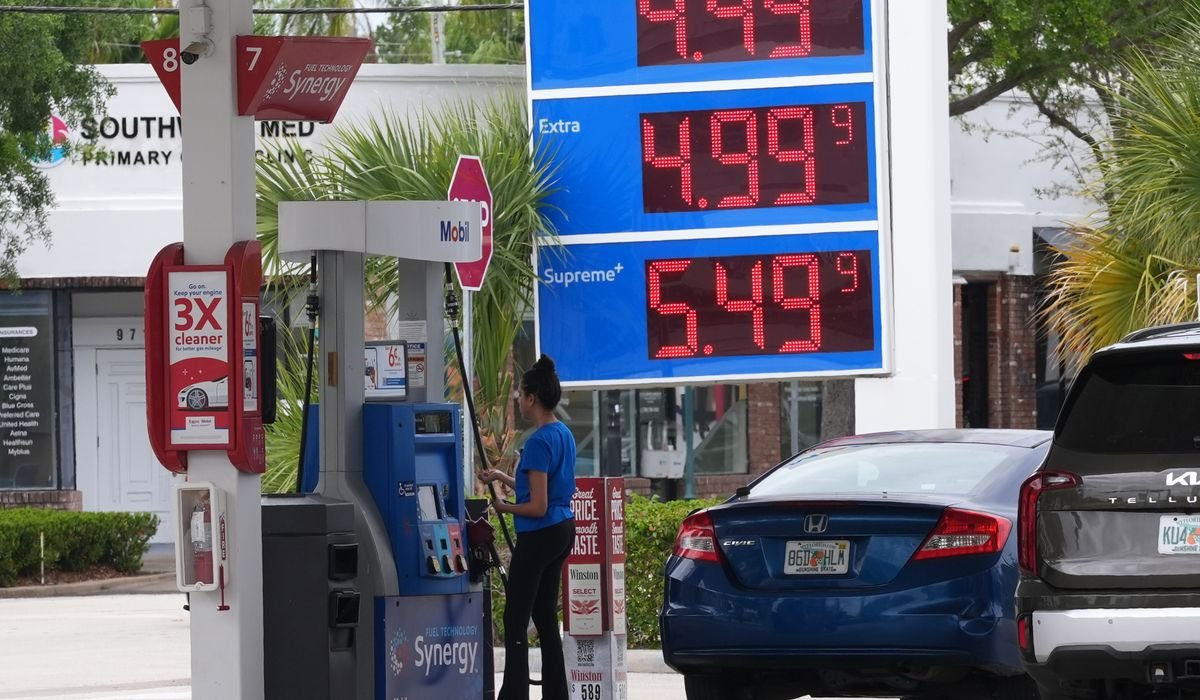
Energy Secretary Chris Wright acknowledged Sunday that gas prices might not fall below $3 a gallon until next year — a notable shift from his earlier prediction that relief was just weeks away.
The walk-back highlights the challenge facing Republicans who had been pointing to cheaper fuel as evidence that Mr. Trump’s economic agenda was taking hold ahead of the midterm elections.
Pressed on CNN’s “State of the Union” about when drivers might see sub‑$3 gas again, Mr. Wright didn’t offer a firm timeline.
“I don’t know. That could happen later this year. That might not happen until next year,” he said.
It’s a sharp contrast to his March 8 appearance on the show, where he said the return of sub‑$3 gas was “not a months thing” and “in the worst case, this is a weeks thing.”
Gasoline prices have jumped more than a dollar a gallon amid the U.S.-Israeli military campaign against Iran. The national average now sits at $4.048 for regular unleaded, up from less than $3 in December, according to the automobile club AAA. The Strait of Hormuz — a key chokepoint for global oil shipments — remains closed.
SEE ALSO: Trump approval slides as Americans sour on economy and Iran war, poll finds
Higher fuel costs ripple through nearly every corner of the economy. Groceries, airline tickets, utilities and anything that moves by truck, ship or plane become more expensive. Manufacturers pay more for petroleum‑based plastics and chemicals, and construction costs climb with pricier asphalt and roofing materials.
Critics of Mr. Trump have revived a familiar form of protest, placing stickers bearing his image and the words “I did that” on gas pumps across the country — the same tactic used against President Joseph R. Biden when fuel prices spiked during his administration.
Mr. Wright said Sunday that the Strait of Hormuz is not safe to transit, with Iranian gunboats firing on tankers trying to pass. He suggested it could reopen within a couple of weeks if a deal with Iran is reached.
“Certainly, with a resolution of this conflict, you will see prices go down,” he said.
The reversal on sub-$3 gas is troublesome for Republicans who, before Mr. Trump agreed to join Israel’s strikes on Iran, had been touting falling gas prices as proof he was easing voters’ pocketbook pain.
In December, the national average for a gallon of gasoline dipped below $3 for the first time in four years, driven by weak demand, cheaper winter‑blend and crude oil around $60 a barrel.
SEE ALSO: Energy Secretary Chris Wright bullish on Iran deal, as Strait of Hormuz shipping fears persist
The National Republican Congressional Committee celebrated the milestone, noting that gas prices had fallen below $3 in 38 states and below $2 in five states.
“President Trump and Republicans are delivering on their promise to lower costs after years of reckless Democrat policies, and the best is yet to come,” an NRCC spokesman said at the time.
The gas‑price retreat comes as a new NBC News Decision Desk poll shows nearly two‑thirds of Americans say rising fuel costs have been a problem for their household, with 29% calling it a serious one. The same survey found just 32% approve of Mr. Trump’s handling of inflation and the cost of living.
Democrats have sought to seize on the voter angst.
Kendall Witmer, director of the Democratic National Committee’s Rapid Response, recently said Mr. Trump “started his deadly and costly war with Iran knowing that everyday Americans would be forced to bear the brunt of even higher prices.”
Ms. Witmer added that even if the war ended today, prices would remain high and that “working families are already stretching their budgets to make ends meet in Trump’s economy, and they can’t afford to wait any longer for prices to come down.”
