
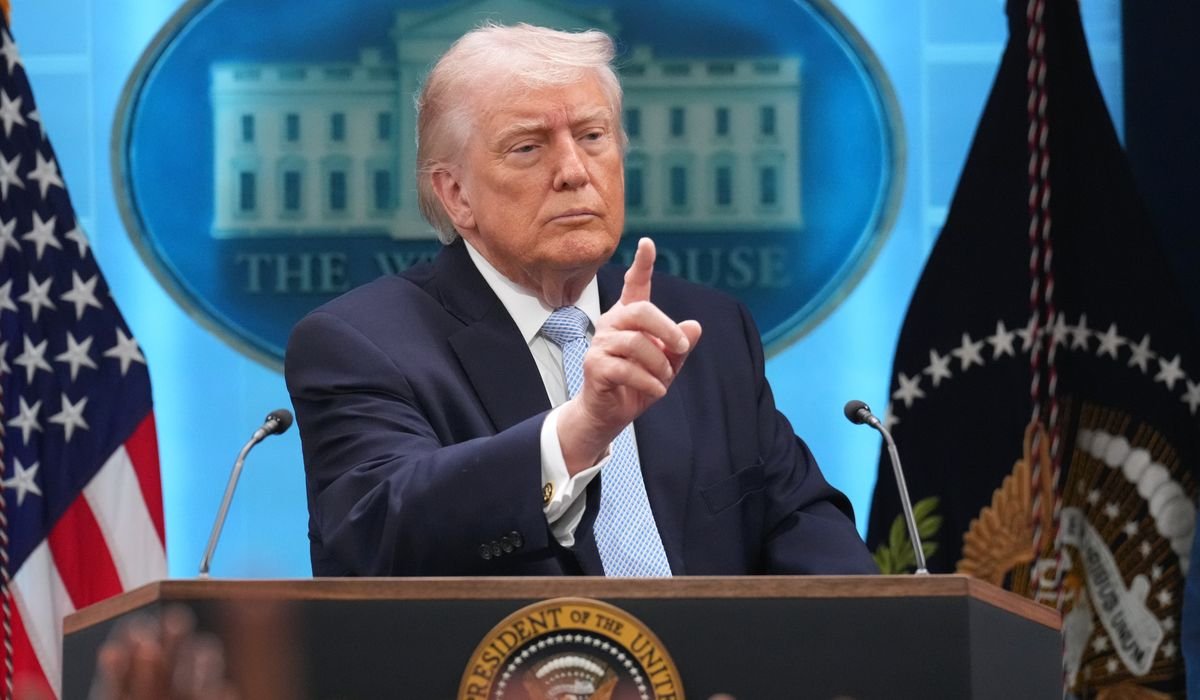
President Trump announced Saturday that a draft of a peace deal between the U.S. and Iran to end weeks of fighting has been negotiated and the Strait of Hormuz will be opening up to shipping traffic.
“An agreement has been largely negotiated, subject to finalization between the United States of America, the Islamic Republic of Iran and various other countries as listed,” Mr. Trump wrote on Truth Social.
“Final aspects and details of the deal are currently being discussed and will be announced shortly. In addition to many other elements of the agreement, the Strait of Hormuz will be opened,” the president continued.
The other Middle Eastern countries that must finalize the peace deal include Jordan, Saudi Arabia, United Arab Emirates, Qatar, Egypt, Turkey, Pakistan and Bahrain. Mr. Trump earlier Saturday had a conference call with the Middle Eastern leaders.
Earlier Saturday, a source close to the negotiations told The Washington Times that the U.S. and Iran would announce the finalization of a draft proposal of a peace deal.
A draft proposal was agreed to early Saturday and expected to be announced within 24 hours, the source said.
Top negotiators, including Iranian Parliament Speaker Mohammad Bagher Qalifbaf, Vice President J.D. Vance, special envoy Steve Witkoff and President Trump’s son-in-law Jared Kushner, have approved the draft.
The draft version of the peace deal has been sent to leaders of both nations for final approval.
If successful, the deal would transform what has been a fragile six-week truce into a permanent peace, even as Mr. Trump has hinted fresh strikes would be possible.
Details of the potential ceasefire agreement remain elusive. It’s unclear how key differences, including the fate of Iran’s nuclear program and its request for sanctions relief, will be resolved. The two sides also need to agree on how to reopen the Strait of Hormuz, which has been largely shuttered since the war started on Feb. 28.
Pakistani Field Marshal Asim Munir held talks in Iran to narrow the differences between the U.S. and Iran after weeks of war left the Strait of Hormuz, a critical waterway for moving goods out of the Middle East, closed to most shipping. About 20% of the world’s oil moves through the strait, and its closure has upended global energy markets.
A Qatari delegation arrived in Tehran as part of the last diplomatic engagements to push the finalized deal across the finish line.
Mr. Munir, who served as the chief mediator in the talks, held multiple meetings to ensure the draft could be finalized and sent to leadership, the source told The Times.
The White House declined to comment.
In Washington, signs suggested a breakthrough. Mr. Vance made an unplanned return from Ohio.
Iran said publicly on Saturday that a peace deal was progressing and that differences will be hammered out at a later stage.
Secretary of State Marco Rubio has hinted that a resolution could be near, while Mr. Trump told Axios on Saturday that it was “50-50” on whether the sides could reach a deal.
The president said if a deal couldn’t be reached, he’d blow Iran “to kingdom come.” He added that he will meet with his top negotiators later Saturday and will have a decision by Sunday.
The president has veered between pushing for a peace deal and ordering a fresh round of strikes. At a New York rally on Friday, he said the war will be over “soon” and “oil prices are going to tumble as soon as I finish up with Iran.”
“The final draft of an agreement text between Iran and the U.S. is still under review,” Iran’s Foreign Ministry spokesman Esmail Baghaei said, according to Iranian state TV. “Over the past week, the process has been moving towards convergence of views.”
He added, “There are still issues that need to be addressed through discussions with mediators. We must wait and see where the situation will lead in the next three or four days.”
Talks reportedly hinge on a 14-point document proposed by Iran, which has served as the main framework for discussions and messages between the two sides.
Mr. Qalibaf has said Iran would pursue its “legitimate rights” on the battlefield and through diplomacy and that it’s worried it can’t trust the U.S., saying it “has no honesty at all.” Iran has repeatedly alleged that the U.S. is not negotiating in good faith during the talks.
He has also warned that Iran’s military forces have rebuilt their capabilities during the ceasefire.
Mr. Rubio, who was in India on Saturday, told reporters that there’s been “some progress.” However, he maintained that the U.S. won’t budge from its position that Iran can’t have a nuclear weapon, must hand over its highly enriched uranium and ships must be allowed to pass freely through the strait.
“The president’s preference is always to solve problems such as these through a negotiated diplomatic solution,” Mr. Rubio said.
Iran has rejected demands to give up its uranium and halt enrichment, while insisting it’s not seeking to build a nuclear bomb. It has also demanded that ships passing through the Strait of Hormuz pay a levy.
Tehran is also seeking relief from harsh economic sanctions, including demands that the U.S. release “a significant portion” of its frozen assets and provide a “transparent” process for unfreezing the rest, according to Iranian state news.
