
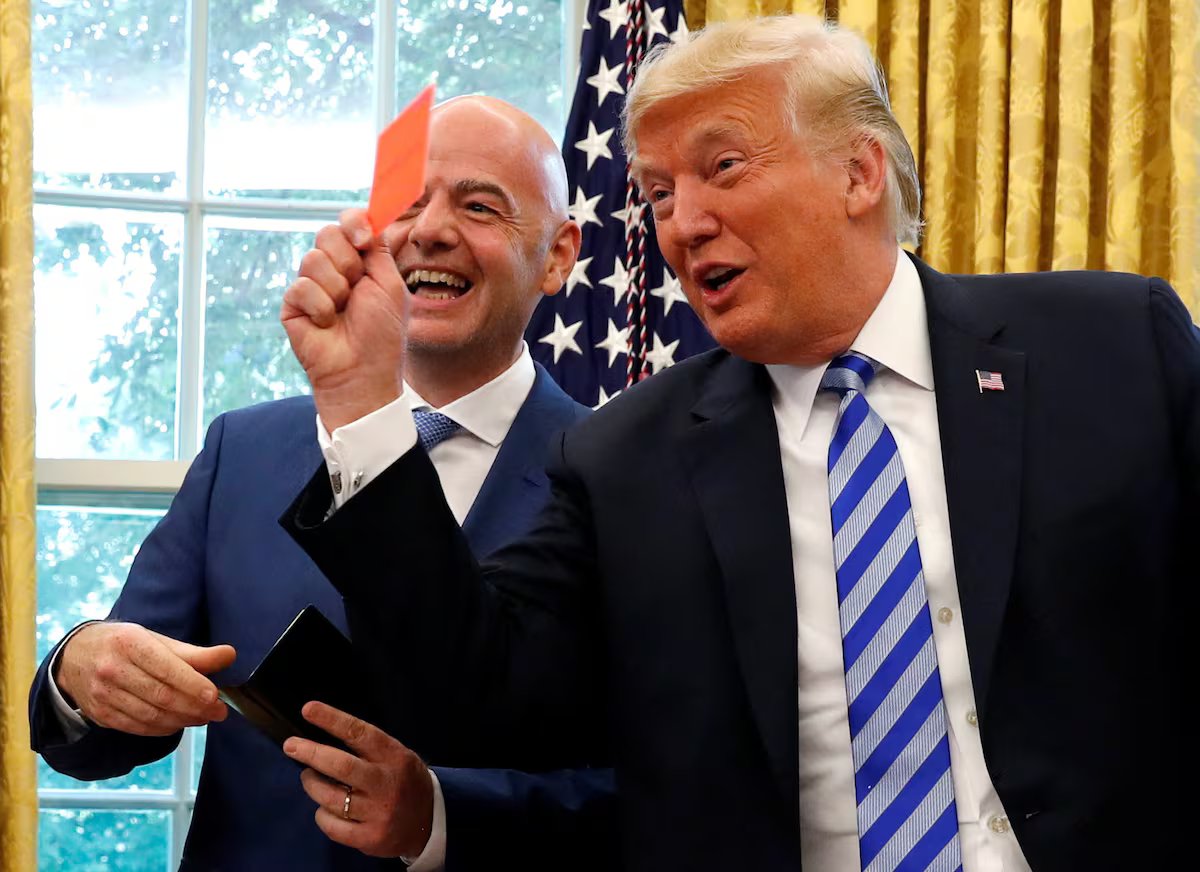
The new scandal rocking the 2026 World Cup is not on the pitch. This time it involves world football’s top official, Gianni Infantino, over the governing body’s decision to reverse the one-game suspension of Folarin Balogun, the United States’ leading scorer, after a phone call from his friend Donald Trump.
The U.S. forward has been cleared of the sanction that would have forced him to miss his team’s decisive match against Belgium Monday night after being issued a red card during his side’s 2-0 victory over Bosnia-Herzegovina. The extraordinary decision has prompted widespread criticism amid allegations of favoritism toward the United States—the only host nation still in the tournament after Canada’s and Mexico’s eliminations—and because of the special relationship between Trump and Infantino.
President Trump commented on the controversial case on Monday. “All I did was ask for a review. I didn’t say, ‘You have to do this.’ I didn’t think it was a foul. I thought it was two great athletes that crashed into each other and got entangled,” the president said during a White House presentation.
“What I thought was horrible was the referee’s performance,” he added. “Nobody talks about that. I didn’t know what the hell a red card was. When I found out I said, ‘you gotta be kidding’.’ This referee, who is a little bit suspect. If you check his past, I don’t want to say that because I don’t like to create controversy, but very suspect… if you like I’ll provide you with the past.”
With this controversy, FIFA appears to be rewriting the rules of world football in a case that is unprecedented in the sport’s history. The case has sparked outrage in Belgium and a chorus of protests among football fans worldwide. The Royal Belgian Football Association (RBFA) has filed an appeal to try to prevent what it considers an injustice. And UEFA, European football’s governing body, said the intervention had “crossed a red line,” describing the decision as “unprecedented, incomprehensible and unjustifiable.” The organization said in a statement that “when the certainty of the rules is no longer guaranteed by its guardians, the integrity of the game is at stake and the credibility of a competition is undermined.”
Old friends
Suspicion has grown because the U.S. president and the FIFA president are old friends. Trump constantly seeks recognition and a leading role, while Infantino specializes in flattery and in pleasing the powerful. Their friendship dates back to August 2018. Infantino had been in office for two years and was visiting the White House for the first time to celebrate FIFA’s award of the 2026 World Cup to a joint bid by the United States, Canada and Mexico. Trump was serving his first presidential term, and the Swiss official, of humble origins and with an extraordinary ability to please, presented him with a football and a personalized shirt. Infantino was hoping to popularize soccer in the United States, where the country’s leading sports—American football (NFL), baseball (MLB) and basketball (NBA)—had long overshadowed the global game.
But what cemented the friendship were Infantino’s public remarks during the Republican president’s lowest moments—when he faced his first impeachment trial in Congress, his reputation was at rock bottom and polls were against him. Trump never forgot that gesture. Since then they have spoken by phone and exchanged messages frequently, and they play golf together. Trump invited Infantino on the first state trip of his second term to countries in the Middle East, treating him as if he were a member of his administration.
Eight years later, a red card has placed the controversial pair in the eye of a storm.
Sign up for our weekly newsletter to get more English-language news coverage from EL PAÍS USA Edition
