
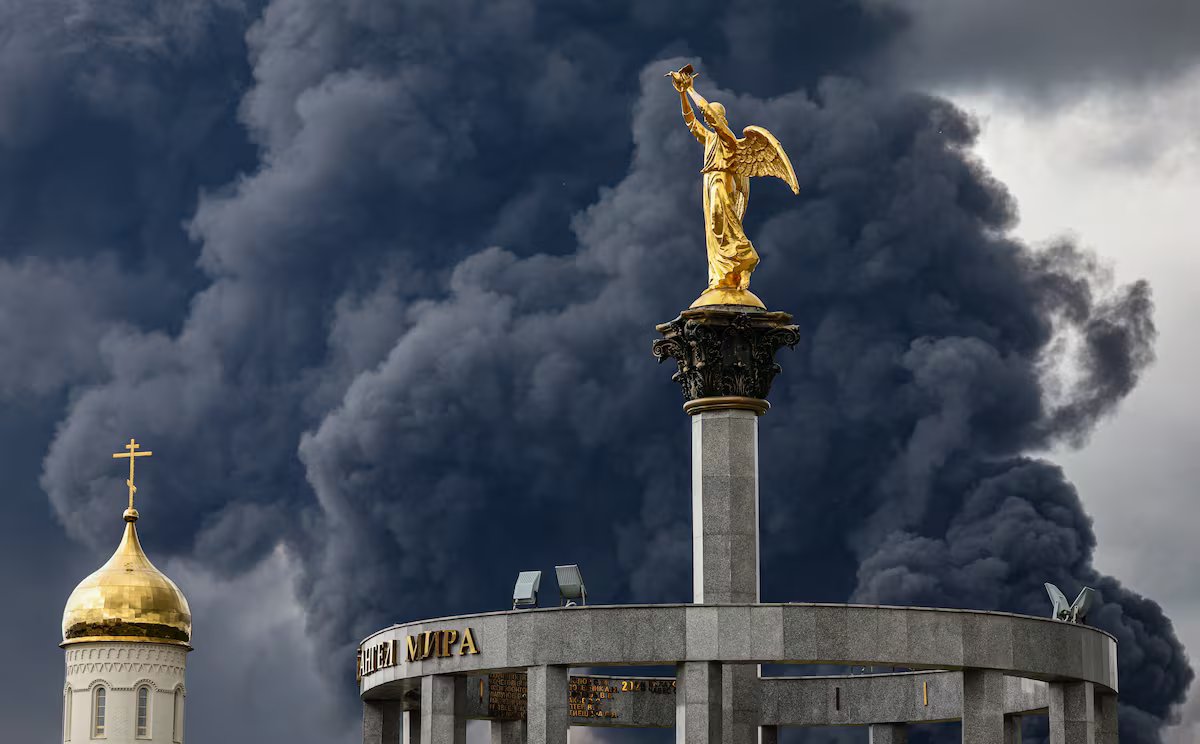
Upon waking up, Taras (a pseudonym to protect his identity) was overjoyed to see some of Russia’s most heavily-fortified areas ablaze. His ambition to defend Ukraine has gone from being a dream to becoming a reality in recent days. “It’s maybe the best feeling ever. Seeing that result is my greatest reward,” he stated during an interview with EL PAÍS in Kyiv. Taras, the head of a local defense company, has spent months with his colleagues developing and testing one of the weapons currently being used to strike Russian strongholds, such as Moscow and St. Petersburg.
The Bars-SM missile-drone program, developed in 2025, has become a key component of Ukraine’s offensive arsenal. It is one of the weapons that the troops are using to attack the southern front. There, another barrage of drones is jeopardizing the stability of the Crimean Peninsula, occupied by Russia since 2014.
Other sources consulted in recent days in the Ukrainian capital (including a former deputy defense minister and a military analyst) believe that this offensive, with its serious impacts on strategic points in the north, as well as in the south aimed at isolating Crimea, is achieving objectives that have never been obtained before. Targeting critical infrastructure within Russia, especially energy facilities, has been part of the Ukrainian strategy for the past year. On the other hand, the tactic of strangling the illegally-annexed peninsula with frequent and targeted attacks on roads, bridges, railways and even ferries is more recent. On Wednesday, June 24, Ukraine managed to cut off the power supply to Sevastopol — the largest city in Crimea, with some 350,000 inhabitants — after bombing its main power station.
In both cases, those consulted by EL PAÍS consider these to be partial victories. However, at the same time, they point to an unprecedented trend since Russian President Vladimir Putin ordered a major invasion in February 2022. Back then, a challenge like the current one being waged against the Kremlin’s forces was unthinkable. More than 52 months have passed — with hundreds of thousands of casualties on both sides — and Putin isn’t just far from achieving his objectives: he has even expressed his anger in recent days.
How have things changed so much in this time? Thanks to the rapid evolution of the arms race, “the attacks against St. Petersburg and Moscow are the most complex and sophisticated ever carried out by Ukrainian forces,” says Vadim Kushnikov, editor of Militarnyi, a defense media outlet.
This expert highlights the improvement in navigation and communication systems, as well as the greater range of the projectiles. There is, however, another aspect to understanding why it’s possible to bypass Russian defenses in some of the most heavily-fortified points of that vast country. “Russian troops are facing a shortage of surface-to-air missiles… and this is one of the reasons why Ukrainian drones and missiles are hitting targets inside Russian territory,” the editor of Militarnyi explains. In any case, he emphasizes that, without the modernization of the Ukrainian arsenal, this wouldn’t be possible, either.
“First, Ukraine has obviously increased its production capacity for long- and medium-range attack weapons. Second, it has managed to win the technological war, although that doesn’t mean [the advantage] will last forever,” says Alina Frolova, Ukraine’s former deputy minister of Defense. She’s currently the vice president of the Center for Defense Strategies (CDS), a research institute in Kyiv.
Frolova adds that, in parallel, “Russia is suffering from shortages of personnel, technology and money, compounded by sanctions.”
Furthermore, Ukraine, unlike Russia, “now has a strategy” that “is working,” the former deputy minister remarks. According to her, this is due to the new leadership of Minister of Defense Mikhail Fedorov, who was appointed this past January. He previously held the portfolio of Digital Transformation. Therefore, it’s not surprising that the military is now much more focused on technological development and that the Armed Forces of Ukraine have many new faces at the helm.
Ukraine is “persistently weakening the enemy’s military potential, disrupting logistics and striking critically important targets deep behind enemy lines. Drones now account for over 90% of enemy losses,” Fedorov stated on social media, on Monday, June 22. He claims that, since the beginning of 2026, they’ve attacked more than 800,000 Russian targets, including air defense systems, artillery, missile launch systems, drones, logistics vehicles, barracks, warehouses and electronic warfare systems.
The objective: “To liberate Crimea”
“In the eyes of experts,” Frolova comments, “deoccupying Crimea is simpler than, for example, deoccupying the Donbas (the volatile eastern region of Ukraine also coveted by Putin) because of the geographical characteristics” of that eastern region bordering Russia, which is connected to the Crimean Peninsula via a land corridor. What’s being sought in Crimea is “an isolation operation,” which is not going to produce short-term results. But if Russia loses this territory, she predicts, it “will be a disaster for Putin.”
Without supplies, fuel, water, or electricity, “what will you do with Crimea? You can’t maintain troops there normally… and I would say that most of the occupying authorities would try to flee,” she maintains, aware that the plan is only in its first phase on the path to the ultimate goal: “to liberate Crimea.” The next step, according to the former minister, should be to completely disable the large bridge that crosses the Kerch Strait into Russia. This is a coveted asset that’s already been attacked several times in recent years.
For Vadim Kushnikov, the editor-in-chief of Militarnyi, the focus is on “isolating the Crimean Peninsula to prevent the Russians from using this vast territory against Ukraine,” as it is “one of the largest military and logistical centers providing direct support to Russian troops.” Along the occupied peninsula, the Russians appear more vulnerable, despite having been established there for 12 years.
Furthermore, managing to attack Moscow’s largest refinery twice in a single week is the result of many months of “hard work.” Taras, the defense innovator, emphasizes this, without offering details. The Bars — the drone-missile manufactured by his company — can strike targets located up to 620 miles away (the straight-line distance from Kyiv to Moscow is approximately 470 miles). It reaches speeds of up to 435 miles per hour and can reach a maximum altitude of 16,400 feet for more than two and a half hours.
This device measures 8.5 feet long and 7.9 feet wide. Depending on the model, it has a maximum takeoff weight of 350 pounds and a warhead containing up to 132 pounds of explosives. It’s equipped with a Starlink internet connection system (owned by Elon Musk’s company), combining innovative technology with the possibility of mass domestic production at affordable prices, another key to the industry. Furthermore, the Bars’ navigation system allows it to detect enemy aircraft, distinguishing them from Ukrainian ones.
However, the Bars is just one of the many weapons developed by Ukrainians over these past years, in a dizzying race for survival. To strike Russia, Kushnikov explains, they also employ the FP-5 “Flamingo” cruise missile and the FP-1 and FP-2 drones, all three manufactured by Fire Point, a Ukrainian defense technology company. The Liutyi kamikaze drone and the Morok kamikaze drone, among others, are also produced domestically.
The effective and costly American Tomahawk missile, which President Volodymyr Zelensky has repeatedly requested from Washington, isn’t part of Kyiv’s arsenal. “Precisely for this reason, Ukraine has chosen to develop its own capabilities,” the director of Militarnyi explains.
He sees “two parallel paths” going forward. “The first is the diplomatic route: negotiations with the United States regarding the supply of cruise missiles. The second is the implementation of a missile program through our own efforts, along with the participation of [our] European partners,” he maintains.
Alina Frolova, meanwhile, emphasizes what’s not always so evident in these cases: “As the military says, hope cannot be part of the strategy.”
Sign up for our weekly newsletter to get more English-language news coverage from EL PAÍS USA Edition
