
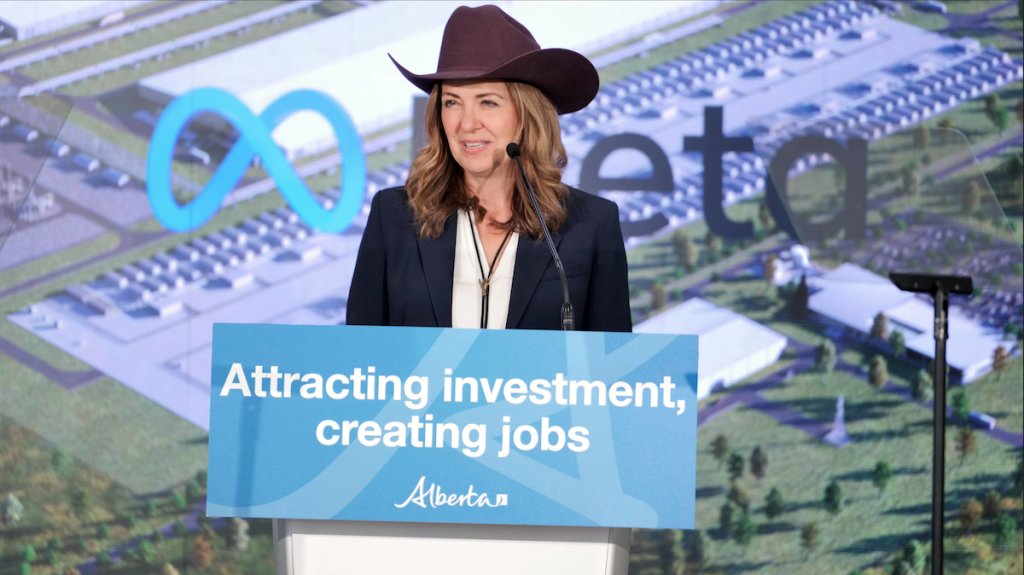
Now that voters everywhere in North America are turning against Artificial Intelligence data centres hard and fast, what’s Alberta’s United Conservative Party going to do?

They’ve spent two years planning to woo data centres to Alberta as if they were the greatest industrial development since the invention of the steam engine. They even quietly created a special “concierge service” to make it easy for as many as 40 massive AI data centres to set up their noisy, polluting shops in rural Alberta.
Unsurprisingly, as journalist Andrew Nikiforuk described the burgeoning opposition to data centres recently in The Tyee, “rural Albertans, like working people everywhere, are asking why their communities should become sacrifice zones for multinational corporations hell-bent on constructing ugly windowless boxes to house computing power that will toss many out of work while sucking up capital, fossil fuel and water.”
So, now that the UCP is alienating significant parts of its own voting base, you have to wonder, will the party change course or double down?
The history of Premier Danielle Smith’s government suggests they’ll stick to trying to gaslight us into believing AI data centres are just “digital refineries” that will magically turn natural gas from clapped out and otherwise uneconomic wells into big money.
South of the U.S. border, the impact of the “data center backlash” on the crucial mid-term elections is becoming serious enough it was considered worthy of in a major front-page story in The New York Times Saturday.

“The fight over data centers is suddenly at the epicenter of the midterm elections,” The Times reported. “Politicians are racing to tap into the backlash — or inoculate themselves — as political strategists in both parties described the issue as an unusually fast-moving force that is already reshaping races for the House, the Senate and governor’s mansions.”
The problem for American Republicans in particular – and maybe for the UCP too – is it’s becoming increasingly obvious AI data centres are a disaster for communities where they’re built and the argument for building them sucks.
In a nutshell, as is increasingly understood by American voters regardless of their political identities, that argument is that AI data centres may kill your job, ensure your kids never work, destroy the value of your property, keep you awake at night, make you sick, poison your land, suck up all the water, and make your energy bills go up, but … “There Is No Alternative!”
All of this will sound familiar to Albertans who are starting to pay attention to the UCP’s plans, as will the promises that water won’t be wasted because of closed-loop cooling technology and power prices won’t go up because data centres will have to generate their own electricity – claims that upon closer examination come with many caveats.
Since the argument for AI data centres isn’t an appealing one, there needs to be a sales pitch that can get the locals to go along with such schemes long enough to make them impossible to block, and that was a topic at a community meeting in St. Albert Saturday about Meta Platforms Inc.’s planned hyperscale AI data centre in nearby Sturgeon County.

“There is a playbook that these guys follow,” retired Simon Fraser University finance professor Carol Edwards told about 100 people at the Edmonton area city’s curling club at the event organized by the local Give Voice group.
“Sneak in under cover of darkness,” said Ms. Edwards, who retired in Olds three years ago and played a prominent role in the successful fight against a massive data centre there that was kyboshed last week by the Alberta Utilities Commission. “Keep as much hidden as possible. Co-opt the politicians. Throw around enormous numbers … everything done in secret.”
Sound familiar? Others make similar observations. Financing details for the facilities are usually cloaked in corporate confidentiality and enforced with non-disclosure agreements on local governments, Saskatchewan-based researcher Simon Enoch of the Canadian Centre for Policy Alternatives said at a presentation on AI data centres in Regina last June. In response, he said then, the projects “are often fast-tracked by local and regional governments, cutting corners to overcome opposition.”
As Edwards said Saturday: “They’re going to come in and lie to you. It’s standard in the data centre industry. Lies, lies, lies, more lies. … They think you’re hicks, yokels, and farmers, and they think they can roll right over you.”

“But as the U.S. has discovered, data center promises are worthless,” she continued. “Bear in mind that they will not have to deliver. Nobody will hold them responsible for the promises that they don’t deliver on. But they will demand that your politicians make them huge promises in return.”
Data centre developers like farming areas near small towns because prime agricultural land usually has water and small towns have the infrastructure they need already in place, Ms. Edwards explained.
Small towns in Alberta are soft targets because they’re desperate for taxes, jobs and development. Local politicians “are suckers for those words,” she warned, and data centre operators need local politicians “willing to look the other way.”
“What they don’t need, and this is the big lie, they don’t need people,” Edwards said. “It is an absolute myth that data centres create jobs. … That’s one of the biggest complaints that we’re hearing with the U.S. communities. This is what they say: all the high-tech jobs they were promised never appeared. What they got out of the deal is two things: scut jobs and costs.”
As another speaker at Saturday’s get-together, Calgary-based geophysicist and podcaster Jenny Yeremiy, pointed out, AI data centre water use statistics are often deceptive because they leave out the water used in power generation.

According to a U.S. study of AI data centre water use in 2023, she noted, “the data centers accounted for 66 billion litres, but then when they looked at the power source, the power that fed those data centers, that was 800 billion litres in that year!”
As for the promise AI data centres will be made to generate their own power, here in Alberta it’s already starting to be bent out of shape.
“Without any public consultation, the Smith Government signed a deal that lets Meta, a foreign corporation, draw as much power as the entire city of Edmonton – for at least two years – before Meta’s own power plant is even running,” Alberta Federation of Labour President Gil McGowan said in July. “When the blackouts hit and the power bills spike, Albertans should remember who signed this deal without asking them first.”
Here’s a small bet, though: by the time that happens, the guilty parties will have retired to Panama or somewhere even nicer.
Well, “town halls” organized in Lacombe and Redwater last week turned into town hell for Technology Minister Nate Glubish, who got stuck with the nasty job of being Premier Smith’s spokesperson for AI data centres. “Jeers, badgering and boos,” as a reporter put it, greeted Mr. Glubish at both events.
The message to the government, at least in those two towns, seemed to be, ‘Never mind the pancakes – %$#& your fascist AI data centres!’
It doesn’t sound as if this issue is going to die quietly any time soon.
